

Under ARS 13-2923, stalking occurs when a person intentionally or knowingly engages in a course of conduct directed at someone that causes the victim emotional distress or reasonable fear of injury, property damage, or death.
The law applies whether the conduct happens in person, through a third party, or by electronic means. You do not have to physically follow someone to be charged. Sending repeated unwanted messages, using GPS to track someone, or monitoring their online activity can all qualify.
The statute defines “course of conduct” as behavior occurring on two or more occasions over any period of time. Two incidents in a single day could meet the threshold.
What are the penalties for stalking in Arizona?
Arizona treats all stalking charges as felonies. The classification depends on the type of fear the victim experienced.
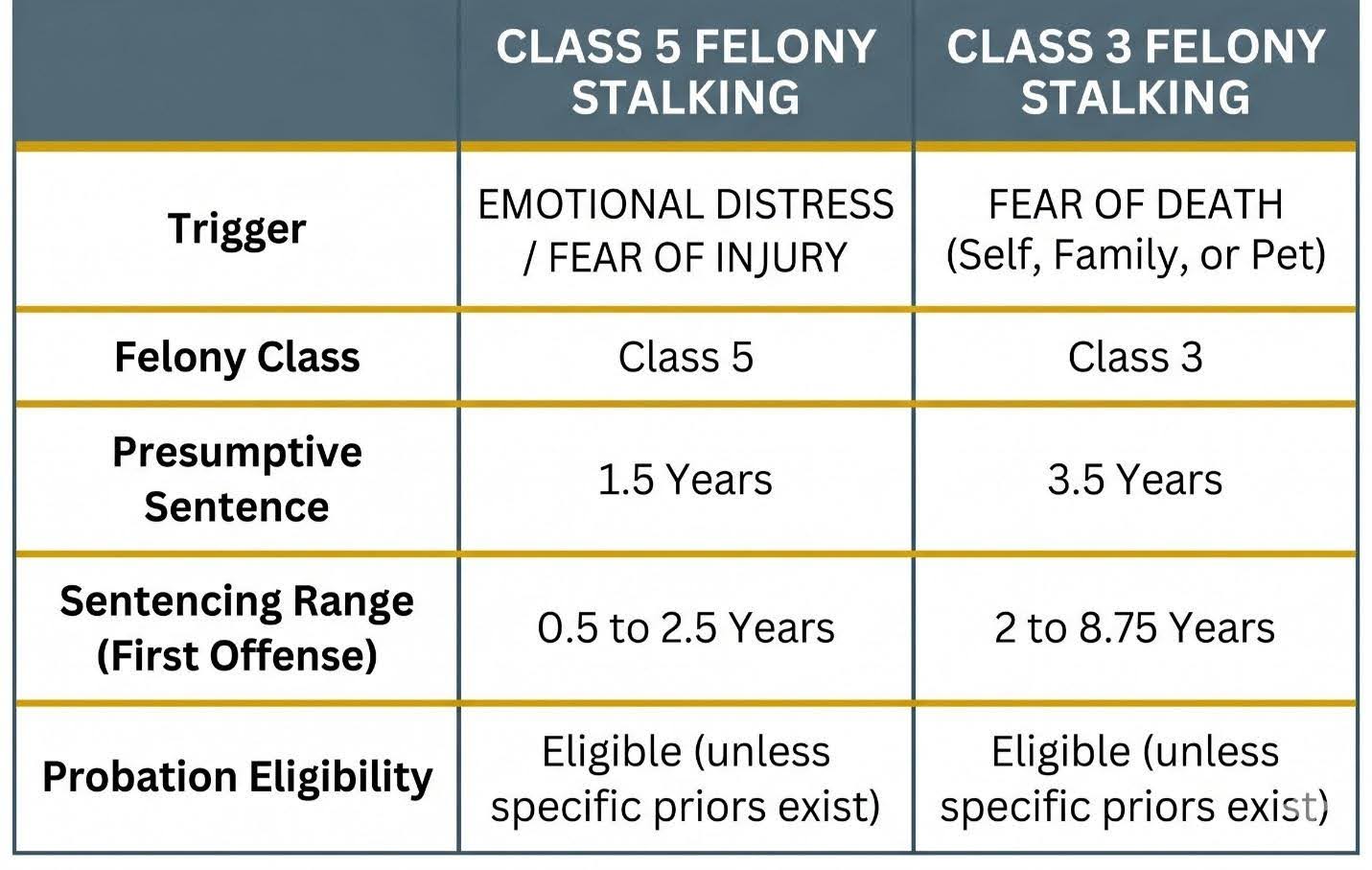
If the conduct caused emotional distress or reasonable fear of injury or property damage, stalking is charged as a Class 5 felony. For a first-time offender, this carries a range of 6 months to 2.5 years in prison. Probation of up to 3 years may be available.
If the conduct caused the victim to reasonably fear death, stalking is charged as a Class 3 felony. This carries 2 to 8.75 years in prison for a first-time offender. For this charge, probation of up to 5 years may be imposed at sentencing.
Prior felony convictions increase these ranges significantly. A sentence for a Class 3 felony can be as long as 25 years if you have multiple prior felony convictions. A conviction also brings fines up to $150,000, a permanent felony record, and loss of voting and firearm rights.
How does the prosecution prove stalking?
To convict you of stalking, the prosecution must prove each of the following elements beyond a reasonable doubt:
- You acted intentionally or knowingly. Accidental or coincidental contact does not meet this standard.
- You engaged in a course of conduct. The behavior must have happened on at least two occasions. A single phone call or encounter is not enough.
- The conduct was directed at a specific person, not random.
- The conduct caused the victim to suffer emotional distress or reasonably fear injury, property damage, or death. The fear must be what a reasonable person would have experienced in the same situation.
What defenses can be used against stalking charges?
Several defense strategies may apply to stalking charges in Arizona.
Protected Activity. Constitutionally protected activity is expressly excluded by the statute and can be a defense. ARS 13-2923 states that it does not criminalize conduct protected by the Constitution. Peaceful protests and other protected First Amendment activity cannot, by themselves, form the basis of a stalking charge.
Lack of Intent. If the state cannot prove that you acted intentionally or knowingly, you are not guilty of stalking. Running into someone repeatedly at a shared location is not stalking if the contact was not intentional or knowingly directed at that person.
Unreasonable Fear. The victim’s fear must be objectively reasonable, based on the circumstances. If the reaction was not what a reasonable person would have experienced, the charge may not hold.
Repeated Conduct. If the alleged conduct does not happen on at least two different occasions, the charge is missing a required part of the crime.
Common myths about stalking charges in Arizona
Myth: “Stalking only means physically following someone around.”
Reality: Arizona’s stalking law covers far more than physical following. It includes electronic surveillance, GPS tracking, monitoring online activity, and repeated unwanted digital communication. You can be charged without ever being in the same room as the alleged victim.
Myth: “If I only contacted someone a couple times, it cannot be stalking.”
Reality: Two incidents can be enough to be charged with stalking. ARS 13-2923 defines a course of conduct as behavior occurring on two or more occasions over any period of time. Even two contacts in one day can meet the legal definition if they cause emotional distress or reasonable fear.
Arizona stalking charges at a glance: quick reference
Statute: ARS 13-2923
- Conduct covered: Physical proximity, verbal or written threats, electronic surveillance, GPS tracking, monitoring internet activity, and repeated electronic communication, all on two or more occasions.
- Class 5 felony: Victim suffered emotional distress or feared injury or property damage. First-offense range: 6 months to 2.5 years. Probation eligible.
- Class 3 felony: Victim reasonably feared death. First-offense range: 2 to 8.75 years.
- Key element: Conduct must be intentional or knowing and occur on at least two occasions.
- Statute of limitations: 7 years. Prosecutors generally have up to 7 years from the date of the alleged offense to bring charges.
Frequently asked questions
Q: Can I be charged with stalking for sending text messages in Arizona?
A: Yes. ARS 13-2923 covers repeated electronic communication directed at a specific person. If you send text messages on more than one occasion and the recipient suffers emotional distress or fears for their safety, you can be charged with felony stalking.
Q: Is stalking a misdemeanor or felony in Arizona?
A: Stalking is always a felony in Arizona. It is charged as a Class 5 felony when the victim fears property damage, injury, or suffers emotional distress, or as a Class 3 felony when the victim reasonably fears death. There is no misdemeanor stalking charge under Arizona law.
Q: Can stalking charges be dropped in Arizona?
A: The victim does not decide whether charges are dropped. That decision belongs to the prosecutor. However, a criminal defense attorney can challenge the evidence or file motions that may lead to charges being reduced or dismissed.
Q: What is the difference between stalking and harassment in Arizona?
A: Harassment under ARS 13-2921 is typically a misdemeanor involving conduct that alarms or torments someone. Stalking under ARS 13-2923 is a felony requiring intentional or knowing repeated conduct that causes emotional distress or reasonable fear of injury, property damage, or death. Stalking carries harsher penalties.
Q: Can a stalking charge lead to a domestic violence designation in Arizona?
A: Yes. Stalking can qualify as a domestic violence offense under ARS 13-3601 when the relationship criteria is met. If the stalking is committed against a spouse, romantic partner, family member, or household member, it may be designated as a domestic violence offense. This can lead to mandatory counseling and can affect child custody.
Find the right attorney for your case
If you have been charged with stalking in Arizona, the most important step you can take is finding an experienced criminal defense attorney who knows Arizona law. Lawyer Listed connects you with a curated, peer-vetted network of elite criminal defense attorneys, free of charge. Our matching tool analyzes your situation and pairs you with the right attorney for your case. Visit https://lawyerlisted.com to get matched today.