
Understanding ARS Criminal Trespass: ARS 13-1502 | ARS 13-1503 | ARS 13-1504
Facing criminal trespass charges in Arizona can feel overwhelming and scary. The legal system is complicated and knowing what you’re up against can make a huge difference. Understanding what ARS criminal trespass means, what the law says, and what penalties you might face are crucial first steps in dealing with your charges.
This guide breaks down everything you need to know about Arizona criminal trespass laws in plain language. It walks you through each type of trespass charge, explains what the laws mean, and helps you understand what could happen if you’re convicted.
What You Will Learn in This Guide
This guide provides a complete overview of criminal trespass ARS laws, including:
- Criminal Trespass 1st Degree (ARS 13-1504)
- Criminal Trespass 2nd Degree (ARS 13-1503)
- Criminal Trespass 3rd Degree (ARS 13-1502)
In addition to outlining these charges, this guide also breaks down key legal terms, explains the sentencing ranges for each level of criminal trespass in Arizona, and addresses the most common questions about these offenses.
Remember, this material is meant to provide general information and is not a substitute for legal advice from an Arizona criminal defense attorney. If you’re facing Arizona criminal trespass charges, let Lawyer Listed match you with your ideal defense lawyer right away.
What Is ARS Criminal Trespass?

Criminal trespass ARS laws make it illegal to knowingly enter or stay on someone else’s property when you don’t have permission to be there. How serious the charge is depends on what type of property you entered or stayed on without permission. Arizona law breaks down criminal trespass into three different degrees, and each one carries different penalties.
ARS Criminal Trespass 3rd Degree: ARS 13-1502 (A1)
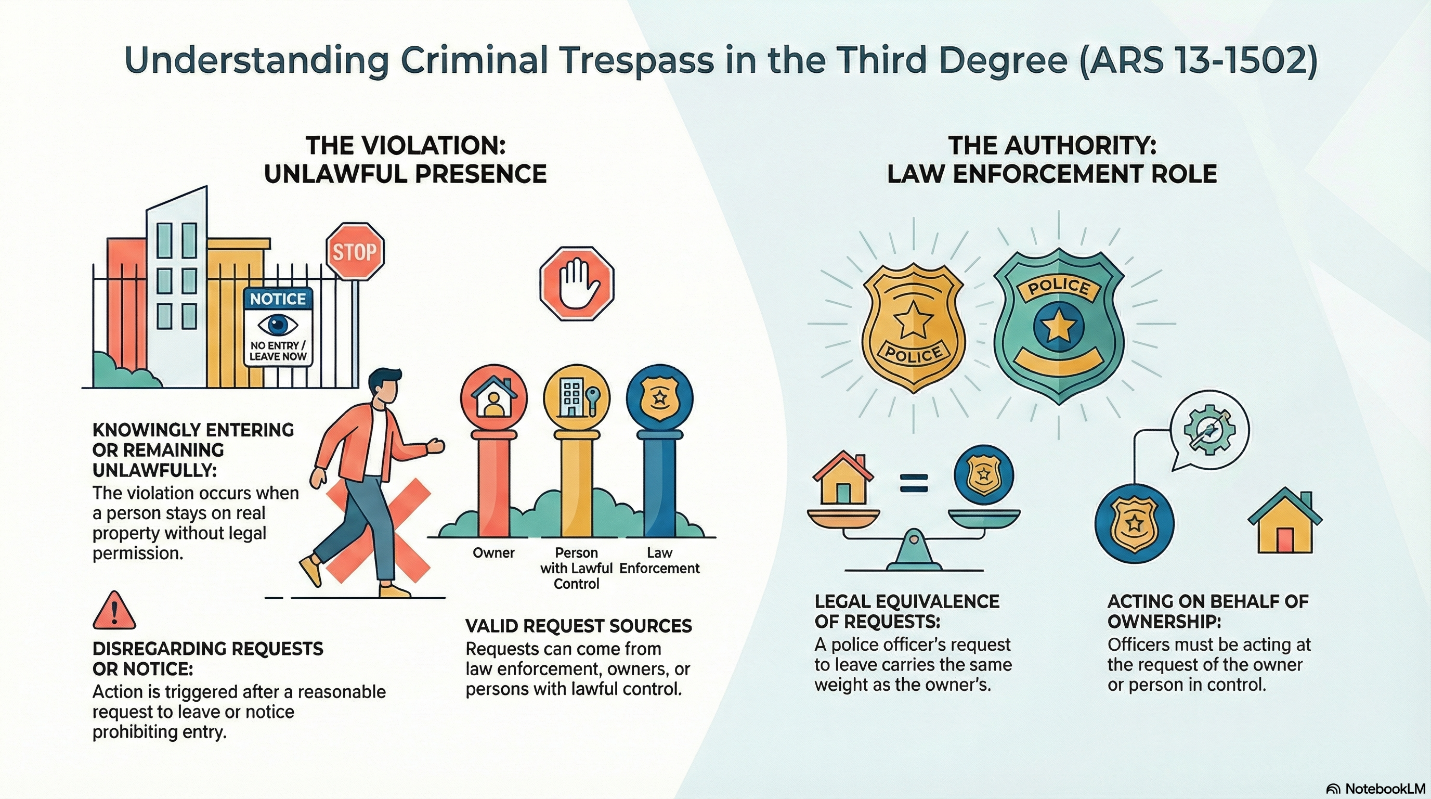
Arizona’s 3rd degree criminal trespass law makes it illegal to knowingly enter or remain unlawfully on someone else’s land after you’ve been given notice that you’re not allowed to be there. That notice can come in different forms. Under ARS 13-1502 (A)(1), any of the following count as a notice that you are not allowed to be on the property:
- A posted “No Trespassing” sign
- A reasonable request to leave from:
- A law enforcement officer
- The property owner
- Any person who has lawful control over the property
The law also explains that if a police officer asks you to leave at the request of the owner or the person in charge, that request has the same legal effect as if it came directly from the owner or person with lawful control.
Elements of Criminal Trespass 3rd Degree Arizona
To convict you of criminal trespass under this statute, the prosecution must prove all of the following elements beyond a reasonable doubt:
You knowingly entered or knowingly remained unlawfully on real property, and
You did so after either:
A reasonable request to leave made by a law enforcement officer, the property owner, or any person having lawful control over the property, or
Reasonable notice prohibiting entry, such as posted signs or other clear communication that entry was not allowed.
ARS Criminal Trespass 2nd Degree: ARS 13-1503
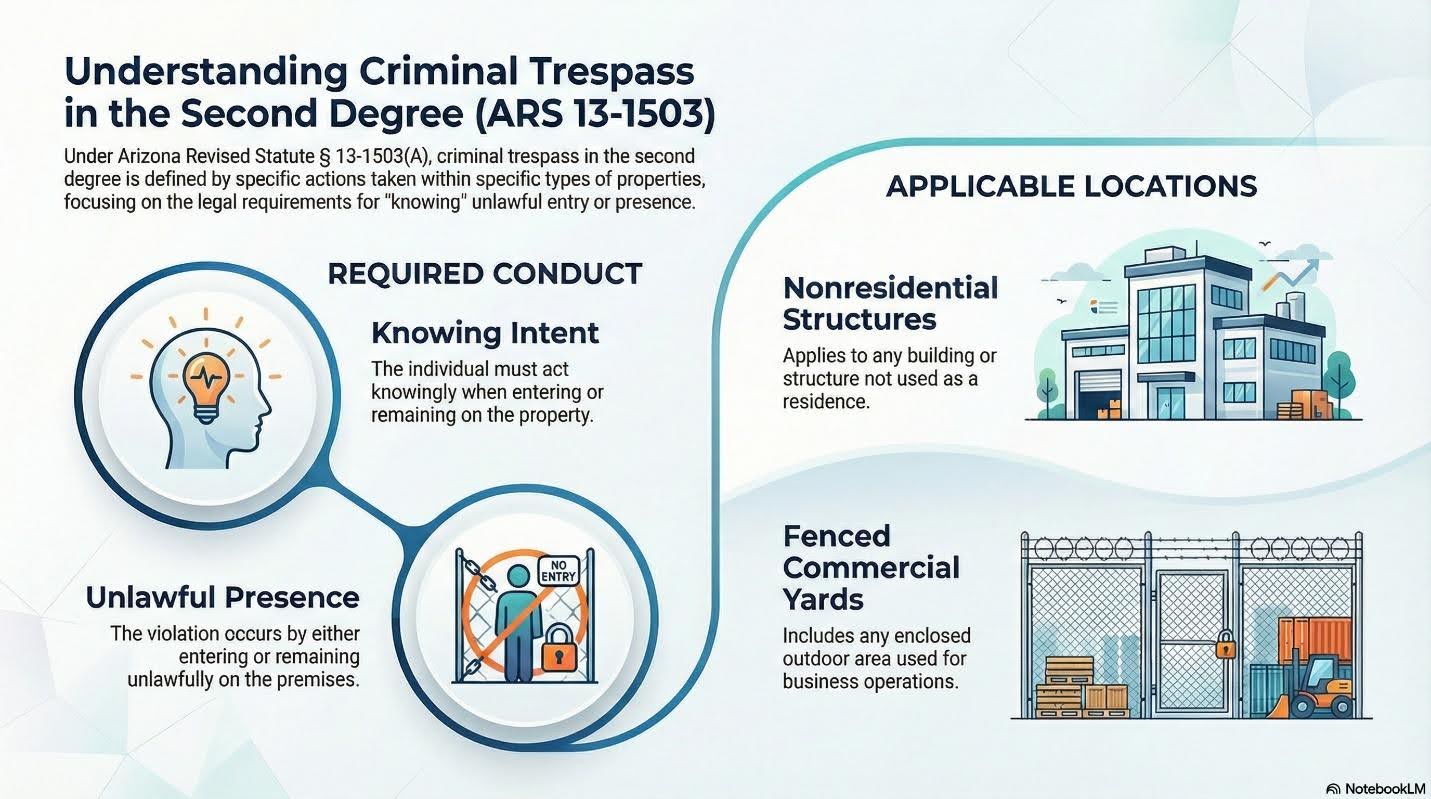
Arizona’s criminal trespass in the second degree makes it a crime to knowingly enter or remain unlawfully in a nonresidential structure or a fenced commercial yard. This charge is more serious than third‑degree trespass because it involves protected business properties and structures.
Under ARS 13‑1503, a nonresidential structure is any structure that is not used as a home, such as retail stores, warehouses, office buildings, or other commercial buildings.
The law also defines a fenced commercial yard as a unit of real property that is completely surrounded or enclosed by a fence, wall, building, similar barrier, or any combination of these barriers, and that is zoned for business operations or is used to store livestock, produce, equipment, or other commercial items.
Elements of Criminal Trespass 2nd Degree Arizona
To convict you of criminal trespass under this statute, the prosecution must prove all of the following elements beyond a reasonable doubt:
You knowingly entered or remained unlawfully in or on a nonresidential structure or in a fenced commercial yard.
You did not have permission or lawful authority to enter or remain on that property.
ARS Criminal Trespass 1st Degree: ARS 13-1504
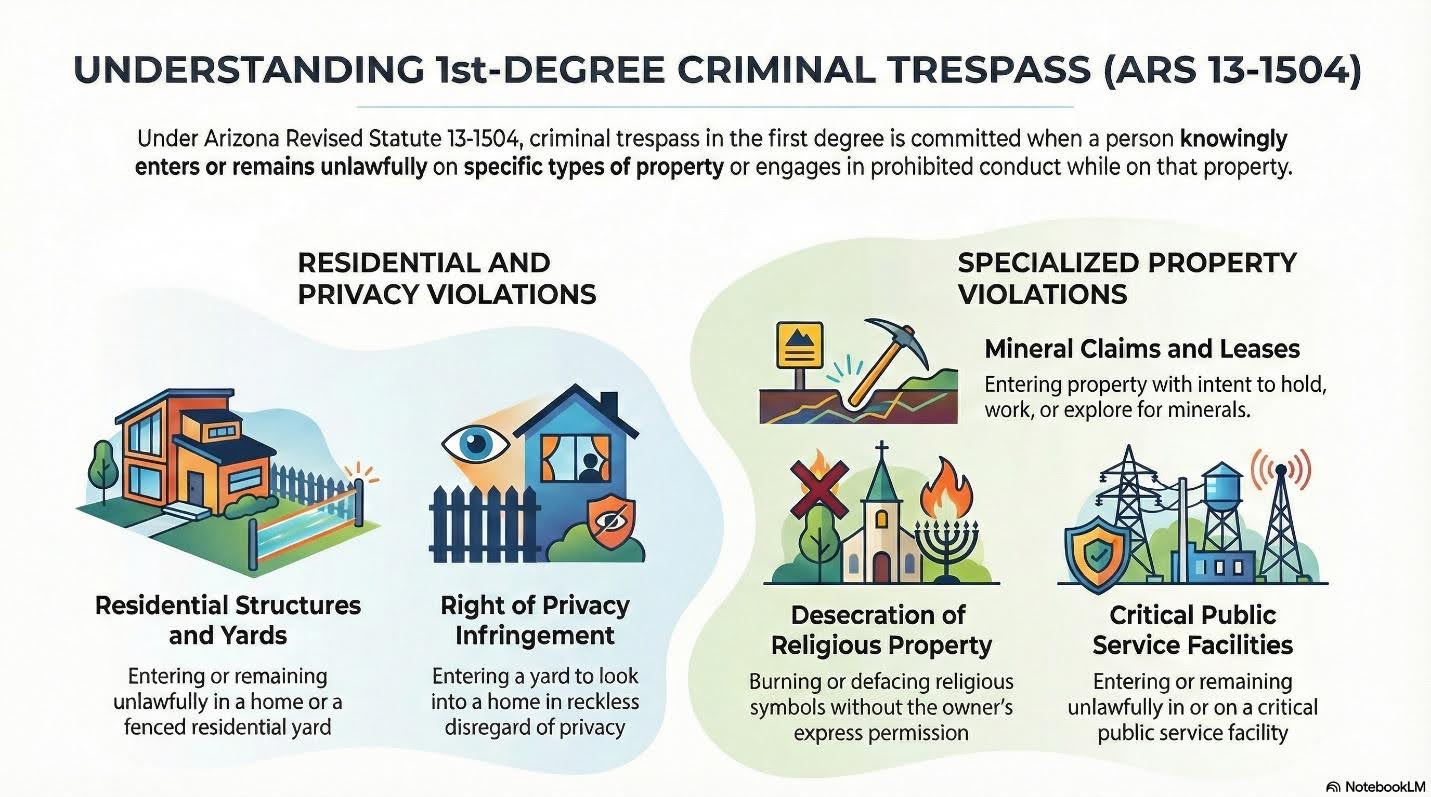
In Arizona, first‑degree criminal trespass is the most serious form of trespassing. Under ARS 13‑1504, a person commits this offense by engaging in one of six specific types of conduct, each tied to a particular type of protected property:
- Residential structure: Entering or remaining in a place designed for people to live in, such as a house, apartment, or mobile home, without permission.
- Fenced residential yard: Entering or staying in the enclosed yard or outdoor area surrounding a residence when you do not have permission to be there.
- Looking into a residence from the yard: Entering a residential yard and, without lawful authority, looking into the home in reckless disregard of the resident’s privacy.
- Property with a valid mineral claim or lease: Unlawfully entering land subject to a valid mineral claim or lease with the intent to hold, work, take, or explore for minerals.
- Property of another for the purpose of desecrating a religious symbol: Entering or unlawfully remaining on someone else’s property to burn, deface, mutilate, or otherwise desecrate a religious symbol or other religious property without the owner’s permission.
- Critical public service facility: Entering or unlawfully remaining in or on a posted and secured facility used by essential service providers, such as utilities, mass transit systems, law enforcement, fire departments, or facilities handling hazardous materials.
Key Concepts of Criminal Trespass
- Intentionally / With intent to: Acting with the objective of causing a specific result or engaging in particular conduct. In plain terms, you meant to do it.
- Knowingly: You are aware of your actions or the circumstances that make up the offense. Knowingly does not require that you know your conduct is illegal; you just need to be conscious of what you are doing or the situation you are in.
- Enter or remain unlawfully: Entering or staying on property when you do not have permission, legal authority, or any other right to be there.
Arizona Statute of Limitations for ARS Criminal Trespass
The statute of limitations is the deadline for filing criminal charges. For misdemeanor criminal trespass, prosecutors must file the case within one year of the incident. For felony criminal trespass, prosecutors have up to seven years from the date of the offense.
Criminal Trespass Arizona Punishment

The penalty for criminal trespass is substantial and can have long‑lasting effects. Sentences vary based on your criminal history and the facts of the case. Understanding these consequences helps you make informed decisions about your defense.
| Offense | Trespass | Charge | Jail/Prison | Probation (max) |
|---|---|---|---|---|
| 3rd degree trespass | Property with notice or request to leave | Class 3 misdemeanor | Jail: up to 30 days | 1 year |
| 2nd degree trespass | Nonresidential structure or fenced commercial yard | Class 2 misdemeanor | Jail: up to 4 months | 2 years |
| 1st degree trespass | Fenced residential yard, violation of privacy, or mineral claim | Class 1 misdemeanor | Jail: up to 6 months | 3 years |
| 1st degree trespass | Residential structure or desecrating religious symbol | Class 6 felony | Prison: 0.33 – 2 years | 3 years |
| 1st degree trespass | Critical public service facility | Class 5 felony | Prison: 0.5 – 2.5 years | 3 years |
Frequently Asked Questions (FAQs)

A: Criminal trespass means knowingly entering or staying on someone else’s property without permission. Arizona law protects a property owner’s right to decide who may be on their land or in their buildings. The degree of criminal trespass depends on the type of property involved and what you were doing while you were there.
A: Yes. A law enforcement officer may tell you to leave property at the request of the owner or the person in control of the property. Under Arizona law, that request has the same legal effect as if the owner made it themselves. If you stay after an officer tells you to leave, you can be charged with criminal trespass.
A: A residential structure is any building or dwelling designed for people to live in. This includes houses, apartments, condominiums, townhouses, and mobile homes. It does not matter whether anyone is home or currently living there; what matters is that the structure is intended and used as a place of residence.
A: Yes. Arizona law defines a fence broadly for criminal trespass. Any enclosure made of a fence, wall, building, similar barrier, or any combination of these counts as a fence. A cinderblock wall, wooden fence, chain‑link fence, or a mix of walls and fencing all qualify as a “fence” under Arizona’s trespass laws.
A: Yes. Under ARS 13‑1504, a residential structure is any place designed for people to live, whether anyone is living there or not. A house that is empty, vacant, between tenants, or appears abandoned still counts as a residential structure. Entering it without permission can still lead to a 1st degree criminal trespass charge.
A: The difference between burglary and criminal trespass comes down to intent. Burglary requires that you entered or remained unlawfully with the intent to commit theft or any other felony once there. Because it involves planning to commit another crime, burglary is treated much more seriously.
Criminal trespass applies when you enter or stay on property without permission, but without the intent to commit theft or another felony. For example, crossing through someone’s yard or entering an empty building out of curiosity would typically be trespass, not burglary.
A: The statute of limitations depends on whether the criminal trespass is charged as a misdemeanor or a felony. For a misdemeanor trespass charge, the State has one year from the date of the incident to file the case. For a felony trespass charge, the State has seven years to begin prosecution. Once these deadlines pass, the State is generally barred from filing criminal trespass charges for that incident.
A: To find the right lawyer for your case, follow these steps: schedule consultations, verify they are licensed and in good standing with the bar, research their experience, check their specialization, consult with other lawyers about their reputation, read client reviews, and ensure you feel comfortable with them.
Don’t worry if this seems overwhelming; Lawyer Listed has already done the work for you and is ready to match you with an elite lawyer tailored to your needs and your case.
Key Takeaways:
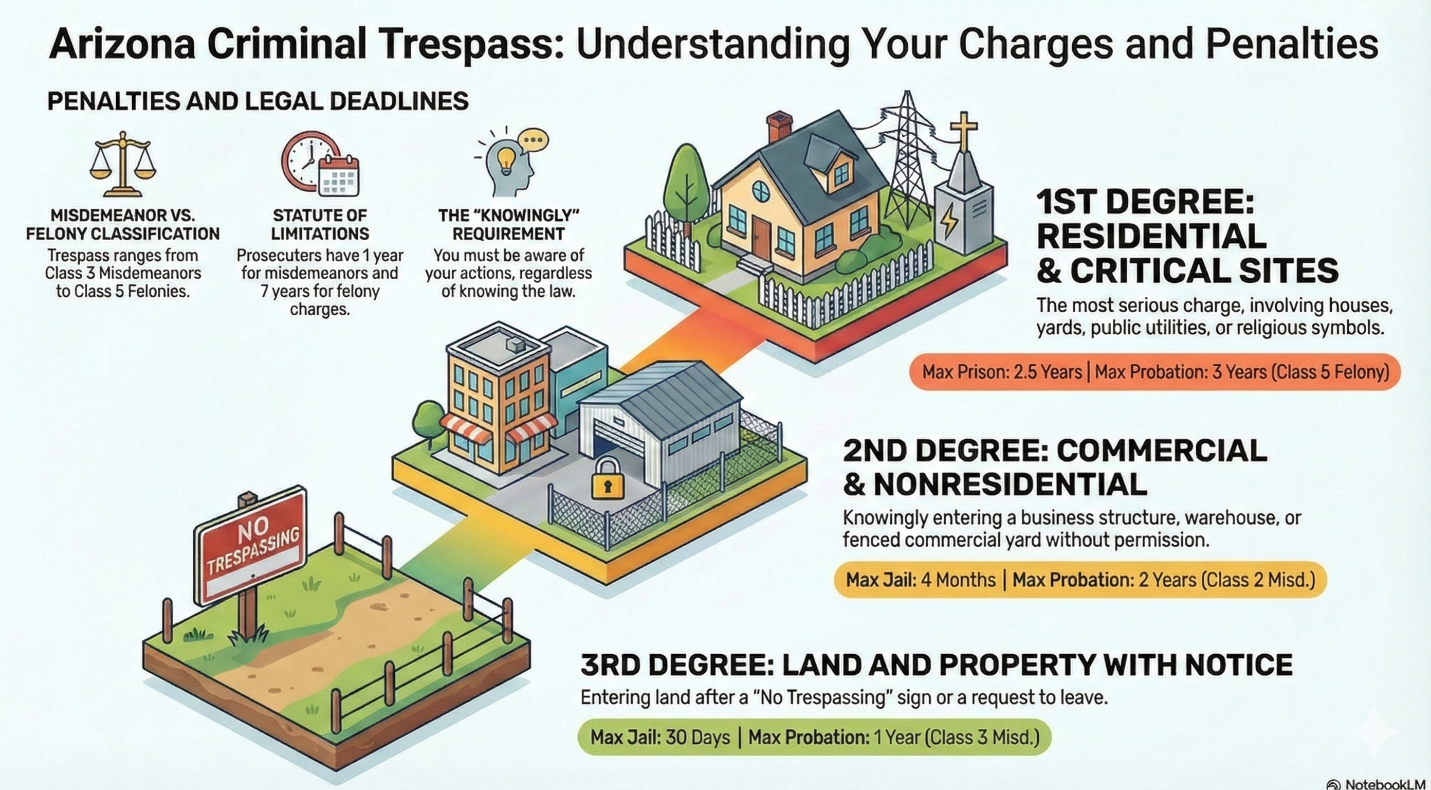
- Definition: Criminal trespass involves knowingly entering or remaining unlawfully on someone else’s property. The severity of your charge and the penalties you face depend primarily on the type of property you trespassed on. Arizona law recognizes that different types of properties deserve different levels of protection.
- Different Degrees of Criminal Trespass Explained:
- ARS Criminal Trespass 1st Degree (ARS 13-1504): This is the most serious trespass charge. It applies when you trespass in a residential structure, fenced residential yard, critical public service facility, or under other specific circumstances like desecrating religious symbols.
- Classification: Ranges from a Class 1 misdemeanor to a Class 5 felony
- Jail or Prison: Between 6 months in jail and 2.5 years in prison, depending on the specific circumstances
- Maximum Probation: 3 years
- ARS Criminal Trespass 2nd Degree (ARS 13-1503): This applies when you trespass in a nonresidential structure or fenced commercial yard.
- Class 2 misdemeanor
- Maximum jail sentence: 4 months
- Maximum probation: 2 years
- ARS Criminal Trespass 3rd Degree (ARS 13-1502): This is the least serious trespass charge. It applies when you trespass on property with posted notice prohibiting entry or after being asked to leave.
- Class 3 misdemeanor
- Maximum jail sentence: 30 days
- Maximum probation: 1 year
- ARS Criminal Trespass 1st Degree (ARS 13-1504): This is the most serious trespass charge. It applies when you trespass in a residential structure, fenced residential yard, critical public service facility, or under other specific circumstances like desecrating religious symbols.
- Statute of limitations: The statute of limitations for criminal trespass is 1 year for misdemeanor offenses and 7 years for felony offenses.
Next Steps:

Criminal trespass is a serious criminal allegation with consequences that can affect the rest of your life. Outcomes depend on many factors. Lawyer Listed meets you where you are and helps you understand the law and your rights.
If you’re facing Arizona criminal trespass charges, engaging a skilled criminal defense attorney is important to protect your rights and manage the process. Don’t try navigating the legal system alone; match with your ideal lawyer at LawyerListed.com and get an experienced criminal defense lawyer on your side right away.