

Facing criminal charges is one of the most frightening experiences a person can go through. Whether you have been arrested, questioned by police, or received a court summons, knowing your rights and understanding the legal system can make a real difference in your case. Criminal defense law is the area of law that protects people accused of crimes. It sets the rules that law enforcement and prosecutors must follow, and it gives defendants the tools to fight charges in court.
This guide explains what criminal defense law is, how the federal and state systems work, and what Arizona law means for you as a defendant. It is written in plain language so you can understand it without a law degree.
It is important to know that this guide is not legal advice. If you have been charged with a crime, it is crucial that you hire a criminal defense attorney who has experience in your type of case. Let Lawyer Listed match you with your ideal lawyer today.
What Is Criminal Defense Law?
Criminal defense law is the body of rules and legal strategies used to defend people who are accused of committing a crime. It covers everything from the moment of arrest to the final outcome of a case, whether that is a dismissal, a plea agreement, or a verdict at trial.
The goal of criminal defense law is to make sure the government plays by the rules. In the United States, a person is presumed innocent until proven guilty. This means the prosecutor, not the defendant, has the burden of proof. The prosecution must prove guilt beyond a reasonable doubt. If they cannot meet that standard, the defendant must be found not guilty.
Criminal defense attorneys use the law to challenge evidence, question witnesses, negotiate with prosecutors, and protect their clients’ constitutional rights. These rights come from the U.S. Constitution and, in Arizona, from the Arizona Constitution as well.
Key Rights of Every Criminal Defendant
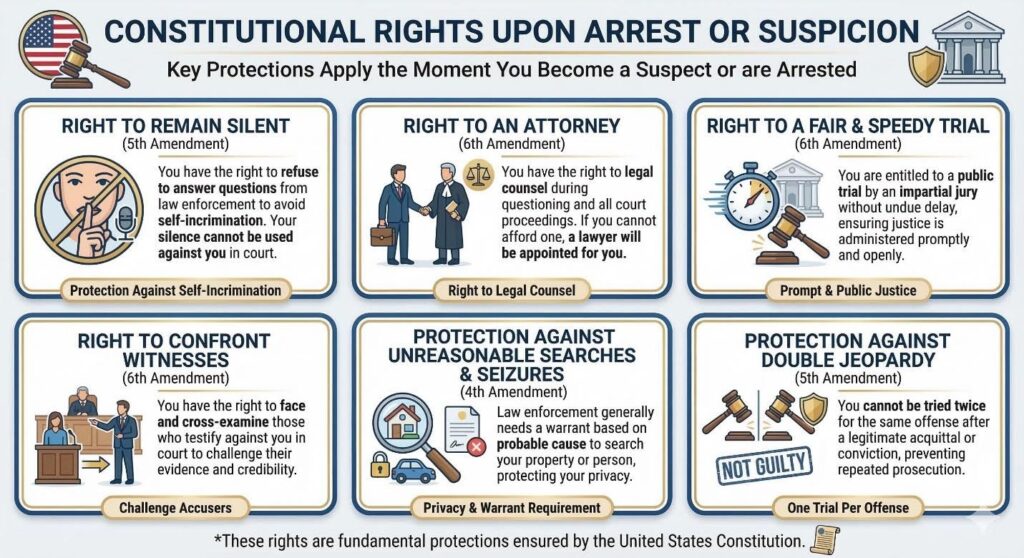
Several important constitutional rights apply the moment a person becomes a suspect or is arrested. These include:
- The right to remain silent (5th Amendment): You do not have to answer questions from police or prosecutors. Anything you say can be used against you.
- The right to an attorney (6th Amendment): You have the right to have a lawyer represent you. If you cannot afford one, a public defender must be appointed for you.
- The right to a fair and speedy trial (6th Amendment): You cannot be held in legal limbo indefinitely. The government must bring your case to trial within a reasonable time.
- The right to confront witnesses (6th Amendment): Your attorney has the right to cross-examine the people who testify against you.
- Protection against unreasonable searches and seizures (4th Amendment): Police generally need a warrant or a valid legal reason to search your home, car, or belongings. Evidence obtained illegally will generally be thrown out.
- Protection against double jeopardy (5th Amendment): If you are found not guilty, the government generally cannot try you again for the same crime.
The Two Systems: Federal vs. State Criminal Law

In the United States, there are two separate criminal court systems: the federal system and the state system. Most criminal cases, including the vast majority of cases in Arizona, are handled at the state level. However, some cases are prosecuted in federal courts, and it is important to understand the difference.
Federal Criminal Law
Federal crimes are offenses that violate laws passed by the U.S. Congress. They are investigated by federal agencies such as the FBI, DEA, ATF, and Homeland Security. Federal cases are prosecuted by U.S. Attorneys and heard in U.S. District Courts.
Federal charges often arise when a crime involves crossing state lines, occurs on federal property, or targets federal agencies or programs. Common examples of federal crimes include:
- Drug trafficking across state lines
- Bank robbery or wire fraud targeting federally insured institutions
- Crimes committed on federal land, such as national parks or military bases
- Immigration violations
- Child pornography and human trafficking
- Tax evasion and federal benefits fraud
Federal judges use the Federal Sentencing Guidelines to help decide prison sentences. The guidelines use a point‑based system that looks at how serious the crime is and the defendant’s criminal history. Judges are required to calculate the guideline range, but they may impose a different sentence if they provide a reasonable explanation.
Sentences in federal courts are generally longer and more uniform than those in state courts. This is partly because federal law includes mandatory minimum sentences and offers less flexibility overall. Since federal parole was abolished in 1987, people in the federal system must serve at least 85% of their sentences. Only limited good‑time credits are available to reduce their prison time.
State Criminal Law in Arizona
Arizona has its own criminal code, found in the Arizona Revised Statutes (A.R.S.). State crimes are investigated by local police, sheriff departments, and Arizona state agencies. They are prosecuted by county attorneys, city attorneys, or, in some cases, the Arizona Attorney General’s Office.
Most crimes you hear about, such as assault, theft, DUI, drug possession, and domestic violence are state crimes handled in Arizona courts. Arizona superior courts handle felony cases, while justice courts and municipal courts handle misdemeanors and petty offenses.
Arizona uses a structured sentencing system with specific prison ranges for different classes of offenses. Unlike federal court, Arizona still has a form of supervised release for some offenders, though it is more limited for serious crimes.
Key Differences at a Glance
The table below compares the federal and Arizona state criminal systems side by side:
| Feature | Federal System | Arizona State System | Key Difference |
|---|---|---|---|
| Who Prosecutes | U.S. Attorney's Office | County Attorney or AZ AG | Different offices, different rules |
| Court | U.S. District Court | Superior Court | Separate court systems |
| Felony Classes | No formal classes; sentencing guidelines | Class 1–6 felonies | AZ uses a tiered class system |
| Misdemeanor Classes | Class A, B, C | Class 1, 2, 3 | Similar structure, different labels |
| Sentencing | Federal Sentencing Guidelines | Arizona Revised Statutes | Federal sentencing is more formulaic |
| Parole | No parole (abolished 1987) | Limited; depends on offense | Federal inmates serve 85% of sentence |
| Double Jeopardy | Federal charges possible after state acquittal | State charges separate from federal | Dual sovereignty doctrine applies |
How Arizona Classifies Crimes
Under Arizona criminal law, all crimes fall into one of three broad categories: felonies, misdemeanors, or petty offenses. The category determines how serious the charge is, what court handles it, and what the potential punishment can be.
Felonies in Arizona
A felony is the most serious type of crime. In Arizona, felonies are divided into six classes. Class 1 is the most serious (e.g. murder), and Class 6 is the least serious. Each class carries a specific range of prison sentences that can increase if the defendant has prior convictions or if there are aggravating factors, which are circumstances that make the crime worse, such as using a weapon or targeting a vulnerable victim.
The table below shows Arizona’s felony classes, common examples, and prison ranges for a first-time offender:
| Class | Examples | Prison Range (First Offense) | Maximum Fine | Maximum Probation |
|---|---|---|---|---|
| Class 1 | First-degree murder | Life or death penalty | Up to $150,000 | N/A |
| Class 2 | Armed robbery, sexual assault | 3 – 12.5 years | Up to $150,000 | 7 years |
| Class 3 | Aggravated assault, auto theft | 2 – 8.75 years | Up to $150,000 | 5 years |
| Class 4 | Forgery, aggravated DUI | 1 – 3.75 years | Up to $150,000 | 4 years |
| Class 5 | Criminal damage, misconduct involving weapons | 6 months – 2.5 years | Up to $150,000 | 3 years |
| Class 6 | Theft ($1,000–$2,000), criminal trespass | 4 months – 2 years (or misdemeanor) | Up to $150,000 | 3 years |
Sentences can be significantly longer if the defendant has prior felony convictions. Arizona law also imposes mandatory prison terms for certain crimes, meaning a judge has no choice but to send the person to prison.
Misdemeanors in Arizona
Misdemeanors are less serious than felonies but still carry real consequences. Arizona has three classes of misdemeanors:
- Class 1 Misdemeanor — The most serious misdemeanor. Punishable by up to 6 months in jail, a maximum fine of $2,500, and up to 3 years of probation. Examples include DUI (first offense), assault, and shoplifting (under $1,000).
- Class 2 Misdemeanor — Punishable by up to 4 months in jail, a maximum fine of $750, and up to 2 years of probation. Examples include criminal damage to property worth less than $250.
- Class 3 Misdemeanor — The least serious class. Punishable by up to 30 days in jail, a maximum fine of $500, and up to 1 year of probation. Examples include minor traffic violations with criminal penalties.
Petty Offenses
Petty offenses are the least serious category. They typically involve small fines and no jail time. Low‑value property offenses, certain traffic‑related offenses, and loitering usually fall into this category.
Common Criminal Defenses in Arizona
A criminal defense attorney’s job is to build the strongest possible case on your behalf. There are many types of defenses available under both federal and Arizona law. Which defense applies depends on the facts of your case.
Challenging the Evidence
One of the most powerful tools in criminal defense is attacking the evidence the prosecution is using against you. This can mean:
- Filing a motion to suppress evidence obtained through an illegal search or seizure
- Challenging the chain of custody of physical evidence
- Questioning the reliability of eyewitness testimony
- Hiring an expert witness to dispute forensic evidence like DNA, blood tests, or digital records
Affirmative Defenses
An affirmative defense is when the defendant admits that the act occurred but argues there was a legally valid reason for it. Common affirmative defenses in Arizona include:
- Self-defense or defense of others — Arizona law (ARS 13-404) allows a person to use physical force to protect themselves or someone else from harm.
- Defense of property — You may use reasonable force to protect your property from theft or criminal damage.
- Insanity — Under Arizona law, a defendant may raise an insanity defense if, at the time of the crime, they did not understand that what they were doing was wrong due to a mental disease or defect. This is a high legal bar to meet.
- Duress — If someone forced or threatened you into committing a crime, this may be a defense.
Constitutional Violations
If law enforcement violated your constitutional rights during the investigation or arrest, your attorney can file motions to have illegally obtained evidence thrown out. If the evidence is thrown out, the prosecution may not be able to prove their case. Common constitutional violations include:
- Conducting a search without a warrant or valid exception
- Failing to read your Miranda rights before a custodial interrogation
- Holding you in custody longer than allowed without charging you
- Coercing a confession through threats or improper pressure
The Arizona Criminal Court Process
Understanding what happens after an arrest can reduce anxiety and help you make better decisions. Below is a general overview of the Arizona criminal process for a felony case:
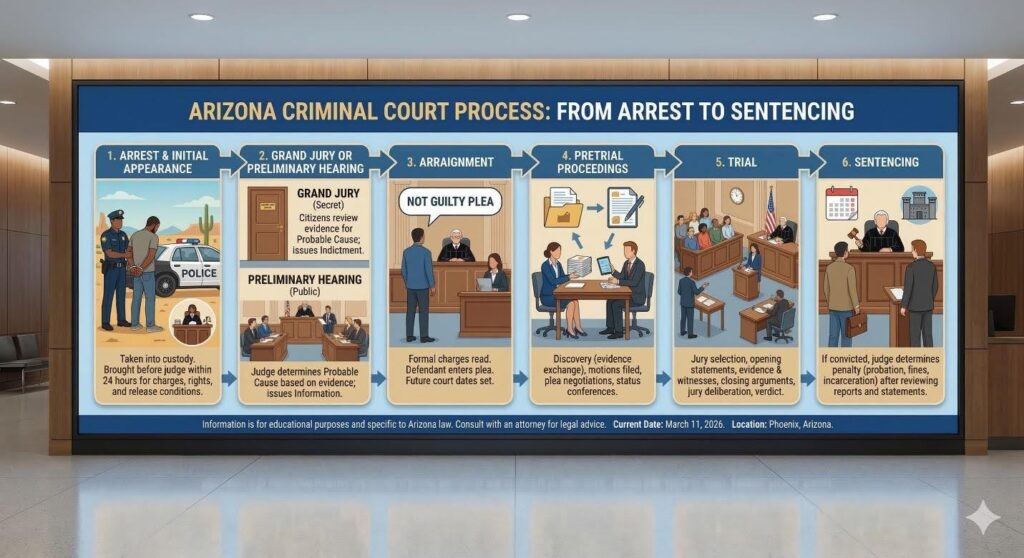
Arrest and Initial Appearance
After an arrest, you will be brought before a judge (usually within 24 hours) for an initial appearance. The judge will inform you of the charges, review conditions of release, and set bail if appropriate.
Grand Jury or Preliminary Hearing
For felony cases in Arizona, the prosecution must convince either a grand jury or a judge at a preliminary hearing that there is probable cause to believe you committed the crime. Probable cause means there is enough evidence that a reasonable person would believe a crime occurred and that you are the one who did it. This is a much lower standard than ‘beyond a reasonable doubt.’
Arraignment in Superior Court
If you are indicted (formally charged), you will appear in Superior Court for arraignment. You will enter a plea of guilty, not guilty, or no contest. Most defendants plead not guilty at this stage to preserve their options while their attorney reviews the evidence.
Pretrial Proceedings
Before trial, your attorney will investigate the case, review evidence provided by the prosecution (called ‘discovery’), and file any necessary motions. This is often when plea negotiations happen. The majority of criminal cases in Arizona are resolved through plea agreements rather than going to trial.
Trial
If your case goes to trial, you have the right to a jury trial in Arizona for felonies and certain misdemeanor charges. The prosecution presents its case first, and your defense attorney can question the witnesses and present your own evidence. After both sides are finished, the jury meets in private to decide the case. In Arizona, a felony jury verdict must be unanimous – either guilty or not guilty. If the jury cannot agree, the judge declares a mistrial, and the trial process may start over with another jury.
Sentencing
If you are convicted, either after a trial or through a guilty plea, the judge will hold a sentencing hearing. The judge considers many factors, including the class of the offense, your prior criminal history, and any aggravating or mitigating circumstances. Your attorney can present evidence and arguments at this stage to advocate for the lowest possible sentence.
Why You Need an Arizona Criminal Defense Attorney
Criminal defense law is complex, and the stakes are extremely high. A conviction can mean prison time, steep fines, a permanent criminal record, and the loss of rights like voting or owning a firearm. For non-citizens, it can also mean deportation.
An experienced Arizona criminal defense attorney can:
- Explain the charges against you and what the prosecution must prove
- Identify weaknesses in the government’s case
- Negotiate with prosecutors to reduce or dismiss charges
- Protect your constitutional rights at every stage of the process
- Represent you effectively if the case goes to trial
If you cannot afford an attorney, you have the right to a court-appointed public defender. While public defenders are skilled attorneys, they often carry very heavy caseloads. If at all possible, consulting with a private criminal defense lawyer who can give your case more personalized attention is worth considering.
Conclusion: Know Your Rights, Protect Your Future
Criminal defense law exists to protect you. No matter what charges you are facing, you have rights that must be respected. The system may feel overwhelming but understanding how it works is the first step to navigating it.
The key points to remember are: you are presumed innocent until proven guilty, the government must prove its case beyond a reasonable doubt, and you have the right to a defense. An experienced Arizona criminal defense attorney can be the difference between a life-altering conviction and a fair resolution. Do not face criminal charges alone; Lawyer Listed is ready to help with your ideal criminal defense match.