

What is Vehicular Aggravated Assault Under Arizona Law?

Arizona does not have a separate statute for vehicular aggravated assault. Instead, prosecutors charge this crime under ARS 13-1204, which is the general aggravated assault law in Arizona.
The charge applies when a driver commits an assault, as defined in ARS 13-1203, under certain aggravating circumstances. In vehicular cases, the most common aggravating factor is that the driver used the car as a dangerous instrument (ARS 13-1204(A)(2)).
Under ARS 13-105, a “dangerous instrument” is anything that, when used in a certain way, is readily capable of causing death or serious physical injury. When a driver operates a car recklessly or while impaired, the vehicle can meet this definition. That is how a car accident becomes a felony aggravated assault charge.
What Are the Penalties for Vehicular Aggravated Assault in Arizona?
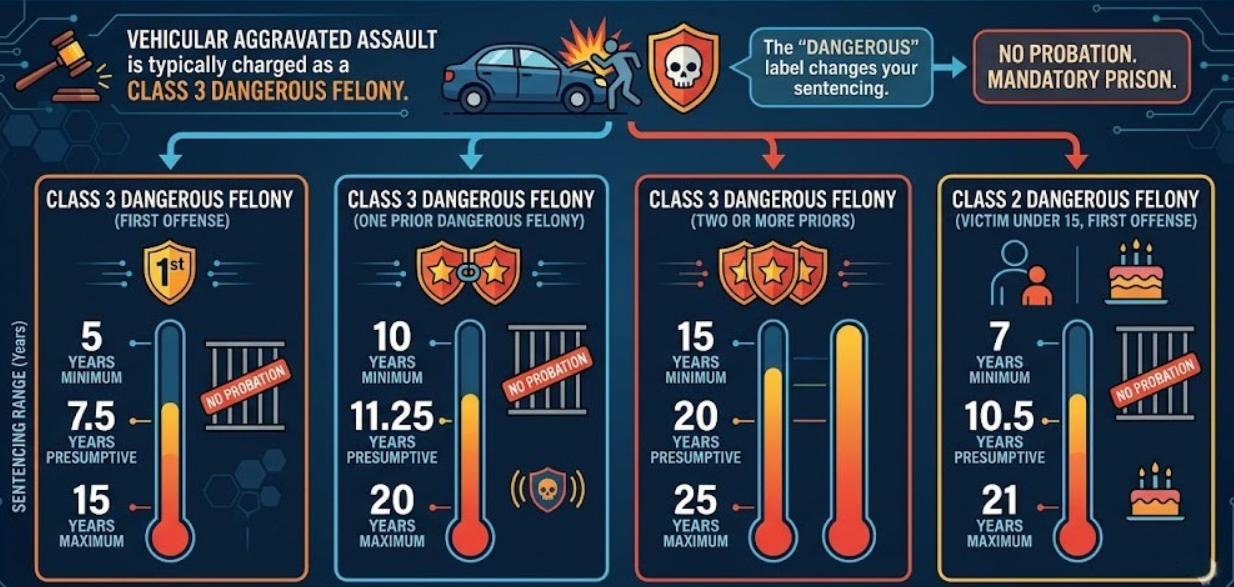
Vehicular aggravated assault is typically charged as a Class 3 dangerous felony. The “dangerous” label matters because it changes your sentencing.
Under ARS 13-704, a first-time Class 3 dangerous felony carries the following prison sentences: 5 years minimum, 7.5 years presumptive, and 15 years maximum. Probation is not available. Prison is mandatory.
One prior dangerous felony increases the range to 10 to 20 years. Two or more priors pushes it to 15 to 25 years. If the victim is under 15, the charge becomes a Class 2 dangerous felony carrying 7 to 21 years.
Beyond prison, you face fines up to $150,000, mandatory restitution, a permanent felony record, and loss of civil rights. If the incident involved a DUI, separate DUI penalties also apply.
How Does the Prosecution Prove Vehicular Aggravated Assault?
To convict you, the prosecution must prove beyond a reasonable doubt that you committed an assault and that an aggravating factor was present.
Assault. Prosecutors usually rely on the “recklessly causing physical injury” theory under ARS 13-1203. Recklessly means being aware of a substantial and unjustifiable risk and choosing to ignore it. Voluntary intoxication does not excuse or cancel recklessness. For example, in DUI cases, the impairment itself is the primary evidence of recklessness. The prosecution does not need to prove you intended to hurt anyone.
Aggravating Factor. The prosecution typically argues that your car was a dangerous instrument. In other words, they paint the picture that your reckless driving behavior (e.g. drunk driving) transformed the car from a simple mode of transportation into a 2,000-pound battering ram hurling down the road putting all other motorists in danger.
What Defenses Can Be Used Against Vehicular Aggravated Assault?
A criminal defense attorney can build a defense based on the facts of your case. Common strategies include:
Challenging recklessness. If the accident was caused by mechanical failure, road conditions, or another driver’s actions, your attorney may argue your driving was not reckless.
Challenging DUI evidence. Your attorney can challenge breath or blood test results, question equipment calibration, or dispute whether the traffic stop was lawful.
Showing fault lies elsewhere. If the other driver caused the collision, or if you were not driving, these facts undermine the prosecution’s case.
Common Myths About This Charge
Myth: If I was drunk and caused an accident, I will automatically be convicted of vehicular aggravated assault.
Reality: A DUI does not automatically lead to a conviction. The prosecution must still prove that you caused the accident and that other elements of aggravated assault are met.
Myth: Vehicular aggravated assault only applies when a driver intentionally tries to hit someone with a car.
Reality: Intent to harm is not required. Most vehicular aggravated assault charges are based on recklessness, not intent. Driving under the influence, excessive speeding, or ignoring traffic signals can all support a recklessness charge.
Frequently Asked Questions
Q: Can I go to prison for a car accident in Arizona?
A: Yes. If a car crash either involves the use of a dangerous instrument or causes serious physical injury, and the prosecution proves you acted recklessly, you can be charged with vehicular aggravated assault. This is a felony that carries mandatory prison time.
Q: Is vehicular aggravated assault the same as a DUI?
A: No. A DUI is a separate charge. However, if you are driving under the influence and cause an accident that results in physical injury, you can be charged with both a DUI and vehicular aggravated assault. The DUI may serve as the prosecution’s evidence of recklessness for the aggravated assault charge.
Q: How long does a vehicular aggravated assault conviction stay on a criminal record in Arizona?
A: A vehicular aggravated assault conviction stays on your criminal record permanently in Arizona. You may be eligible to have your record set aside under ARS 13-905 after completing your sentence, but this does not erase the conviction.
Q: Can I lose my driver’s license for vehicular aggravated assault in Arizona?
A: Yes. A vehicular aggravated assault conviction, especially one involving DUI, will likely result in suspension or revocation of your driver’s license. If the underlying incident involved DUI, you may also be required to install an ignition interlock device before your driving privileges are restored.
Related Arizona Criminal Defense Guides
Many vehicular aggravated assault cases begin with a DUI arrest. If you are also facing DUI charges, understanding Arizona DUI penalties will help you see the full picture.
Vehicular aggravated assault is one type of aggravated assault under ARS 13-1204. If your charges involve circumstances beyond the vehicle, a broader look at this statute may help.
Vehicular manslaughter in Arizona
If the person injured in the accident later dies, charges could escalate to manslaughter under ARS 13-1103.
Find the Right Attorney for Your Case
If you have been charged with vehicular aggravated assault in Arizona, finding an experienced criminal defense attorney is your most important next step. Lawyer Listed connects you with a curated, peer-vetted network of elite criminal defense attorneys, free of charge. Our matching tool analyzes your situation and pairs you with the right attorney for your case. https://lawyerlisted.com