

What to do right now
- Write down everything you remember about your arrest and the events leading up to it, including what officers said, who was present, and whether you were read your rights.
- Do not discuss your case with anyone other than your attorney, and avoid posting anything about your charges on social media.
- Find a criminal defense attorney before your first court date. Lawyer Listed can match you with an experienced Arizona defense attorney for free.
What is a criminal defense strategy?

A criminal defense strategy is the plan your attorney builds to fight the charges against you. Every strategy starts with the same question: what does the prosecution need to prove, and where are the weaknesses in their case?
In Arizona, the prosecution must prove every element of a crime beyond a reasonable doubt. That is a high standard. Your defense attorney’s job is to find the gaps, inconsistencies, or violations in the state’s case and use them to your advantage.
Some strategies aim to get charges dismissed entirely. Others focus on reducing the charges to something less serious or minimizing the penalties. The right approach depends on the facts of your case, the evidence available, and your personal goals.
Challenging the prosecution’s evidence
One of the most common defense strategies is attacking the evidence the prosecution plans to use against you. If the evidence is weak, unreliable, or was obtained improperly, your attorney may be able to get it excluded from trial entirely.
Motions to suppress evidence
The Fourth Amendment to the U.S. Constitution protects you from unreasonable searches and seizures. If police searched your home, car, or person without a valid warrant or legal justification, your attorney can file a motion to suppress that evidence.
When a court grants a suppression motion, the prosecution cannot use that evidence at trial. In some cases, this can remove the key piece of evidence the state was relying on, which may lead to reduced charges or a full dismissal.
Common examples of suppression arguments include: traffic stops without reasonable suspicion, searches without a warrant or valid consent, and confessions obtained before Miranda warnings were given.
Challenging witness credibility
Eyewitness testimony is not always reliable. Misidentification, poor lighting, high-stress situations, and suggestive police lineups can all lead witnesses to identify the wrong person. Your attorney can cross-examine witnesses and call into question the reliability of eyewitness identification.
Questioning forensic evidence
Forensic evidence like blood tests, breathalyzer results, or DNA analysis is only as strong as the procedures used to collect and process it. If the chain of custody was broken, the equipment was not calibrated properly, or the lab made errors, your attorney can challenge the reliability of the results.
Self-defense and justification under Arizona law
Arizona law recognizes several situations where using force is legally justified. If you were protecting yourself, someone else, or your home, your attorney may argue that your actions were legally permitted.
Under ARS 13-205, self-defense is classified as a justification defense in Arizona, not an affirmative defense. This is an important distinction. Once you presents evidence of justification, the burden shifts to the prosecution to prove beyond a reasonable doubt that you did not act with justification. You do not need to prove self-defense was warranted; the state must disprove it.
Self-defense (ARS 13-404)
Under ARS 13-404, you are justified in using physical force against another person when a reasonable person would believe force is immediately necessary to protect against someone else’s unlawful physical force. The key word is “reasonable.” The court looks at whether an average person in your situation would have felt the same way.
Deadly force (ARS 13-405)
Deadly force is only justified when a reasonable person would believe it is immediately necessary to protect against someone else’s use of unlawful deadly force. Arizona is a “stand your ground” state, meaning you have no duty to retreat before using force if you are in a place you have a legal right to be and you are not engaged in an unlawful act.
Defense of others and defense of home (ARS 13-406, 13-418)
Arizona also allows you to use force to protect another person if that person would have been justified in using force themselves (ARS 13-406). The Castle Doctrine (ARS 13-418) gives homeowners additional protections when someone unlawfully and forcibly enters their home.
Lack of intent
Many criminal charges in Arizona require the prosecution to prove that you acted “intentionally” or “knowingly.” These are called the mens rea elements, which is a legal term for the mental state required to commit a crime.
If your attorney can show that you did not act with the required mental state, this can be a strong defense. For example, if you are charged with theft but genuinely believed the property belonged to you, you may lack the intent required for a conviction.
This defense is used in cases involving accidents, mistaken identity, or situations where someone’s actions were misinterpreted.
Alibi defense
An alibi defense means you were somewhere else when the crime happened, so you could not have committed it. Your attorney will present evidence to prove your location at the time of the offense.
Alibi evidence can include witness testimony from people who were with you, timestamped receipts, surveillance video, GPS records, or cell phone location data. If your alibi holds up, the jury cannot reasonably find you guilty.
Entrapment (ARS 13-206)
Entrapment occurs when law enforcement officers pressure, persuade, or manipulate someone into committing a crime they would not have otherwise committed. Under ARS 13-206, this is an affirmative defense in Arizona.
To successfully claim entrapment, you must prove three things by clear and convincing evidence:
- The idea to commit the crime came from law enforcement,
- Law enforcement urged and induced you to commit the crime, and
- You were not already inclined to commit that type of offense before law enforcement got involved.
There is an important catch in Arizona. You must admit to the elements of the crime before claiming entrapment. This means you cannot argue “I did not do it” and “I was entrapped” at the same time. This makes entrapment a higher-risk strategy that requires careful evaluation by your attorney.
Entrapment does not apply when law enforcement simply provides an opportunity to commit a crime, such as an undercover officer posing as a buyer. It only applies when officers cross the line into coercion or manipulation.
Duress and Necessity
Duress and necessity are both defenses that apply when you committed an act out of fear or emergency, not out of criminal intent.
Duress (ARS 13-412)
Under ARS 13-412, you may have a defense if a reasonable person would believe they were forced to commit the act by the threat of immediate physical force that could cause serious injury. There are limits to the duress defense. It is not available if you intentionally put yourself in a situation where duress was likely. It is also not available for offenses involving homicide or serious physical injury.
Necessity (ARS 13-417)
The necessity defense applies when you had no reasonable alternative but to commit the offense in order to prevent a greater harm. For example, if you drove under the influence to escape a situation where you were being physically attacked, a necessity defense may apply. Your attorney must show that the harm you were trying to prevent was greater than the harm caused by the offense, that you did not create the situation that led to the necessity, and that you had no reasonable alternative.
The insanity defense in Arizona (ARS 13-502)
Arizona handles the insanity defense differently from many states. Instead of finding a defendant “not guilty by reason of insanity,” Arizona uses a verdict of “guilty except insane” under ARS 13-502.
To use this defense, you must prove by clear and convincing evidence that you were suffering from a mental disease or defect so severe that you did not know your criminal act was wrong at the time you committed it.
If you are found to be guilty except insane, you are not sent to prison. Instead, the judge suspends the sentence and orders you to be committed to a secure state mental health facility. The length of the commitment matches the prison sentence that you would have otherwise received.
This defense does not apply to conditions caused by voluntary intoxication, character defects, psychosexual disorders, impulse control disorders, or temporary emotional states like anger or jealousy.
How your attorney chooses a defense strategy
No two criminal cases are the same. Your attorney will look at the specific facts of your situation, the strength of the prosecution’s evidence, and the charges you face before recommending a strategy.
In many cases, your attorney will use more than one approach. For example, your lawyer might file a motion to suppress evidence while also preparing a self-defense argument for trial. Layering strategies strengthens your overall defense.
This is why it is so important to share every detail of your case with your attorney, even the details that seem unimportant. A small fact, like what time you left work or what an officer said before searching your car, can make the difference between a conviction and a dismissal.
Common myths about criminal defense strategies
Myth: “If the police did not read me my rights, my case gets thrown out.”
Reality: Miranda rights only apply when you are both in custody and being interrogated. If the police question you during a traffic stop before you are formally arrested, those statements may still be admissible. The absence of a Miranda warning does not automatically dismiss your case, but it may make certain statements you made inadmissible at trial.
Myth: “Entrapment applies any time an undercover officer offers you a chance to break the law.”
Reality: Providing an opportunity to commit a crime is legal. Entrapment requires law enforcement to pressure, manipulate, or coerce you into committing a crime you were not already inclined to commit. An undercover officer posing as a drug buyer is not entrapment by itself.
Myth: “If I was defending myself, I cannot be charged with a crime.”
Reality: You can still be arrested and charged even if you acted in self-defense. Self-defense is a legal argument your attorney raises in court. The prosecution must then prove beyond a reasonable doubt that your use of force was not justified. This is decided by a judge or jury, not at the scene.
Arizona criminal defense strategies: a quick reference guide
Use this reference to understand the basic defense options available in Arizona criminal cases. This is not a substitute for legal advice, but it can help you have a more productive conversation with your attorney.
Strategy | Statute | Core argument |
Challenging evidence | Fourth Amendment | Evidence was obtained illegally or is unreliable |
Self-defense | ARS 13-404, 13-405 | Force used was legally justified |
Lack of intent | Varies by charge | Defendant did not have the required mental state |
Alibi | N/A | Defendant was elsewhere when the crime occurred |
Entrapment | ARS 13-206 | Law enforcement induced the crime |
Duress | ARS 13-412 | Defendant was forced by threat of physical harm |
Necessity | ARS 13-417 | No reasonable alternative to avoid greater harm |
Guilty except insane | ARS 13-502 | Mental disease prevented knowledge the act was wrong |
Frequently asked questions
Q: Can I use more than one defense strategy at the same time?
A: In most cases, yes. Your attorney can challenge the evidence while also preparing a defense like lack of intent or self-defense. The one exception is entrapment, which requires you to admit to the elements of the crime under Arizona law, meaning it cannot be combined with a “not guilty” plea.
Q: What happens if evidence is suppressed in my case?
A: If the court grants a motion to suppress, the prosecution cannot use that evidence at trial. Depending on how important the evidence was to the state’s case, this can lead to reduced charges, a more favorable plea deal, or a complete dismissal.
Q: Is self-defense a guaranteed way to beat assault charges in Arizona?
A: No. Self-defense is a legal argument, not a guaranteed outcome. The prosecution can still try to prove that your use of force was not reasonable or proportionate. A judge or jury makes the final decision based on the specific facts of your case.
Q: Do I have to testify at my own trial?
A: No. The Fifth Amendment protects you from being forced to testify against yourself. Your attorney will advise you on whether testifying is in your best interest based on the specific circumstances of your case.
Q: Can a criminal defense attorney get my charges dropped before trial?
A: Yes, in some cases. An attorney can negotiate with prosecutors, file motions to suppress evidence, or present information that leads the prosecution to drop or reduce charges before trial. This is more common than many people realize.
Q: What is the difference between a felony and a misdemeanor defense in Arizona?
A: The same types of defense strategies can apply to both felonies and misdemeanors. The main difference is the stakes: felonies carry more severe penalties, including longer prison sentences.
Find the right attorney for your case
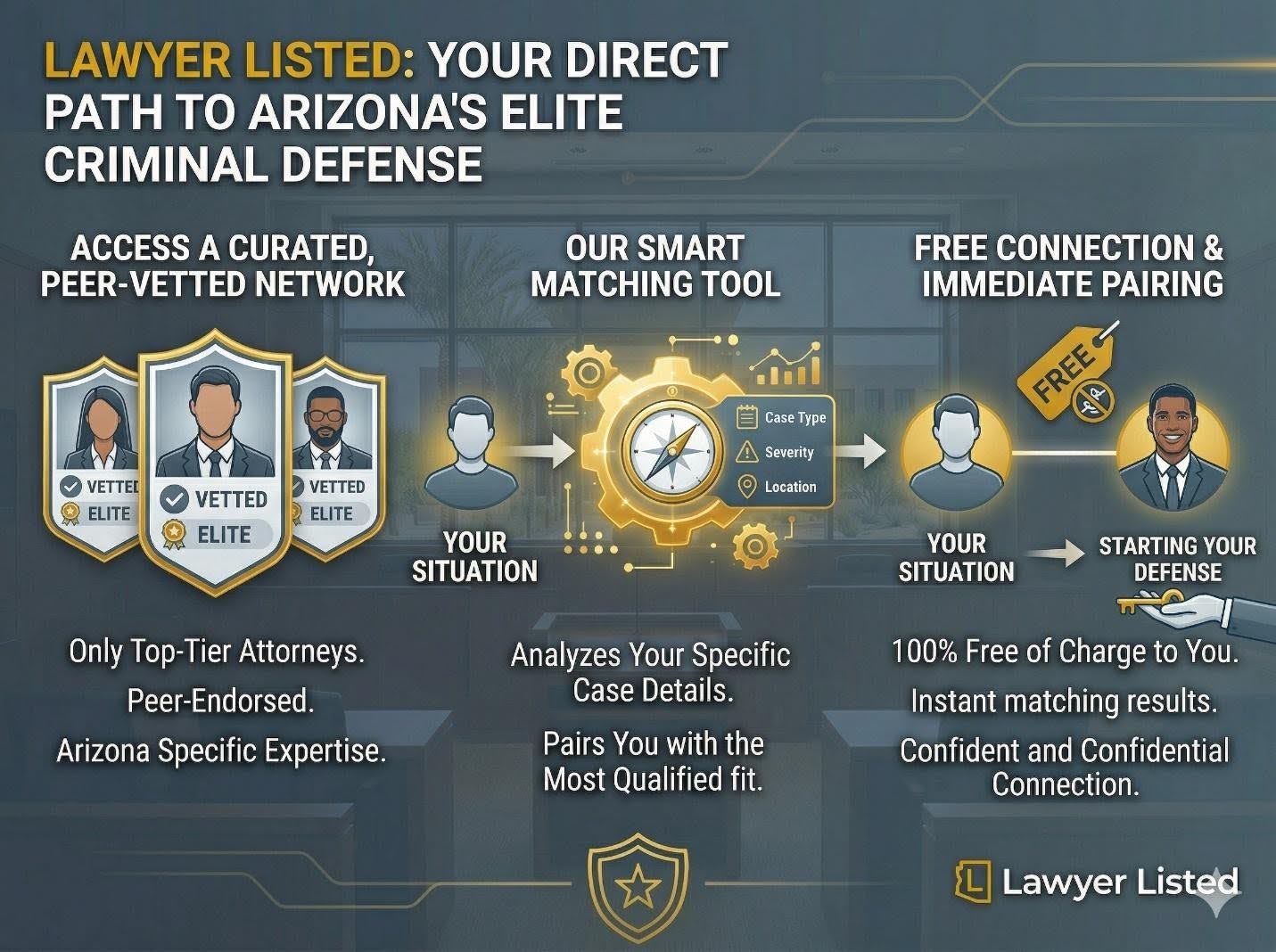
If you have been charged with a crime in Arizona, the most important step you can take right now is finding an experienced criminal defense attorney who knows Arizona law. The right attorney can evaluate the evidence against you, identify the strongest defense strategies for your situation, and fight for the best possible outcome.
Lawyer Listed connects you with a curated, peer-vetted network of elite criminal defense attorneys, free of charge. Our matching tool analyzes your specific situation and pairs you with the ideal lawyer to handle your case. Get matched with an attorney now.