

What Counts as Unauthorized Use of a Credit Card under Arizona Law?
Under ARS 13-2105, a person commits fraudulent use of a credit card if they use a credit card, debit card, or card number to get money, goods, or services while knowing they do not have permission to use it. The law also applies if you use a card you know is forged, expired, canceled, or revoked with the same intent to defraud.
The statute covers more than stolen cards. It also covers situations where a person pretends to be the cardholder to make a purchase, even if they never touched the actual card. Using someone’s card number online without their permission also counts.
What Are the Penalties for Unauthorized Credit Card Use in Arizona?
Even small purchases add up quickly. The statute looks at the value of all money, goods, services, and other things of value obtained or attempted to be obtained in any consecutive six-month period. This means several small charges can raise a misdemeanor to a felony.
- Class 5 felony: Total value of $1,000 or more
- Class 6 felony: Total value of $250 or more but less than $1,000
- Class 1 misdemeanor: Total value less than $250
Offense | Charge | Prison | Probation (max) |
Value: $1,000 or more | Class 5 felony | Prison: 0.5 – 2.5 years | 3 years |
Value: $250 – $999 | Class 6 felony | Prison: 0.33 – 2 years | 3 years |
Value: Less than $250 | Class 1 misdemeanor | Jail: Up to 6 months | 3 years |
How Does the Prosecution Prove This Charge?
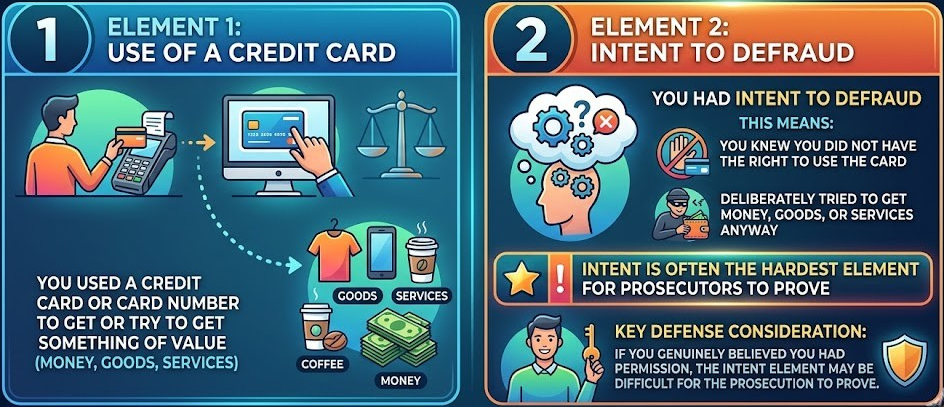
To convict you under ARS 13‑2105, the prosecution must prove two elements beyond a reasonable doubt:
- You used a credit card or card number to get or try to get something of value.
- You had intent to defraud. This means you knew you did not have the right to use the card and deliberately tried to get money, goods, or services anyway.
Intent is often the hardest element for prosecutors to prove. If you genuinely believed you had permission, the intent element may be difficult for the prosecution to prove.
What Defenses Can Be Used Against This Charge?
Several defenses may apply depending on the facts of your case.
- Lack of intent to defraud. If you reasonably believed you had the cardholder’s permission, you did not act with fraudulent intent. For example, a family member may have previously told you to use their card for household expenses.
- Mistaken identity. Credit card fraud cases often rely on digital evidence like IP addresses and transaction records. If someone else made the purchase using the card or number, the evidence may not point to you.
- Authorization by the cardholder. If the cardholder gave you permission, the charge does not hold up, even if they later changed their mind and reported the transaction.
Common Myths About This Charge
Myth: If I only used the card once for a small amount, it is not a big deal.
Reality: Any unauthorized use of a credit card can result in criminal charges in Arizona. Even a single transaction under $250 is a class 1 misdemeanor, which can carry up to six months in jail and leave you with a permanent criminal record.
Myth: Using a family member’s credit card is not illegal because they are family.
Reality: Arizona law does not make exceptions for family relationships. If you used someone’s card without their consent, you can be charged under ARS 13-2105 regardless of whether the cardholder is a relative, spouse, or friend.
Frequently Asked Questions
Q: Can I be charged with credit card fraud if the transaction was declined?
A: Yes. ARS 13-2105 covers both completed and attempted transactions. You can be charged even if the purchase did not go through.
Q: What is the difference between credit card theft and fraudulent use of a credit card?
A: Credit card theft (ARS 13-2102) covers taking or possessing someone else’s card without consent. Fraudulent use (ARS 13-2105) covers actually using the card to obtain something of value. You can be charged with both.
Q: Can credit card fraud charges be dropped in Arizona?
A: Charges may be reduced or dismissed if your attorney can show lack of intent, mistaken identity, or that you had the cardholder’s authorization.
Q: Is unauthorized use of a credit card a felony in Arizona?
A: In Arizona, unauthorized use of a credit card can be either a misdemeanor or a felony, depending on the amount involved. If the value is under $250, it’s a misdemeanor. If it’s between $250 and $1,000, it becomes a Class 6 felony. Anything over $1,000 is charged as a Class 5 felony.
Related Arizona criminal defense guides
Credit card fraud and identity theft often overlap. If personal information was used to open accounts or make purchases, you may face additional charges under ARS 13-2008.
Fraud and forgery charges in Arizona
If the card used was forged or altered, you could also face forgery charges under ARS 13-2002, a class 4 felony with harsher penalties.
Find the right attorney for your case
If you have been charged with unauthorized use of a credit card in Arizona, finding an experienced defense attorney is the most important step you can take. Lawyer Listed connects you with a curated, peer-vetted network of elite criminal defense attorneys, free of charge. Visit https://lawyerlisted.com to get matched today.