

Key takeaways
1. Arizona divides crimes into three misdemeanor classes (Class 1, 2, and 3) and six felony classes (Class 1 through 6), with Class 1 being the most serious in each category. 2. Misdemeanors carry up to six months in county jail and fines up to $2,500. Felonies can result in years or decades in state prison and fines up to $150,000. 3. Felony convictions carry additional consequences that misdemeanors do not, including the loss of your right to vote, own a firearm, and hold certain professional licenses. 4. Some charges, particularly Class 6 felonies, can be reduced to misdemeanors under certain circumstances. 5. An experienced criminal defense attorney can often negotiate to reduce charges, secure probation, or pursue alternatives to jail or prison time. |
How Arizona classifies criminal charges
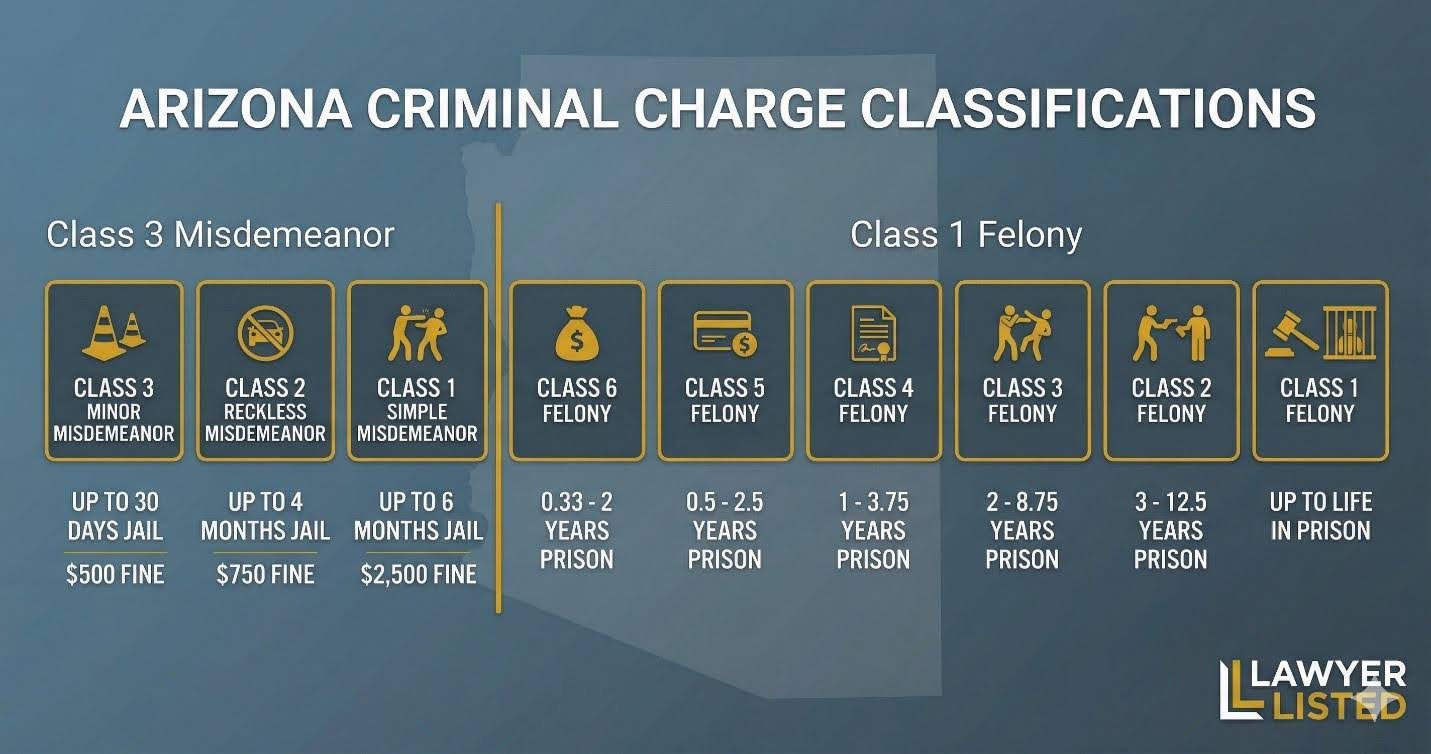
Arizona law divides criminal offenses into two main categories: misdemeanors and felonies. Within each category, crimes are further divided into classes based on severity.
Misdemeanors are considered less serious offenses. Arizona has three classes of misdemeanors, with Class 1 being the most serious and Class 3 being the least serious. Misdemeanor sentences are served in county jail, not state prison.
Felonies are more serious crimes. Arizona has six classes of felonies, with Class 1 being the most severe (reserved for murder) and Class 6 being the least severe. Felony sentences are served in the Arizona Department of Corrections.
The class of your charge determines the range of penalties a judge can impose. It also affects whether you are eligible for probation, diversion programs, or plea negotiations that could reduce your charge.
Where the classification comes from
Each criminal offense in Arizona is assigned a classification by statute. When a prosecutor files charges, the charging document will specify the exact statute you are accused of violating and the class of offense it falls under.
For example, a standard first-offense DUI is classified as a Class 1 misdemeanor under ARS 28-1381. Aggravated DUI, by contrast, is a Class 4 felony under ARS 28-1383. Same general type of offense, very different classifications, and very different consequences.
The classification matters because it sets the boundaries for your sentence. Generally, a judge cannot sentence you beyond the maximum allowed for your charge class, but they also cannot go below the minimum in certain cases.
Arizona misdemeanor classes and penalties
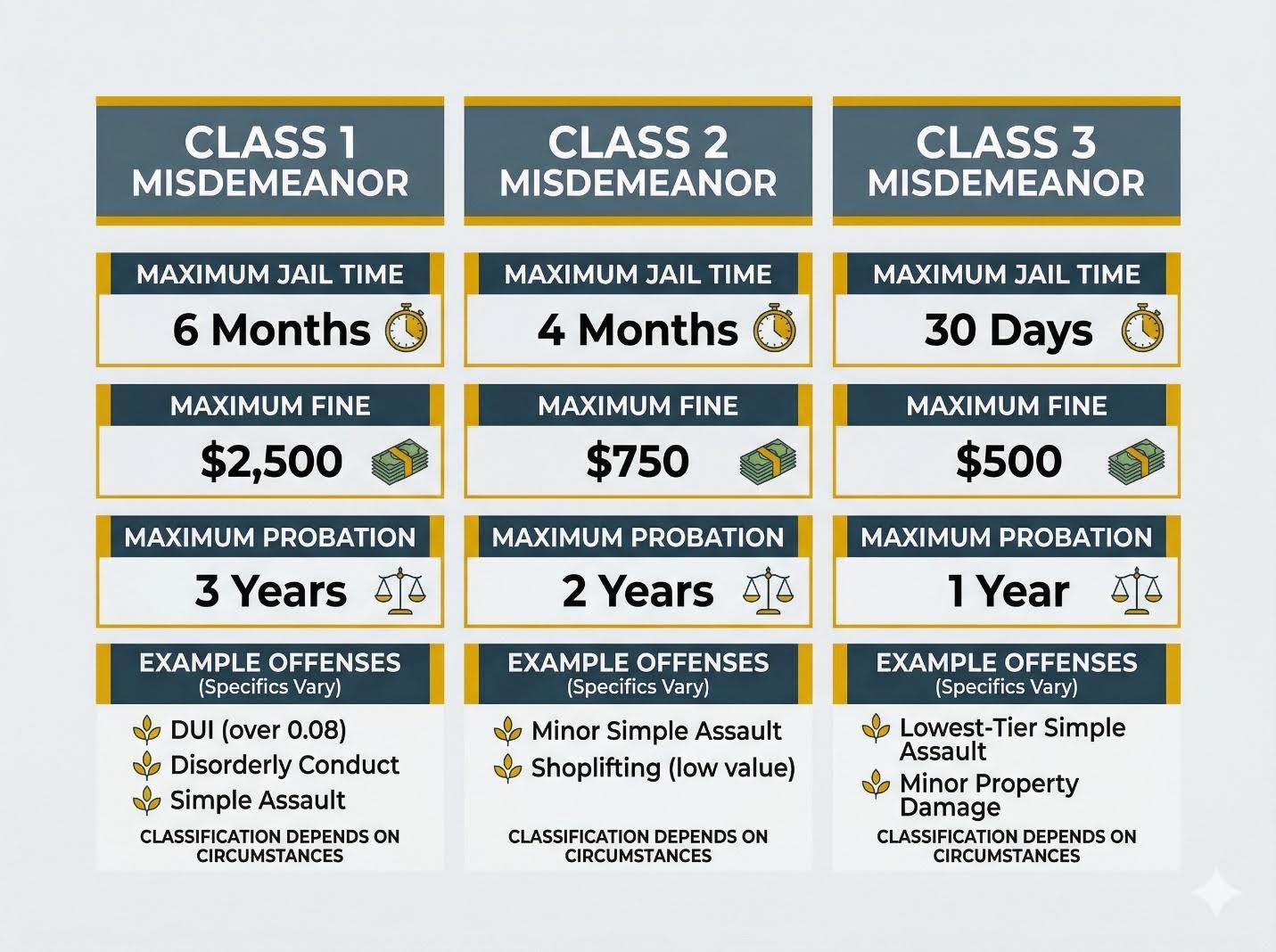
Under ARS 13-707, misdemeanor sentences are served in county jail rather than state prison. Each class carries a different maximum sentence and fine amount, as set by ARS 13-802.
Class 1 misdemeanor
A Class 1 misdemeanor is the most serious type of misdemeanor in Arizona. The maximum penalty is six months in jail and a fine of up to $2,500. Probation for a Class 1 misdemeanor can last up to three years.
Some of the most common Class 1 misdemeanors in Arizona include DUI (first offense), shoplifting (property valued under $1,000), disorderly conduct, assault causing minor injury, criminal damage under $1,000, and domestic violence assault.
Many of these charges carry mandatory minimum sentences. A first-offense DUI, for example, carries a mandatory minimum of 10 days in jail under Arizona law, even though it is classified as a misdemeanor.
Class 2 misdemeanor
A Class 2 misdemeanor carries a maximum sentence of four months in jail and fines of up to $750. Probation can last up to two years.
Examples of Class 2 misdemeanors include reckless driving, criminal trespass in the second degree, and minor in possession or consumption of alcohol.
While these charges are less severe than a Class 1 misdemeanor, they still result in a criminal record that can show up on background checks.
Class 3 misdemeanor
A Class 3 misdemeanor is the least serious criminal charge in Arizona. The maximum penalty is 30 days in jail and a fine of up to $500. Probation can last up to one year.
Common Class 3 misdemeanors include criminal speeding (exceeding the speed limit by more than 20 mph or driving over 85 mph), assault by touching (making physical contact intended to insult or provoke), and criminal trespass in the third degree.
Even at this level, a conviction creates a criminal record. First-time offenders may be eligible for diversion programs that can lead to dismissal of the charges.
Arizona felony classes and penalties
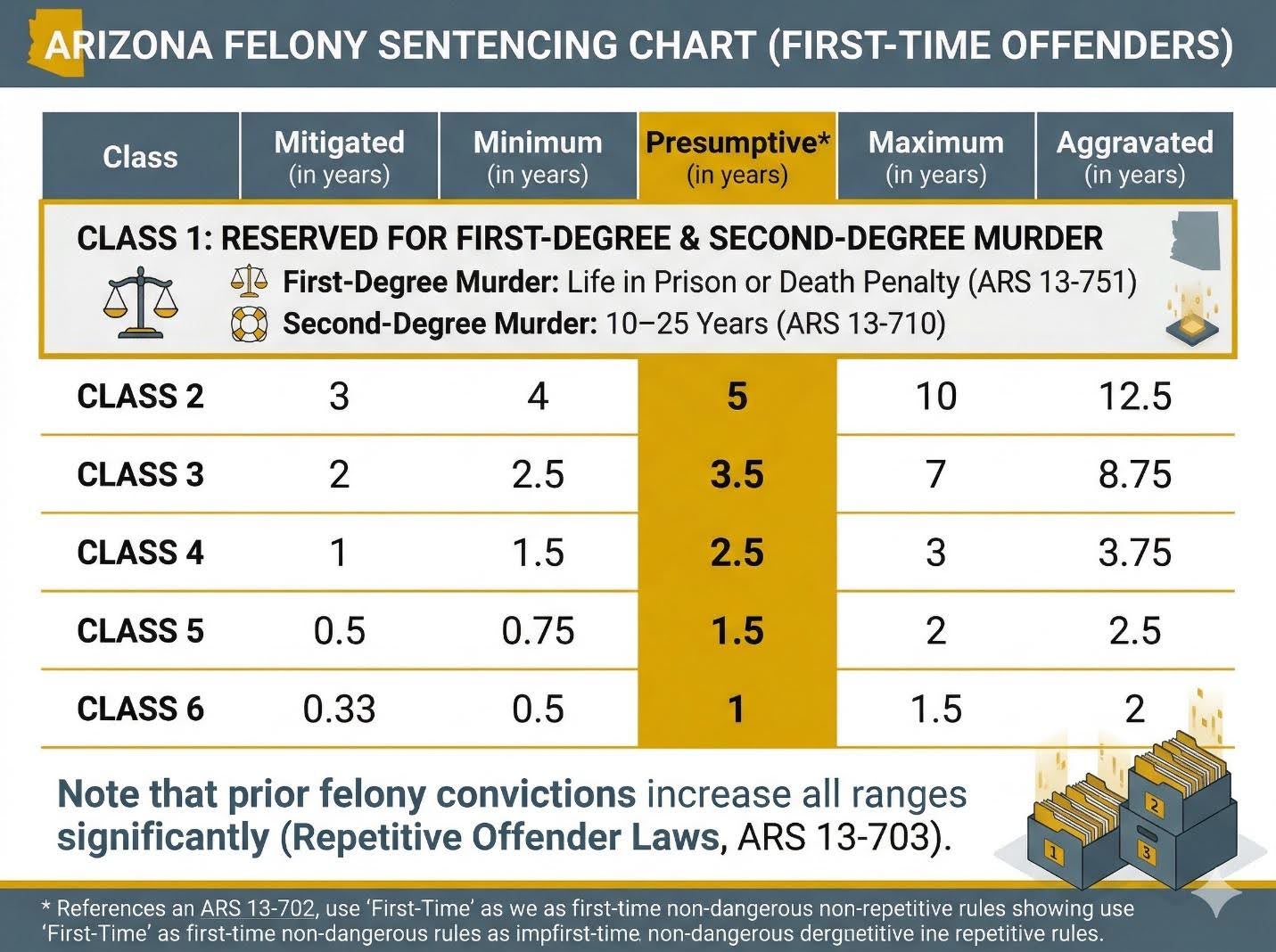
Felonies are the most serious criminal charges in Arizona. Under ARS 13-702, first-time felony offenders face a sentencing range that varies by class. Fines for felonies can reach up to $150,000 under ARS 13-801.
Unlike misdemeanors, felony sentences are served in the Arizona Department of Corrections (state prison). However, first-time offenders convicted of non-dangerous felonies may be eligible for probation instead of prison.
Class 1 felony
Class 1 felonies are the most serious crimes in Arizona. Only two offenses carry this classification: first-degree murder and second-degree murder.
First-degree murder can result in life in prison or the death penalty. Second-degree murder carries a sentencing range of 10 to 25 years in prison, with a presumptive sentence of 16 years.
Class 2 felony
Class 2 felonies are very serious offenses. For a first-time offender, the sentencing range is 3 to 12.5 years in prison, with a presumptive sentence of 5 years.
Examples of Class 2 felonies include manslaughter, sexual assault, armed robbery, sex trafficking, manufacturing methamphetamine, and theft of property worth more than $25,000.
Class 3 felony
The sentencing range for a first-time Class 3 felony is 2 to 8.75 years in prison, with a presumptive sentence of 3.5 years.
Common Class 3 felonies include assault with a deadly weapon, second-degree burglary, auto theft, and certain drug offenses involving the sale or transportation of narcotics.
Class 4 felony
A first-time Class 4 felony carries a sentencing range of 1 to 3.75 years in prison, with a presumptive sentence of 2.5 years.
Examples include aggravated DUI, robbery, forgery, possession of narcotic drugs, and theft of property worth between $3,000 and $4,000.
Class 5 felony
The sentencing range for a first-time Class 5 felony is 6 months to 2.5 years in prison, with a presumptive sentence of 1.5 years.
Class 5 felonies include aggravated domestic violence, stalking, credit card theft, and criminal damage to property between $2,000 and $10,000.
Class 6 felony
A Class 6 felony is the least serious felony in Arizona. For a first-time offender, the sentencing range is 4 months to 2 years in prison, with a presumptive sentence of 1 year.
Examples include theft of property worth between $1,000 and $2,000, possession of drug paraphernalia, and criminal trespass in the first degree.
Class 6 felonies hold a unique position in Arizona law. Under ARS 13-604, a judge may designate a Class 6 felony as a Class 1 misdemeanor if the offense did not involve a dangerous weapon or serious injury and the judge believes that a felony designation would be too harsh. The judge can either designate the offense as a misdemeanor at the time of sentencing or wait until probation ends to decide whether the offense should be a felony or a misdemeanor.
Common Arizona misdemeanors and felonies compared
Many types of criminal conduct can be charged as either a misdemeanor or a felony depending on the circumstances. The difference often comes down to factors like the value of property involved, the severity of injury, whether a weapon was used, or whether you have prior convictions.
Here are some of the most commonly charged offenses in Arizona and how they are classified:
DUI: A standard first-offense DUI is a Class 1 misdemeanor. However, if you have a suspended license, a minor in the vehicle, or two prior DUI convictions within seven years, the charge becomes an aggravated DUI, which is a Class 4 felony.
Assault: Simple assault causing minor injury is a Class 1 misdemeanor. But if the assault involves a deadly weapon, causes serious physical injury, or targets certain protected individuals like police officers, the charge becomes aggravated assault, which is a felony.
Theft: The classification depends almost entirely on the value of the stolen property. Theft of property under $1,000 is a Class 1 misdemeanor. Theft of $1,000 to $1,999 is a Class 6 felony. The felony class increases as the dollar value rises, up to a Class 2 felony for theft exceeding $25,000.
Drug offenses: Possession of drug paraphernalia is a Class 6 felony, but it may be treated as a misdemeanor for first-time offenders. Possession of narcotic drugs for personal use is a Class 4 felony. Possession for sale or trafficking can reach Class 2 felony status.
Domestic violence: Domestic violence is not a standalone charge. It is a designation added to other offenses (like assault or disorderly conduct) when the victim is a household member. A first domestic violence assault is typically a Class 1 misdemeanor, but a third domestic violence conviction within 84 months becomes aggravated domestic violence, a Class 5 felony.
What happens after you are charged
The process after being charged with a crime in Arizona depends on whether you are facing a misdemeanor or a felony. Both paths lead to court, but the steps along the way are different.
The misdemeanor process
Misdemeanor cases are handled in municipal courts or justice courts. After you are cited or arrested, you will receive a court date for your arraignment. At the arraignment, you will be informed of the charges and asked to enter a plea.
Most misdemeanor cases are resolved through plea negotiations before trial. A defense attorney may be able to negotiate for reduced charges, diversion programs, or alternative sentencing like community service or counseling. If no agreement is reached, the case goes to a bench trial (decided by a judge) or a jury trial.
The felony process
Felony cases are handled in Arizona Superior Court. The process is longer and more complex.
After arrest, you will appear before a judge for an initial appearance, where bail may be set. A preliminary hearing or grand jury proceeding will determine whether there is enough evidence to move forward. If the case proceeds, you will be arraigned in Superior Court.
Felony cases involve extensive pretrial proceedings, including scheduling hearings, motions hearings, and settlement conferences. If the case goes to trial, felony defendants are entitled to a jury trial.
Long-term consequences beyond jail and fines

The penalties listed in the statute are only part of the picture. Both misdemeanors and felonies carry consequences that extend well beyond the courtroom.
Criminal record
Both misdemeanors and felonies create a permanent criminal record in Arizona. This record shows up on background checks for jobs, housing, and educational programs.
Under ARS 13-911, Arizona allows eligible individuals to petition to seal their criminal records. The waiting period depends on the offense class: two years for Class 2 or 3 misdemeanors, three years for Class 1 misdemeanors, five years for Class 4 through 6 felonies, and 10 years for Class 2 or 3 felonies. Not all offenses are eligible. Dangerous offenses, crimes against children, and certain violent felonies cannot be sealed.
Employment and housing
Employers and landlords in Arizona can and do run background checks. A criminal conviction, even a misdemeanor, can make it harder to get a job or find housing. Felony convictions have an even greater impact, especially for positions that require professional licenses or security clearances.
Certain professions in Arizona require a fingerprint clearance card under ARS 41-1758.03. A criminal conviction can disqualify you from working in healthcare, education, law enforcement, and other licensed fields.
Civil rights
Felony convictions affect your civil rights in ways that misdemeanors do not. If you are convicted of a felony in Arizona, you lose the right to vote, the right to hold public office, the right to possess firearms, and the right to serve on a jury.
For first-time felony offenders, civil rights (except gun rights for dangerous offenses) are automatically restored upon completion of the sentence under ARS 13-907. If you have multiple felony convictions, you must apply to the court for restoration under ARS 13-908.
Common myths about Arizona criminal charges
Myth: A misdemeanor is not a big deal and will not affect my life.
Reality: A misdemeanor conviction in Arizona creates a permanent criminal record that shows up on background checks. It can disqualify you from certain jobs, professional licenses, and housing. A Class 1 misdemeanor like DUI also carries mandatory jail time.
Myth: If I am charged with a felony, I am definitely going to prison.
Reality: Not necessarily. First-time offenders convicted of non-dangerous felonies in Arizona are often eligible for probation. A skilled defense attorney can negotiate alternatives to prison in many cases.
Myth: Once I serve my time, the conviction goes away.
Reality: Criminal convictions in Arizona do not automatically disappear. They remain on your record indefinitely unless you petition to have them sealed under ARS 13-911. Even then, sealed records can still be accessed by law enforcement and used to enhance future sentences.
Frequently asked questions
Q: Can a felony be reduced to a misdemeanor in Arizona?
A: In some cases, yes. Class 6 felonies can be designated as Class 1 misdemeanors under ARS 13-604 if the offense did not involve a dangerous weapon or serious injury. The judge may make this designation at sentencing or after successful completion of probation.
Q: Do I need a lawyer for a misdemeanor charge in Arizona?
A: You are not required to have a lawyer for a misdemeanor but hiring one can significantly improve your outcome. A defense attorney can negotiate for reduced charges, diversion programs, or alternative sentencing. Even a misdemeanor conviction creates a permanent criminal record that can affect your employment and housing.
Q: Will a misdemeanor show up on a background check in Arizona?
A: Yes. Both misdemeanor and felony convictions in Arizona appear on criminal background checks unless they have been sealed under ARS 13-911. Employers, landlords, and licensing boards can all access this information. Sealing is available for eligible offenses after completing your sentence and waiting the required time period.
Q: What is the difference between jail and prison in Arizona?
A: In Arizona, jail refers to county facilities where misdemeanor sentences are served. The maximum jail sentence is six months. Prison refers to the Arizona Department of Corrections, where felony sentences are served. Prison sentences can range from several months to life, depending on the felony class and circumstances.
Q: Can you get probation for a felony in Arizona?
A: Yes, for certain offenses. First-time offenders convicted of non-dangerous felonies in all classes (2 through 6) are eligible for probation. However, probation is not available for dangerous felonies, which involve the use of a deadly weapon or the intentional infliction of serious physical injury. Your eligibility depends on the specific offense, your criminal history, and the judge’s discretion.
Q: Does Arizona have a three-strikes law?
A: Arizona does not have a formal “three strikes” law like some states. However, ARS 13-703 and 13-706 impose increasingly severe sentences for repeat felony offenders. A person with two or more prior felony convictions can face significantly longer prison terms, and certain repeat violent offenders can be sentenced to life in prison.
Find the right attorney for your case

If you have been charged with a misdemeanor or felony in Arizona, the most important step you can take right now is finding an experienced criminal defense attorney who knows Arizona law. The difference between a misdemeanor and a felony can come down to the specific facts of your case and how your attorney handles the defense. Lawyer Listed connects you with a curated, peer-vetted network of elite criminal defense attorneys, free of charge. Our matching tool analyzes your specific situation and pairs you with the best attorney to handle your case. Visit https://lawyerlisted.com to get matched today.