
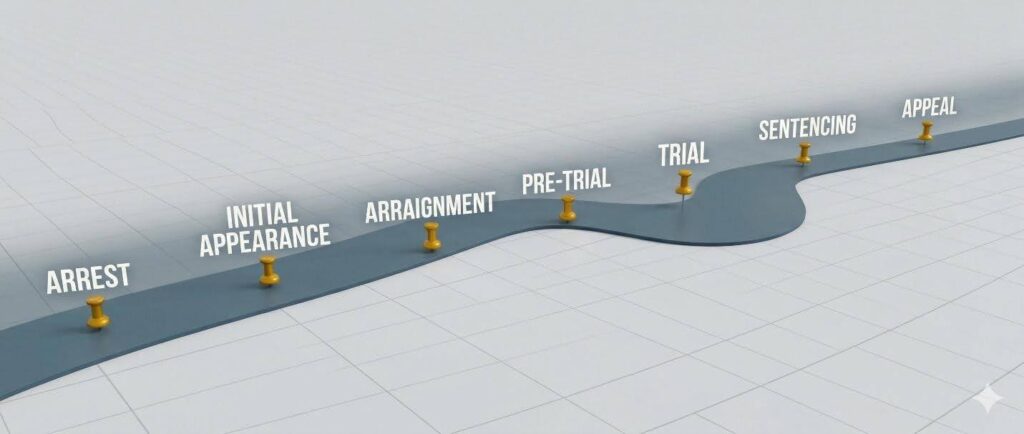
If you have been charged with a crime in Arizona, you are probably feeling overwhelmed, scared, and unsure of what happens next. That is completely normal. The criminal justice system can feel like a maze, and it moves fast. But here is the good news: you have rights. Real, powerful rights that protect you at every single stage, from the moment you are arrested all the way through sentencing and a potential appeal if you are convicted.
This guide will walk you through those rights in plain language so you can understand what to expect, what to demand, and how to protect yourself. Think of this as a conversation with a friend who happens to know the law. The first thing you should know is that you need help; you need a qualified attorney on your side to fight for your rights. Let Lawyer Listed match you with your ideal criminal defense lawyer today.
What Happens When You Are Arrested in Arizona
An arrest is the starting point of a criminal case, and it can happen quickly. An officer might arrest you on the spot if they see a crime happen, or they might have a warrant signed by a judge. Either way, once you are in custody, your constitutional rights kick in immediately.
Your Miranda Rights
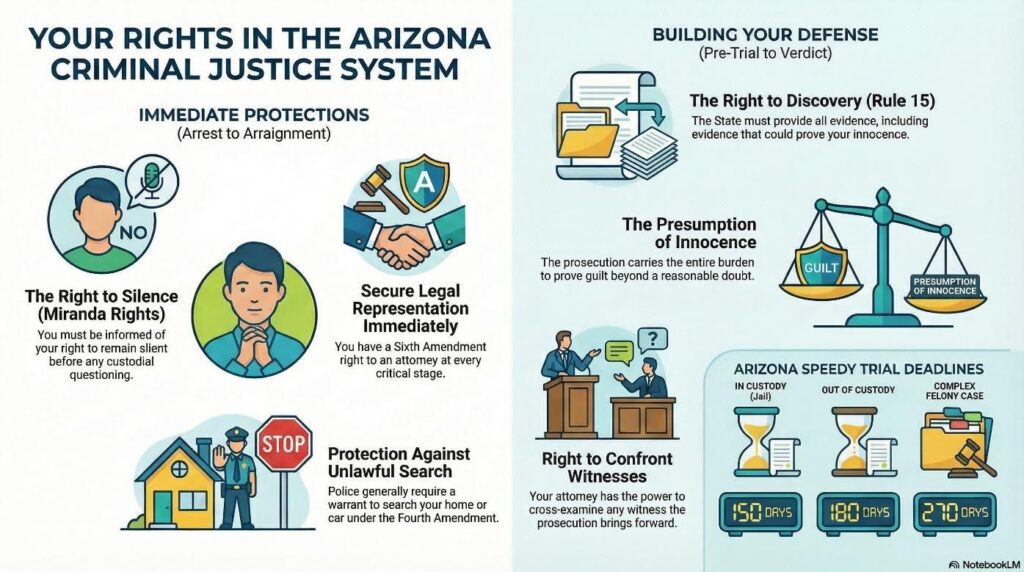
You have probably heard of Miranda rights on TV. In real life, they matter even more. Before police can question you while you are in custody, they must tell you:
- You have the right to remain silent. Anything you say can be used against you in court.
- You have the right to an attorney. If you cannot afford one, the court will appoint one for you at no cost.
If the police question you without giving these warnings, your answers may be thrown out of court. This does not mean your case gets dismissed automatically, but it does mean the prosecution may lose key evidence. The best advice? Use your right to remain silent. Politely tell officers you want a lawyer before answering any questions. You are not being difficult; you are being smart.
Protection Against Unlawful Search and Seizure
The Fourth Amendment to the U.S. Constitution protects you from unreasonable searches and seizures. In most situations, police need a warrant to search places like your home or your car. There are exceptions, like if you give consent, if evidence is in plain view, or in exigent circumstances where officers believe harm is imminent or evidence will be destroyed. If police searched you or your property without a valid reason, your attorney can file a motion to suppress that evidence, meaning it cannot be used against you at trial.
Your Rights During the Criminal Court Process
Once your case moves into the court system, a whole new set of protections comes into play. Arizona follows both the U.S. Constitution and the Arizona Constitution, which in some cases gives defendants even stronger rights than federal law requires.
Initial Appearance and Bail
After your arrest, you must be brought before a judge within a short period, typically within 24 hours. This is called your initial appearance. At this hearing, the judge will:
- Inform you of the charges against you
- Advise you of your rights, including the right to an attorney
- Set the conditions for your release, including bail or bond
Under Arizona law, most defendants have the right to bail. Article 2, Section 22 of the Arizona Constitution says that bail should be set based on several factors, including the seriousness of the offense, your criminal history, and whether you are a flight risk. However, bail can be denied in certain cases, such as capital offenses or sexual assault charges, when the evidence of the crime is strong. The court may also deny bail if you were out on bail on a separate felony charge or if the court deems you to pose a substantial danger to another person or the community.
The Right to an Attorney
The Sixth Amendment guarantees your right to have a lawyer represent you. If you cannot afford a private attorney, the court will appoint a public defender to your case. This right applies at every critical stage of the proceedings, from arraignment through trial, sentencing, and appeal. Do not waive this right. Having an experienced criminal defense attorney by your side is one of the most important things you can do to protect your future.
Arraignment
The arraignment is the hearing where you officially hear the charges against you and enter a plea. You generally have three options:
- Not guilty: This means you deny the charges and forces the state to prove its case. This is the most common plea at arraignment.
- Guilty: This means you admit to the charges. If you enter a plea of guilty, the next stage in the process is sentencing.
- No contest (nolo contendere): This means you are not admitting guilt, but you are not fighting the charges either. It has the same effect as a guilty plea for sentencing purposes.
Your attorney will advise you on the best plea to enter based on the facts of your case. In most situations, entering a not guilty plea at arraignment is the right move because it keeps your options open.
Your Pre-Trial Rights
The Right to Discovery
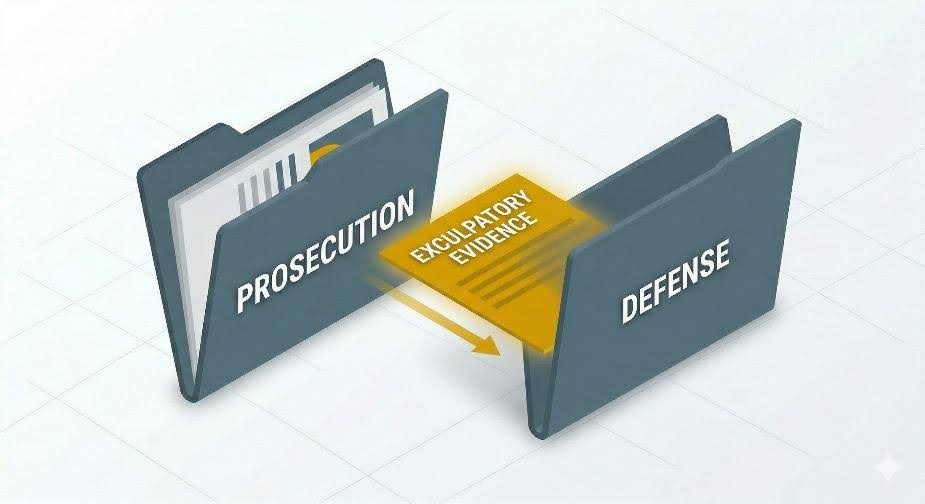
Discovery is the legal process where both sides share evidence before trial. The prosecution is required to turn over all evidence it plans to use, including police reports, witness statements, lab results, and any other relevant documents. Under Arizona Rules of Criminal Procedure, Rule 15, the state must also hand over exculpatory evidence. That is evidence that could help prove your innocence. If the prosecution hides favorable evidence from you, it violates your constitutional rights under a landmark U.S. Supreme Court decision known as Brady v. Maryland.
The Right to a Speedy Trial
Both the U.S. Constitution (Sixth Amendment) and the Arizona Constitution (Article 2, Section 24) guarantee your right to a speedy trial. Arizona reinforces those constitutional protections by imposing specific time limits on how quickly after arraignment the State must bring a criminal case to trial. The following deadlines apply to felony charges:
- In custody: 150 days
- Out of custody: 180 days
- Complex case: 270 days for complex felony cases, such as first-degree murder, wiretap cases, or cases the court formally designates as complex
- Capital case: 24 months in capital cases, measured from the filing of the State’s notice of intent to seek the death penalty
These deadlines exist to ensure that criminal cases move forward and that your constitutional right to a prompt resolution is protected.
Preliminary Hearing or Grand Jury
In felony cases, the state must establish probable cause before your case can go to trial. This happens in one of two ways. A preliminary hearing is a mini-trial where a judge decides if there is enough evidence to move forward. A grand jury is a group of citizens who review the evidence and decide whether to issue an indictment (formal charges). In Arizona, the prosecution typically uses a grand jury.
Pre-Trial Motions
Before trial, your attorney can file motions to shape how your case is handled. Some common pre-trial motions include:
- Motion to suppress evidence: Asks the court to exclude evidence obtained illegally.
- Motion to dismiss: Asks the court to throw out the case entirely due to lack of evidence or legal errors.
Pre-trial motions can make or break a case. A successful motion to suppress key evidence could force the prosecution to offer a better plea deal or even drop the charges altogether.
Your Rights at Trial
The Right to a Jury Trial
If your case goes to trial, you have the right to have a jury of your peers decide your guilt or innocence. In Arizona, juries are typically made up of 8 to 12 people. Arizona rules require that juries in cases involving a possible death sentence or imprisonment of 30 years or more consist of 12 people. In all other cases, the jury must have at least 6 jurors.
The jury’s verdict must be unanimous for a conviction or an acquittal. If the jury cannot agree, the judge will declare a mistrial, and the prosecution can choose to retry the case.
The Presumption of Innocence
This is one of the most important rights you have. You are presumed innocent until the prosecution proves you guilty beyond a reasonable doubt. That is a very high standard. It means the jury cannot have any reasonable doubt about your guilt after hearing all of the evidence before they can convict you of the crime. The burden of proof is always on the state. You never have to prove your innocence; this means you do not have to present a defense or testify.
The Right to Confront Witnesses
Under the Sixth Amendment, you have the right to face your accusers. This means the prosecution must bring its witnesses to court to testify in person, and your attorney gets to cross-examine them. Cross-examination is one of the most powerful tools in a criminal defense. It allows your lawyer to challenge a witness’s story, point out inconsistencies, and expose bias.
The Right Against Self-Incrimination
The Fifth Amendment protects you from being forced to testify against yourself. At trial, you have the absolute right to remain silent. The prosecution cannot call you to the witness stand, and the judge will instruct the jury that they cannot hold your silence against you. If you choose to testify, you open yourself up to cross-examination by the prosecution, so this is a decision you and your lawyer should make carefully.
Key Rights at Each Stage of Your Case
The table below provides a quick reference for your most important rights at each stage of the criminal process in Arizona.
| Stage | Your Key Rights | What It Means for You |
|---|---|---|
| Arrest | Right to remain silent; right to an attorney; protection from unreasonable search | Do not answer questions without a lawyer. Ask if you are free to leave. |
| Initial Appearance | Right to be informed of charges; right to bail in most cases | The judge will tell you the charges and set bail or release conditions. |
| Arraignment | Right to enter a plea; right to an attorney | You formally respond to the charges. Most defendants plead not guilty here. |
| Pre-Trial | Right to discovery; right to a speedy trial; right to file motions | Your attorney reviews evidence and can challenge the state's case before trial. |
| Trial | Presumption of innocence; right to a jury; right to confront witnesses; right against self-incrimination | The state must prove guilt beyond a reasonable doubt. You do not have to testify. |
| Sentencing | Right to be heard; right to present mitigating evidence | You and your attorney can argue for a lighter sentence based on your circumstances. |
| Appeal | Right to appeal a conviction; right to appointed counsel on appeal | A higher court reviews your case for legal errors that may have affected the outcome. |
Plea Bargaining: What You Should Know

The vast majority of criminal cases in Arizona do not go to trial. They are resolved through plea bargaining, which is a negotiation between your attorney and the prosecutor. In a plea agreement, you agree to plead guilty to a lesser charge or to the original charge in exchange for a lighter sentence or the dismissal of other charges.
A plea agreement can be a smart move in some situations, especially if the evidence against you is strong. But you should never feel pressured to take a deal. It is your right to go to trial if that is what you want. Your attorney’s job is to explain the strengths and weaknesses of your case so you can make an informed decision.
Key things to know about plea bargaining:
- You have the right to accept or reject any plea offer. The decision is always yours, not your lawyer’s.
- A guilty plea is final in most cases. Once you plead guilty and the court accepts it, you generally cannot take it back.
- The judge does not have to accept the plea deal. The court has the final say on whether the plea agreement is fair.
Your Rights at Sentencing
If you are found guilty at trial or plead guilty, your case moves to sentencing. In Arizona, sentencing can vary widely depending on the type of offense, your criminal history, and the specific circumstances of the case.
Factors the Judge Considers
Arizona Revised Statutes (A.R.S.) Title 13 lays out the sentencing framework for criminal offenses. Judges consider aggravating factors (things that make the crime more serious) and mitigating factors (things that may justify a lighter sentence). Examples of aggravating factors include the use of a weapon, the presence of a victim who was particularly vulnerable, or a prior criminal record. Mitigating factors might include your age, your role in the offense, mental health issues, or whether this is your first offense.
Your Right to Be Heard
At sentencing, you have the right to make a statement to the judge. You can express remorse, explain your circumstances, and ask for leniency. Victims also have the right to speak under Arizona’s Victims’ Bill of Rights (Article 2, Section 2.1 of the Arizona Constitution). Your attorney can also present evidence and arguments for a lesser sentence.
Types of Sentences in Arizona
Depending on the offense, a judge may impose a range of sentences:
- Probation: You serve your sentence in the community under supervision instead of going to prison.
- Incarceration: Time in county jail (for misdemeanors) or state prison (for felonies).
- Fines and restitution: You may be ordered to pay fines to the court and restitution to victims.
- Community service: The court may require you to complete a certain number of hours of unpaid work.
- Suspended sentence: The judge sets a sentence but does not impose it right away. If you follow the terms of your probation, you may avoid serving the sentence.
Your Right to Appeal a Criminal Conviction in Arizona

A conviction is not necessarily the end of the road. If you believe legal errors were made during your case, you have the right to appeal. An appeal is not a new trial. It is a review by a higher court to determine whether the lower court made mistakes that affected the outcome.
Direct Appeal
After a conviction, you can file a direct appeal with the Arizona Court of Appeals. For felonies, you must file a notice of appeal within 20 days of sentencing. Your appellate attorney will review the trial record and identify potential errors, such as improper jury instructions, wrongly admitted evidence, or prosecutorial misconduct.
Post-Conviction Relief (Rule 32 and Rule 33)
If your direct appeal is unsuccessful, you may be able to seek post-conviction relief under Arizona Rules of Criminal Procedure. Common grounds for post-conviction relief include claims of ineffective assistance of counsel (meaning your attorney made serious mistakes), newly discovered evidence, or constitutional violations.
Federal Habeas Corpus
If you have exhausted your state court options, you may be able to file a petition for habeas corpus in federal court. This is a limited remedy that focuses on whether your federal constitutional rights were violated. It is a complex process with strict rules, but it is another option to explore with your attorney if state appeals fail.
Practical Tips for Protecting Your Rights
Knowing your rights is one thing. Using them wisely is another. The choices you make during your case can affect your freedom, your record, and your future. Here are some practical steps to help protect yourself throughout the criminal justice process:
- Stay calm during an arrest. Do not resist, argue, or run. Exercise your right to remain silent and ask for an attorney.
- Hire an attorney as soon as possible. If you cannot afford one, request a public defender at your initial appearance.
- Do not discuss your case with anyone except your lawyer. Conversations with friends, family, or cellmates are not protected.
- Show up to every court date on time. Missing a hearing can result in a bench warrant for your arrest and additional charges.
- Follow all conditions of your release. If you are out on bail, obey every condition the judge set.
- Keep records. Save copies of all paperwork, court dates, and communications related to your case.
Moving Forward: You Have More Power Than You Think
Facing criminal charges in Arizona is stressful, but you are not powerless. The Constitution gives you a strong set of rights that exist to keep the system fair and to hold the government accountable. From the right to remain silent at arrest to the right to appeal after a conviction, these protections are yours, and no one can take them away.
The most important step you can take right now is to get an experienced criminal defense attorney on your side. A good lawyer will explain your options, fight for your rights, and guide you through each stage of the process. Lawyer Listed helps you find the ideal criminal defense attorney based on your case and preferences so you can move forward with confidence.