

If you have been charged with a crime in Arizona, you are probably scared, confused, and unsure of what comes next. That is completely normal. The criminal justice system is complicated, and the stakes could not be higher. Your freedom, your reputation, and your future are all on the line. This is exactly why having a criminal defense lawyer by your side matters so much. But what does a defense lawyer actually do for you?
Most people think a criminal defense attorney only shows up in court to argue your case. The truth is, their work goes far beyond the courtroom. From the moment you are arrested to the final resolution of your case, a skilled defense lawyer plays several critical roles that can shape the outcome.
In this guide, we will walk you through five key roles a criminal defense lawyer plays when representing someone charged with a crime in Arizona. Understanding these roles can help you appreciate why hiring the right attorney is one of the most important decisions you will make.
Role 1: Protecting Your Constitutional Rights

The most fundamental role of a criminal defense lawyer is protecting your rights. The United States Constitution and the Arizona Constitution both guarantee specific rights to anyone accused of a crime. These rights exist to make sure the government treats you fairly, even when you are accused of breaking the law.
Your defense attorney acts as a watchdog. They make sure law enforcement, prosecutors, and the court follow the rules at every stage of your case. If anyone violates your rights, your lawyer is the one who catches it and takes action.
Key Rights Your Lawyer Protects
- The right to remain silent. Under the Fifth Amendment, you do not have to answer questions from the police or prosecutors. Your lawyer will advise you on when to speak and when to stay quiet, so you do not accidentally say something that hurts your case.
- The right to an attorney. The Sixth Amendment guarantees your right to have a lawyer represent you. In Arizona, Rule 6.1 of the Arizona Rules of Criminal Procedure provides that your right to counsel includes the right to consult privately with your attorney as soon as possible after being taken into custody.
- The right against unreasonable searches and seizures. The Fourth Amendment protects you from illegal searches of places like your home and car. If police conducted illegal searches without a valid warrant or proper legal authority, your attorney can challenge any evidence they found.
- The right to a fair trial. You are entitled to a trial by jury in all felony cases. Your lawyer ensures that the jury selection process is fair, that evidence is presented properly, and that the prosecution proves its case beyond a reasonable doubt.
If any of your rights were violated during your arrest, investigation, or prosecution, your defense attorney can file motions to suppress evidence. This means the judge may throw out evidence that was gathered illegally. In some cases, a violation of your rights can lead to your charges being reduced or dismissed entirely.
Role 2: Investigating Your Case and Building a Defense Strategy

Your defense lawyer doesn’t just take the prosecutor’s version of events at face value. One of the most important things a criminal defense attorney does is conduct an independent investigation into your case. This means digging into the facts, examining the evidence and looking for anything the police or prosecution may have missed or gotten wrong.
What a Defense Investigation Looks Like
A thorough defense investigation may include several steps, depending on the details of your case:
- Reviewing police reports and arrest records. Your lawyer will carefully read through the documents related to your arrest and charges. They look for errors, inconsistencies, and signs that proper procedures were not followed.
- Examining physical evidence. This could include anything from surveillance footage and photographs to lab results and forensic reports. Your attorney may hire independent experts to review the prosecution’s evidence or conduct their own testing.
- Interviewing witnesses. Your lawyer may talk to witnesses who saw what happened, as well as character witnesses who can speak to your reputation and behavior. Witness testimony can be powerful in building a defense.
- Visiting the scene. In some cases, your attorney may visit the location where the alleged crime took place. Seeing the scene firsthand can reveal important details that do not come through in police reports.
- Identifying weaknesses in the prosecution’s case. Every case has strengths and weaknesses. Your lawyer’s job is to find the weak spots in the prosecution’s argument and use them to your advantage.
Based on what they find, your lawyer will develop a defense strategy tailored to the facts of your case. There is no one-size-fits-all defense. A good attorney considers every angle and chooses the approach that gives you the best chance at a favorable outcome.
Common Defense Strategies in Arizona
Depending on the circumstances, your lawyer might use one or more of the following defense strategies:
- Self-defense: You acted to protect yourself or someone else from immediate harm.
- Lack of intent: You did not mean to commit the crime. Many offenses require the prosecution to prove you acted intentionally or knowingly.
- Mistaken identity: You were not the person who committed the crime.
- Constitutional violations: Evidence was obtained illegally and should be excluded from your trial.
- Alibi: You were somewhere else when the crime occurred.
Role 3: Negotiating Plea Bargains and Reduced Charges

Here is something that surprises many people: the majority of criminal cases in Arizona never go to trial. Instead, they are resolved through plea negotiations between the defense attorney and the prosecutor. A plea bargain is an agreement where the defendant pleads guilty to a lesser charge or receives a lighter sentence in exchange for avoiding the time, expense, and uncertainty of a trial.
Your defense attorney plays a critical role in this process. They negotiate on your behalf with the prosecutor to get you the best possible deal. This is not about giving up. It is about making smart, strategic decisions based on the facts of your case.
How Plea Negotiations Work
Plea negotiations typically happen after your lawyer has reviewed all the evidence and assessed the strengths and weaknesses of the prosecution’s case. Your attorney may negotiate for:
- Reduced charges. For example, getting a felony charge reduced to a misdemeanor, which carries significantly lighter penalties.
- Lighter sentencing. Even if the charge stays the same, your lawyer may negotiate for a shorter prison sentence, probation instead of prison time, or reduced fines.
- Dismissal of some charges. If you are facing multiple charges, your lawyer may be able to get some of them dropped as part of a plea agreement.
- Alternative sentencing. In some cases, your attorney can negotiate for alternatives like community service, counseling, or diversion programs instead of jail time.
It is not your lawyer’s role to pressure you to accept a plea deal. They explain your options clearly, lay out the pros and cons of each path, and let you make the final decision. A good defense attorney makes sure you fully understand what you are agreeing to before you sign anything.
When a Plea Deal Makes Sense
A plea bargain may be the right choice when the evidence against you is strong, when a trial carries a high risk of conviction with harsher penalties, or when the deal offered provides a meaningful benefit compared to the potential trial outcome. Your lawyer will give you honest, straightforward advice about whether a plea deal is in your best interest.
Role 4: Representing You in Court
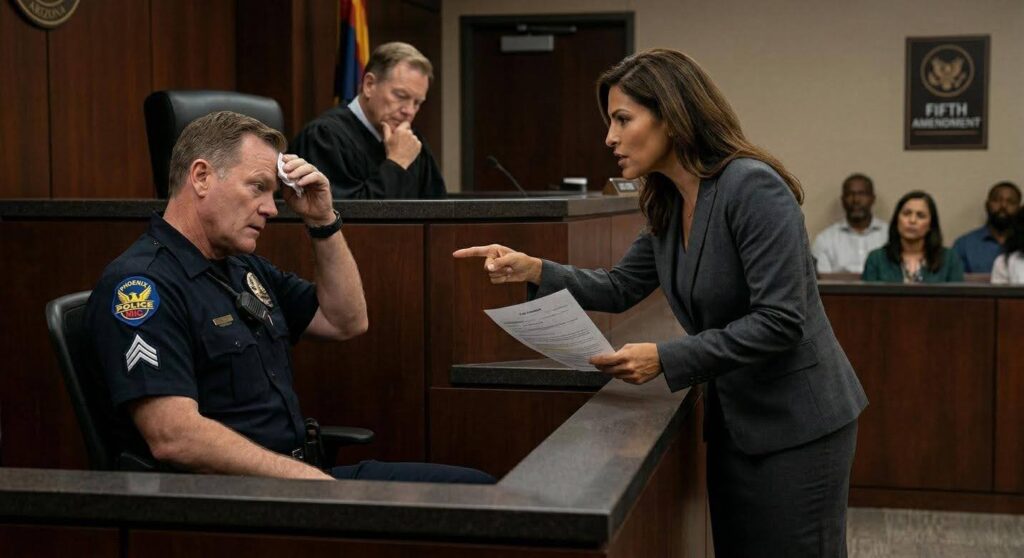
When your case does go to trial, your defense attorney becomes your voice in the courtroom. This is the role most people picture when they think of a criminal defense lawyer. Your attorney stands beside you, argues on your behalf, and fights to protect your freedom.
What Your Lawyer Does at Trial
A criminal trial involves several stages, and your defense attorney actively works on your behalf at every one of them:
- Jury selection. Your lawyer participates in choosing the jury that will hear your case. They look for jurors who will be fair and impartial, and they can challenge potential jurors who may be biased against you.
- Opening statements. Your attorney presents an overview of your defense to the jury. This sets the stage for the evidence and testimony that will follow.
- Cross-examining witnesses. When the prosecution calls witnesses, your lawyer has the right to question them. Cross-examination is a powerful tool for exposing inconsistencies, biases, or errors in the prosecution’s case.
- Presenting your defense. Your attorney calls defense witnesses, introduces evidence that supports your case, and may call expert witnesses to challenge the prosecution’s evidence.
- Closing arguments. At the end of the trial, your lawyer delivers a final argument to the jury, summarizing the evidence and explaining why the prosecution has failed to prove its case beyond a reasonable doubt.
Courtroom advocacy requires a specific set of skills. Your lawyer must be quick on their feet, persuasive, and familiar with the rules of evidence and courtroom procedure. The way your attorney presents your case to the jury can make the difference between a conviction and an acquittal.
Beyond the Trial: Hearings and Motions
Your defense lawyer also represents you at other important court proceedings, including:
- Initial appearances and arraignments. These are your first court appearances after being charged. Your lawyer ensures you understand the charges against you and enters a plea on your behalf.
- Bail hearings. Your attorney argues for your release from jail while your case is pending. They present reasons why you should be released on bail and advocate for the lowest bail amount possible.
- Pre-trial motions. Your lawyer may file motions to suppress evidence, dismiss charges, or address other legal issues before trial begins.
Sentencing hearings. If you are convicted or plead guilty, your attorney argues for the lightest possible sentence. They present mitigating factors, such as your background, character, and circumstances, to the judge.
Role 5: Guiding You Through the Criminal Justice Process

What This Guidance Looks Like
- Explaining the charges against you. Your lawyer breaks down the specific charges you are facing, what the prosecution needs to prove, and what penalties you could be looking at if convicted.
- Walking you through the court process. From your first court appearance to the final resolution of your case, your attorney explains each step so you are never caught off guard.
- Setting realistic expectations. A good defense lawyer is honest with you about the strengths and weaknesses of your case. They do not make promises they cannot keep. Instead, they give you a clear picture of your options and the likely outcomes.
- Advising you on decisions. Throughout your case, you will face important decisions: whether to accept a plea deal, whether to go to trial, whether to testify. Your lawyer helps you weigh the pros and cons of each choice so you can make informed decisions.
- Communicating with you regularly. A good defense attorney keeps you updated on the progress of your case and is available to answer your questions. You should never feel left in the dark about what is happening with your own case.
This guidance role may not seem as dramatic as arguing in court, but it’s just as important. When you understand what is going on and feel confident in the decisions you are making, you are better equipped to handle the stress and uncertainty of a criminal case.
At a Glance: 5 Roles of a Criminal Defense Lawyer
The table below summarizes the five key roles your defense attorney plays and what each one means for your case.
| Role | What Your Lawyer Does | Why It Matters |
|---|---|---|
| Protects Your Rights | Monitors law enforcement and the court to ensure your constitutional rights are respected at every stage | Prevents illegal evidence from being used against you; can lead to charges being reduced or dismissed |
| Investigates Your Case | Reviews evidence, interviews witnesses, examines the scene, and identifies weaknesses in the prosecution's case | Builds a strong, tailored defense strategy that gives you the best chance at a favorable outcome |
| Negotiates Plea Bargains | Works with the prosecutor to negotiate reduced charges, lighter sentences, or alternative sentencing | May result in significantly lower penalties; resolves your case without the risk and cost of a trial |
| Represents You in Court | Handles jury selection, cross-examines witnesses, presents evidence, and delivers opening and closing arguments | Provides skilled courtroom advocacy that can mean the difference between conviction and acquittal |
| Guides You Through the Process | Explains charges, court procedures, and your options; advises you on every key decision in your case | Reduces confusion and anxiety; empowers you to make informed decisions about your own future |
Why Hiring the Right Criminal Defense Lawyer Matters
Not all criminal defense lawyers are created equal. The attorney you choose can have a major impact on the outcome of your case. When looking for a defense lawyer in Arizona, consider the following:
- Experience with Arizona criminal law. Arizona has its own criminal statutes, sentencing guidelines, and court procedures. You need a lawyer who knows the system inside and out.
- A track record of results. Look for an attorney who has a history of getting charges reduced, cases dismissed, or favorable verdicts at trial.
- The right fit for your personality. You deserve a lawyer who approaches the practice of law in a way that resonates with you. It matters if you are looking for a shark in the courtroom or a sympathetic ear skilled at explaining every aspect of the process.
- The right fit for your case. Every criminal case is different. Make sure your attorney has experience handling cases similar to yours.
Arizona law does allow you to represent yourself, which is known as proceeding “pro se.” However, this is almost never a good idea. The criminal justice system is complex, and prosecutors are trained professionals who handle cases like yours every day. Going up against them without a skilled attorney in your corner puts you at a serious disadvantage.
Conclusion: Your Defense Lawyer Is Your Most Important Ally
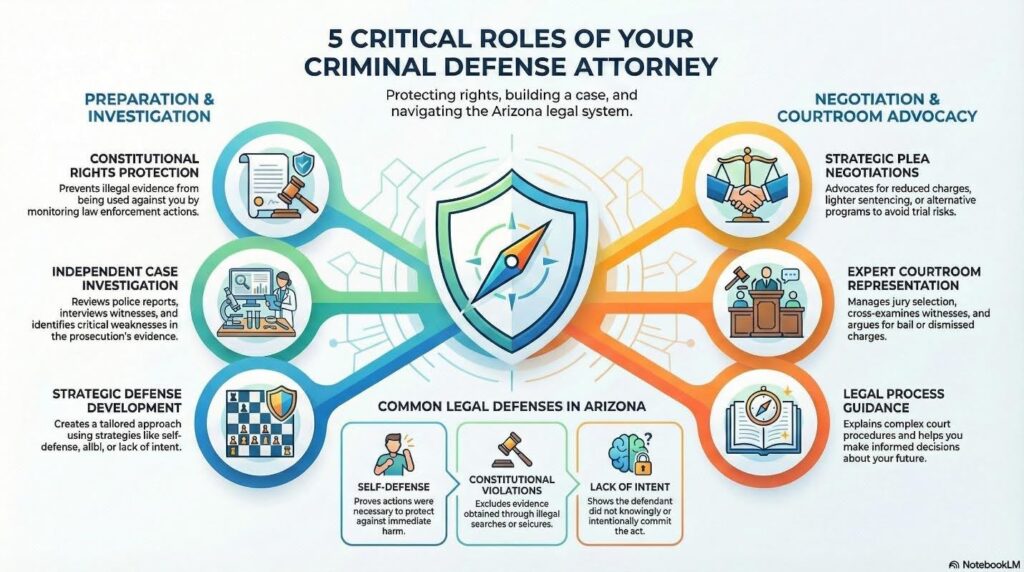
When you are facing criminal charges in Arizona, a defense lawyer is much more than someone who stands next to you in court. They are your protector, your investigator, your negotiator, your advocate, and your guide. They play five essential roles that touch every stage of your case, from the moment of your arrest to the final resolution.
Understanding these roles can help you see why hiring the right criminal defense attorney is so important for your future. The outcome of your case may depend on it. If you or someone you love has been charged with a crime in Arizona, do not wait to seek legal representation. The sooner you have a skilled defense lawyer working on your case, the better your chances of protecting your rights and achieving the best possible outcome. Lawyer Listed is dedicated to matching you with your ideal criminal defense attorney based on your needs and the requirements of your case.