
Understanding ARS Theft: ARS 13-1802
Facing theft charges under ARS 13-1802 can feel overwhelming. The legal system is complicated, and the criminal process can be confusing. Lawyer Listed provides clear information about the charge and the possible penalties, helping you understand each step of the process.
This guide breaks down Arizona theft laws in clear, straightforward language. It explains the key legal terms, walks you through the sentencing guidelines under Arizona theft laws, and answers the most common questions asked by people charged with this crime.
Remember, this information is for educational purposes only and is not a substitute for legal advice from an experienced Arizona criminal defense attorney. If you are charged with theft, let Lawyer Listed match you with your ideal criminal defense lawyer as soon as possible.
What Is ARS Theft of Property or Services?

ARS theft covers many different actions involving taking or misusing someone else’s property without their permission. Theft also includes unlawfully obtaining services. The foundation of Arizona theft laws is simple: you knowingly took control of something that didn’t belong to you without legal permission to do so.
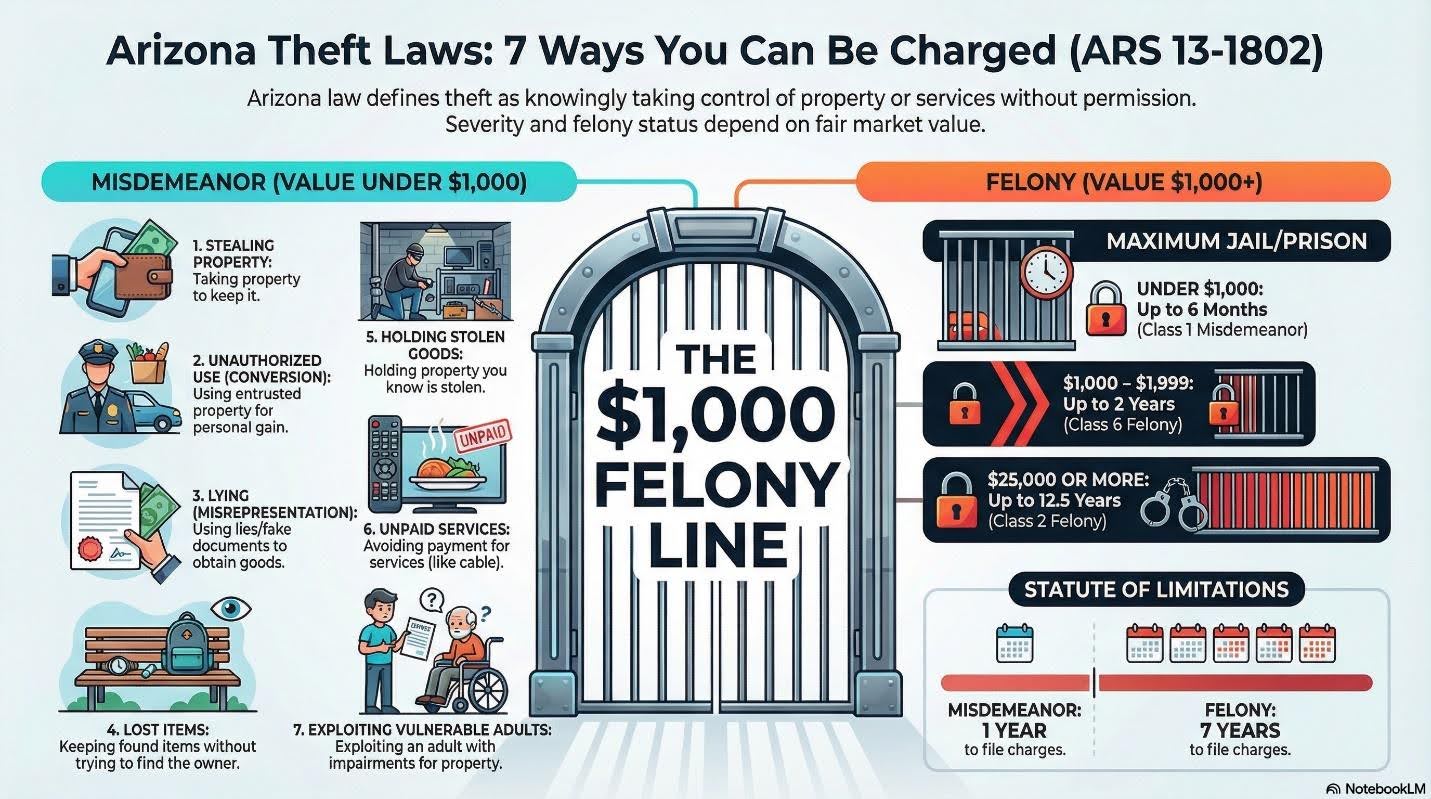
ARS 13 1802 breaks down theft into seven main categories. Each type involves a different way of unlawfully taking or using property or services:
- Controlling property with the intent to deprive: This involves taking property that isn’t yours with the intent to keep it permanently or prevent the owner from getting it back. Stealing an e‑bike from a bike rack is a straightforward example.
- Converting property or services for unauthorized use: This occurs if you are entrusted with property or services for a specific purpose but you use them for personal benefit instead. Using a company credit card to buy personal items falls into this category.
- Obtaining property or services through material misrepresentation: This means acquiring something of value by lying about important facts. Creating fake documents to obtain money, property, or services you’re not entitled to is a common example.
- Coming into possession of lost or mislaid property: Keeping property you find without making reasonable efforts to return it can be treated as theft. For instance, picking up a wallet outside a store and leaving with it without trying to locate the owner may lead to criminal liability.
- Controlling stolen property: This applies when you know or should reasonably know that the property in your possession was stolen by someone else. Holding stolen car parts for a friend who plans to sell them is a common example.
- Obtaining services without paying: This involves receiving services that normally require payment and intentionally avoiding paying for them. Illegally accessing cable or internet service is a typical example.
- Theft from vulnerable adults: This form of theft occurs if you are in a position of trust and you take advantage of a vulnerable adult’s property. Manipulating an elderly relative into giving an expensive gift they otherwise would not have given is one example.
Key Concepts of Theft
- Intentionally / With intent to: Acting with the objective of causing a specific result or engaging in particular conduct. In plain terms, you meant to do it.
- Knowingly: You are aware of your actions or the circumstances that make up the offense. Knowingly does not require that you know your conduct is illegal; you just need to be conscious of what you are doing or the situation you are in.
- Control or exercise control: Acting in a way that prevents others from using their property unless they do so under the terms set by the person exercising control.
- Deprive:
- Keep someone from their property either permanently or for so long that they lose a significant part of its value, usefulness, or enjoyment;
- Hold someone’s property with the plan to return it only if they pay a reward or other compensation; or
- Get rid of someone’s property in a way that makes it unlikely the owner will ever get it back.
- Material misrepresentation: A false promise, statement, or act about something in the past, present, or future that is made fraudulently and plays a key role in causing someone to wrongfully give up control of their property or services.
- Property: Anything that has value, whether it’s a physical object or something intangible, such as information or trade secrets.
- Services: Work or benefits provided to someone else. This includes labor, professional work, transportation, cable or video services, computer or communication services, gas or electricity, hotel or restaurant accommodations, and rental of living or business space. It also includes admission to events or exhibitions and the use of vehicles or other movable property.
- Value: The fair market value of property or services at the time of the theft.
Arizona Statute of Limitations for ARS Theft
The statute of limitations is the deadline for filing criminal charges. For misdemeanor theft, prosecutors must file the case within one year of the incident. For felony theft, prosecutors have up to seven years from the date of the offense.
Sentencing for ARS Theft

The penalties for theft are serious and vary significantly based on several factors, including the specific charge against you, your criminal history, and the circumstances surrounding the crime. The most important factor determining the severity of your theft charge is the value of the stolen goods or services. The higher the value of what was stolen, the more serious the charge and the harsher the potential punishment.
The following table shows the range of theft offenses and their potential penalties:
| Class | Elements of Offense | Jail/Prison | Probation (max) |
|---|---|---|---|
| Class 1 Misdemeanor | Shoplifting property value of less than $1,000. | Jail: up to 6 months | 3 years |
| Class 6 Felony | Shoplifting property value between $1,000 and $1,999. | Prison: 4 months – 2 years | 3 years |
| Class 5 Felony |
Shoplifting property value of $2,000 or more. Shoplifting as part of a continuing criminal episode. Shoplifting to assist a gang or criminal syndicate. |
Prison: 6 months – 2.5 years | 3 years |
| Class 4 Felony |
Shoplifting using an artifice, instrument, device, or container. Shoplifting with two or more prior theft-related offenses or convictions. |
Prison: 1 – 3.75 years | 4 years |
Frequently Asked Questions (FAQs)

A: Under Arizona law, theft is defined as knowingly taking or controlling another person's property or services with the intent to deprive them of it. This broad definition includes many scenarios, but the key element is that you knew the property wasn't yours and you took or kept control of it anyway.
A: Under Arizona law, a vulnerable adult is any person who is 18 or older and unable to protect themselves from abuse, neglect, or exploitation because of a physical or mental impairment. This can include elderly adults with dementia, individuals with developmental disabilities, people with serious mental illness, and adults with physical limitations that prevent them from safeguarding their own interests. Theft involving a vulnerable adult is treated especially seriously in Arizona and can lead to enhanced penalties.
A: In Arizona, theft becomes a felony when the value of the property or services involved is $1,000 or more. Anything under $1,000 is generally charged as a misdemeanor. This threshold matters because felony convictions carry far more serious consequences than misdemeanors.
A: Arizona courts use several factors to determine the value of stolen property. The primary measure is the item’s fair market value—essentially, what a willing buyer would pay a willing seller for the item in its condition at the time of the theft. Courts may also consider the replacement cost, the original purchase price, and any damage the item sustained during the incident. When the case involves stolen services rather than physical property, the court looks to the usual cost of those services. The prosecution must prove the value of the property or services beyond a reasonable doubt, and the defense can challenge the accuracy of that valuation.
A: In Arizona, the statute of limitations for prosecuting theft depends on how the offense is classified. If the charge is filed as a misdemeanor, the State must bring the case within one year from the incident. If the charge is filed as a felony, the State has up to seven years to start the case. After these time limits pass, the State is generally not allowed to file criminal charges for that offense.
A: To find the right lawyer for your case, follow these steps: schedule consultations, verify they are licensed and in good standing with the bar, research their experience, check their specialization, consult with other lawyers about their reputation, read client reviews, and ensure you feel comfortable with them.
Don’t worry if this seems overwhelming; Lawyer Listed has already done the work for you and is ready to match you with an elite lawyer tailored to your needs and your case.
Key Takeaways:
- Definition: Theft, under ARS 13-1802, is a crime that involves taking, controlling, or misusing another person’s property or services without their consent or legal authority. The key element is that you knowingly acted without permission.
- Categories of theft (with simple examples):
- Controlling property with the intent to deprive: Stealing an e‑bike.
- Converting property or services for unauthorized use: Misusing a company credit card.
- Obtaining property or services through material misrepresentation: Creating false documents to obtain money or goods.
- Coming into possession of lost or mislaid property: Finding a wallet and keeping it instead of trying to return it.
- Controlling stolen property: Holding stolen car parts for someone else.
- Obtaining services without paying: Illegally accessing cable or internet services.
- Theft from vulnerable adults: Manipulating an elderly relative into giving you an expensive gift.
- Sentencing: Penalties for ARS theft vary based on the value of the stolen property or service.
- Misdemeanor theft: Stealing property or services with a value of less than $1,000 is a Class 1 misdemeanor. This carries up to six months in jail and up to three years of probation.
- Felony theft: Stealing property or services with a value of $1,000 or more. Felony theft can range from a Class 6 felony ($1,000 – $1,999) to a Class 2 felony ($25,000 or more). Prison sentences range from a minimum of four months for a Class 6 felony up to 12.5 years for a Class 2 felony.
- Statute of limitations: The statute of limitations for theft is 1 year for misdemeanor offenses and 7 years for felony offenses.
Next Steps:

Theft is a serious criminal allegation with consequences that can affect the rest of your life. Outcomes depend on many factors. Lawyer Listed meets you where you are and helps you understand the law and your rights.
If you are facing theft charges under Arizona theft laws, engaging a skilled criminal defense attorney is important to protect your rights and manage the process. Don’t try navigating the legal system alone; match with your ideal lawyer at LawyerListed.com and get an experienced criminal defense lawyer on your side right away.