
Understanding ARS Extortion: ARS 13-1804
Facing extortion charges under ARS 13-1804 can feel overwhelming and frightening. The legal system is complicated, and the process can seem confusing. Lawyer Listed provides clear information about the charge and the possible penalties, helping you understand each step of the process.
This guide breaks down the Arizona extortion law in clear, straightforward language. It explains the key legal terms, walks you through the sentencing guidelines for extortion Arizona charges, and answers the most common questions asked by people charged with this crime.
Remember, this information is for educational purposes only and is not a substitute for legal advice from an experienced Arizona criminal defense attorney. If you are charged with extortion, let Lawyer Listed match you with your ideal criminal defense lawyer as soon as possible.
What Is ARS Extortion?

ARS extortion is theft by threat. Under ARS 13-1804, extortion happens when someone knowingly obtains or tries to obtain property or services from another person by making threats against them. The law defines extortion broadly, which means many different types of threatening behavior can lead to criminal liability.
The crime is the threat itself. In other words, you can be charged with extortion in Arizona even if you never carry out the threat you made.
Arizona’s extortion law identifies several specific types of threats that can lead to criminal charges when they are used to obtain property or services you have no legal right to:
Threats Involving Weapons or Serious Harm:
- Threats with Deadly Weapons or Dangerous Instruments: Threatening to hurt someone by using a deadly weapon or dangerous instrument.
- Threats of Death or Serious Physical Injury: Threatening to kill someone or cause another person serious physical injury.
- Threats of Physical Injury: Threatening to cause any type of physical injury to another person.
Threats Involving Property and Reputation:
- Threats of Property Damage: Threatening to damage or destroy someone’s property.
- False Accusations and Criminal Charges: Threatening to falsely accuse someone of committing a crime or to file false criminal charges against them.
- Threats of Reputation Damage: Threatening to reveal secrets or make statements, whether true or false, that would harm someone’s reputation, expose them to hatred or ridicule, or damage their credit or business reputation.
Threats Involving Official Actions and Property:
- Threats of Official Action: Threatening to take or refuse to take official action as a public servant or threatening to make another public servant do the same on your behalf.
- Threats of Property Seizure: Threatening to force someone to give up their property. This broad category can cover many different situations involving the property of another person.
Key Concepts of Extortion
- Knowingly: You are aware of your actions or the circumstances that make up the offense. Knowingly does not require that you know your conduct is illegal; you just need to be conscious of what you are doing or the situation you are in.
- Dangerous instrument: Anything that, under the circumstances in which it is used, attempted to be used, or threatened to be used, is readily capable of causing death or serious physical injury.
- Deadly weapon: Anything designed for lethal use, including a firearm.
- Deprive:
- Keep someone from their property either permanently or for so long that they lose a significant part of its value, usefulness, or enjoyment;
- Hold someone’s property with the plan to return it only if they pay a reward or other compensation; or
- Get rid of someone’s property in a way that makes it unlikely the owner will ever get it back.
- Physical injury: The impairment of physical condition.
- Serious physical injury: Physical injury that creates a reasonable risk of death, or that causes serious and permanent disfigurement, serious impairment of health, or loss or protracted impairment of the function of any bodily organ or limb.
- Property: Anything that has value, whether it’s a physical object or something intangible, such as information or trade secrets.
- Services: Work or benefits provided to someone else. This includes labor, professional work, transportation, cable or video services, computer or communication services, gas or electricity, hotel or restaurant accommodations, rental of living or business space, admission to events or exhibitions, and the use of vehicles or other movable property.
- Fair market value: The price the property would most likely sell for on the date of the alleged theft, after subtracting any liens or other debts tied to it. This assumes the property was on the market for a reasonable amount of time, the buyer and seller understood the deal, each was acting in their own best interest, and neither one was pressured or forced into the sale.
Arizona Statute of Limitations for Extortion
The statute of limitations is the deadline for filing criminal charges after an alleged offense. For extortion, prosecutors generally have up to seven years from the date of the alleged offense to bring charges.
Sentencing under the ARS Extortion Law

The penalty for extortion is substantial and can have long‑lasting effects. Sentences for ARS extortion vary significantly depending on what type of threat was made. Arizona law classifies extortion charges as either Class 2 or Class 4 felonies based on the nature of the threat.
Class 2 Felony Extortion: You will face a Class 2 felony charge if your threat involved either:
- The use of a deadly weapon or dangerous instrument
- Causing death or serious physical injury to another person
Class 4 Felony Extortion: You will face a Class 4 felony charge if your threat involved any of the other types listed under Arizona extortion law—threats that do not involve weapons, death, or serious physical injury.
| Offense | Charge | Prison | Probation (max) |
|---|---|---|---|
| Extortion: Deadly weapon, dangerous instrument, death, or serious physical injury | Class 2 felony | 3 – 12.5 years | 7 years |
| Extortion: Threats not involving death, serious physical injury, or weapons | Class 4 felony | 1 – 3.75 years | 4 years |
Frequently Asked Questions (FAQs)

A: Theft by extortion happens when a person uses threats to obtain, or attempt to obtain, someone else’s property or services. The threat must involve doing something harmful in the future, such as causing physical injury, damaging property, committing another crime, accusing someone of a crime, exposing a secret, or taking or withholding action as a public servant. The core idea is that the person uses intimidation—not force—to get something of value they are not entitled to.
A: Yes. The specific threat you make determines whether you’re charged with a Class 2 or Class 4 felony. Most extortion cases in Arizona are charged as Class 4 felonies. However, if the threat involves causing physical injury with a deadly weapon or dangerous instrument, or causing death or serious physical injury, the charge increases to a Class 2 felony, which carries much harsher penalties.
A: A deadly weapon is an object specifically designed to cause death. Firearms, combat knives, and similar items fall into this category because their design and intended purpose make them inherently lethal.
A dangerous instrument is broader. It refers to any object that, in the way it is used or threatened to be used, is capable of causing death or serious injury. Unlike a deadly weapon, this classification depends on the circumstances. For example, a baseball bat is normally a sporting item, but it becomes a dangerous instrument if used to strike someone. The same applies to vehicles, tools, bottles, or virtually any object used as a weapon.
A: Yes. Under ARS 13‑1804, extortion is complete the moment you make the threat. You do not have to follow through on the threat, and you do not have to actually obtain property or services. If you make a threat with the intent to get something of value, that alone is enough for criminal charges.
A: Yes. Arizona’s extortion law applies to threats made through any form of communication. That includes text messages, emails, social media posts, direct messages, online chat apps, and phone calls. The way the threat is delivered doesn’t matter—what matters is whether you used a threat to try to obtain property or services from someone.
A: In Arizona, prosecutors have seven years to initiate criminal charges for extortion. This means that if more than seven years have passed since the alleged offense, the State is typically prohibited from bringing charges.
A: To find the right lawyer for your case, follow these steps: schedule consultations, verify they are licensed and in good standing with the bar, research their experience, check their specialization, consult with other lawyers about their reputation, read client reviews, and ensure you feel comfortable with them.
Don’t worry if this seems overwhelming; Lawyer Listed has already done the work for you and is ready to match you with an elite lawyer tailored to your needs and your case.
Key Takeaways:
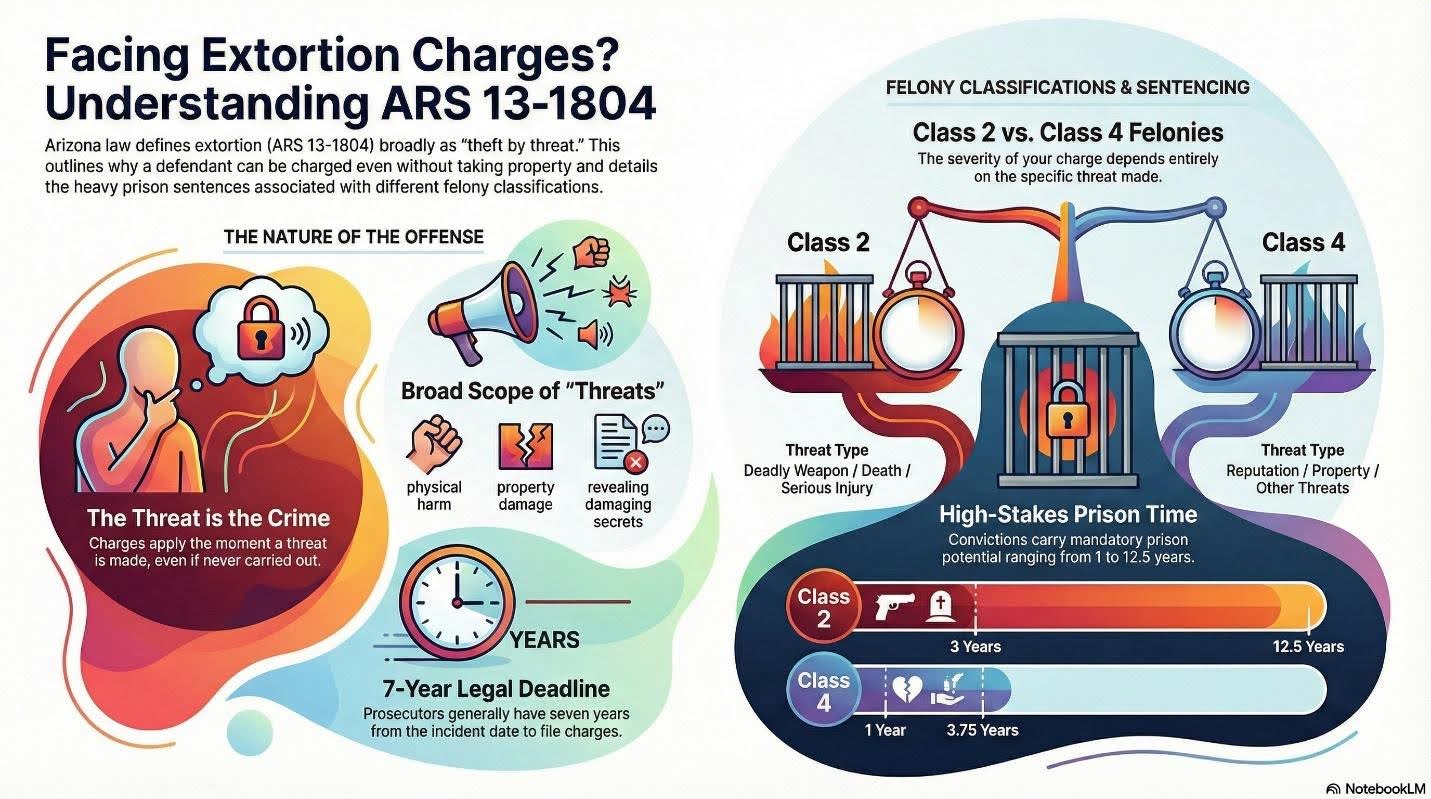
- Definition: Under ARS 13‑1804, extortion means obtaining or attempting to obtain property or services by making threats against another person. The offense is complete once the threat is made. You can be charged even if you never follow through and never receive anything of value.
- Threats that lead to extortion charges:
- Deadly Weapon/Dangerous Instrument: Threatening to cause injury using any weapon or instrument capable of causing serious harm.
- Death/Serious Physical Injury: Threatening to kill someone or cause them severe bodily harm.
- Physical Injury: Threatening to cause any level of physical harm to another person
- Property Damage: Threatening to damage or destroy someone’s property.
- False Accusations/Criminal Charges: Threatening to make false accusations or file false criminal charges against someone.
- Reputation Damage: Threatening to expose secrets, spread rumors, or make statements (true or false) that would damage someone’s reputation, business standing, or credit.
- Official Action: Threatening to take or refuse to take official action as a public servant, or to influence a public servant to do so.
- Property Seizure: Threatening to force someone to surrender their property.
- Sentencing: Extortion carries different penalties depending on the circumstances of the crime.
- Extortion – threats involving weapons, dangerous instruments, killing, or serious physical injury: Classified as a Class 2 felony with a potential prison sentence ranging from 3 to 12.5 years and/or up to 7 years of probation.
- Extortion – threats not involving weapons, dangerous instruments, killing or serious physical injury: Classified as a Class 4 felony with a prison sentence between 1 and 3.75 years and/or up to 4 years of probation.
- Statute of limitations: The statute of limitations for extortion is seven years from the date of the offense.
Next Steps:

Extortion under ARS 13 1804 is a serious criminal charge that can have life-changing consequences. The specific charges you face and the potential sentence if you’re convicted depend on many factors, including the exact nature of the threats you made, your criminal history, and the circumstances surrounding the incident.
If you’re facing extortion Arizona charges, engaging a skilled criminal defense attorney is important to protect your rights and manage the process. Don’t try navigating the legal system alone; match with your ideal lawyer at LawyerListed.com and get an experienced criminal defense lawyer on your side right away.