
Understanding ARS Criminal Damage: ARS 13-1602
Facing criminal damage charges can be overwhelming. The legal system is complicated, and the criminal process can be confusing. Lawyer Listed provides clear information about the charges and the possible penalties, helping you understand each step of the process.
This guide breaks down criminal damage ARS charges in clear, straightforward language. It explains the key legal terms, walks you through the sentencing guidelines under Arizona criminal damage laws, and answers the most common questions asked by people charged with this crime.
Remember, this information is for educational purposes only and is not a substitute for legal advice from an experienced Arizona criminal defense attorney. If you are charged with criminal damage in Arizona, let Lawyer Listed match you with your ideal criminal defense lawyer as soon as possible.
What Is ARS Criminal Damage?

Criminal Damage: ARS 13-1602
The criminal damage ARS statute covers several different types of prohibited conduct, and any of these actions—when done without the owner’s permission—can qualify as a violation of ARS 13‑1602:
- Property Damage or Defacement: Recklessly damaging or defacing someone else’s property. This is the most typical form of criminal damage, and the law allows charges even when the damage is small and seemingly insignificant.
- Property Tampering: Recklessly tampering with property in a way that reduces how well it works or what it’s worth. This covers actions that don’t leave visible damage but still make the property less useful or valuable. For example, breaking an important part of a machine without leaving obvious marks would fall under this category.
- Utility Damage: Recklessly damaging property owned by a utility company. This could mean vandalizing power lines, water pipes, or gas lines. These actions often lead to harsher penalties because they can affect public services and safety.
- Obstructing Access: Recklessly blocking a passageway or preventing livestock from reaching their only water source. This shows how criminal damage can hurt others beyond just property loss.
- Unauthorized Markings: Recklessly drawing or writing messages, slogans, or symbols on public or private buildings or structures without the owner’s permission (not including the ground). This usually refers to graffiti.
- Intentional Utility Tampering: Intentionally tampering with utility property. This includes more than just damage. Connecting an extension cord to an outdoor electrical box owned by the utility company to get electricity without it being recorded on your meter counts as tampering with a utility company under Arizona law.
The severity of the criminal damage charge under ARS 13-1602 depends on how much damage was caused and the circumstances surrounding the crime.
Aggravated Criminal Damage: ARS 13-1604
Aggravated criminal damage, defined in ARS 13-1604, involves intentionally or recklessly damaging specific types of property without permission, including:
- Places of Worship: Damaging property used for religious purposes. For example, throwing a rock through a church’s stained‑glass window would qualify because it harms property used for worship.
- Educational Facilities: Damaging schools or educational buildings. An example would be spray‑painting graffiti on the exterior walls of a public school after hours.
- Cemeteries and Mortuaries: Damaging cemeteries, mortuaries, or personal property connected to burial or memorialization. For instance, knocking over several headstones while driving through a cemetery would fall under this category.
- Infrastructure Targeting: Damaging utility or agricultural infrastructure, construction sites, or existing structures to steal non-ferrous metals. An example would be destroying a construction site gate in order to remove copper wiring from an unfinished building.
Damage Calculations
In Arizona, the amount of property damage plays a major role in determining how serious the criminal damage charge is. The law sets different levels of punishment based on the dollar value of the damage caused. The State must prove both the amount of damage and how that amount was calculated. There is not a single required formula, but courts follow some well‑established principles to keep things fair and consistent.
How Damage Is Measured
When property can be repaired, the damage amount is usually based on the reasonable cost of fixing or restoring it. If the property is destroyed—or if repairs would cost more than the item was worth—the law instead uses the fair market value of the property right before the damage, or a reasonable replacement value when market value can’t be determined. The goal is to measure the victim’s actual loss, not to inflate the amount with unrelated or unnecessary expenses.
A few examples of acceptable evidence include:
- Testimony from the property owner or someone familiar with repair costs
- Expert opinions or written repair estimates
- Insurance payment records
When Damage Can Be Added Together
Arizona law allows the State to combine damage amounts when the harm arises from one plan or a continuous course of conduct. In practical terms, if multiple items—or even multiple victims—were affected during the same overall incident, the State can add all of the damage together. This combined total can significantly increase the severity of the charge. In some cases, it can raise a misdemeanor to a felony.
What the State Must Prove
The State cannot rely on unsupported guesswork or opinions with no factual basis to prove damages. The State must prove the damage amount beyond a reasonable doubt, and the evidence must be strong enough that reasonable people would accept it as accurate. The number must reflect the true loss, not speculation or inflated costs.
Key Concepts of Criminal Damage
- Intentionally / With intent to: Acting with the objective of causing a specific result or engaging in particular conduct. In plain terms, you meant to do it.
- Recklessly: You are aware of and deliberately choose to ignore a significant and unjustifiable risk that could lead to harmful consequences. This conscious disregard must represent a substantial departure from how a reasonable person would behave under the same circumstances.
- Damage: Any physical or visual impairment of any surface.
- Defacing: Any unnecessary act that noticeably harms or marks a surface or place, or placing, attaching, or painting any notice or marking on a structure without the owner’s permission. This includes anything that alters how the surface looks in a meaningful way.
- Property of another: Property in which any person other than the defendant holds a legal interest. This includes community property and other property the defendant may also have an interest in.
- Tamper: Any act of interference.
- Tampering with a utility company: Interference with equipment that a utility company owns or operates—anything used to deliver power, water, gas, or other services. This includes damaging or changing the equipment, connecting to it without permission, defacing or removing it, or stopping a meter from recording usage. It also covers taking or using utility services without authorization, diverting the flow of those services, or helping someone else do any of these things.
- Nonferrous metals: Metals that will not normally attract a magnet, including copper, brass, and aluminum.
Arizona Statute of Limitations for ARS Criminal Damage
The statute of limitations is the deadline for filing criminal charges. For misdemeanor criminal damage, prosecutors must file the case within one year of the incident. For felony criminal damage, prosecutors generally have up to seven years from the date of the offense to file charges.
Criminal Damage ARS Sentences

The penalty for criminal damage is substantial and can have long‑lasting effects. Sentences vary based on your criminal history and the facts of the case. Understanding these consequences helps you make informed decisions about your defense.
Misdemeanor Criminal Damage
The penalties for misdemeanor criminal damage are less severe than felony charges but still carry substantial consequences.
| Misdemeanor | Crime | Jail (max) | Probation (max) |
|---|---|---|---|
| Class 2 | Damage: $1 – $250 | 4 months | 2 years |
| Class 1 | Damage: $251 – $999 | 6 months | 3 years |
Felony Criminal Damage
The penalties for felony criminal damage are severe. They depend on the class of felony and the facts of your case.
| Felony | Crime | Prison | Probation (max) |
|---|---|---|---|
| Class 6 |
Damage: $1,000 – $1,999 Damaging cemetery, educational or religious building: Damage: $1 – $1,499 |
0.33 – 2 years | 3 years |
| Class 5 |
Damage: $2,000 – $9,999 Promotion of gang or criminal syndicate Damaging cemetery, educational or religious building: Damage: $1,500 – $9,999 Damage to obtain nonferrous metals: Damage: $1 – $1,499 |
0.5 – 2.5 years | 3 years |
| Class 4 |
Damage: $10,000+ Utility damage: $5,000+ Utility damage causing imminent safety hazard Damage to obtain nonferrous metals: Damage: $1,500 – $9,999 Damaging cemetery, educational or religious building: Damage: $10,000+ |
1 – 3.75 years | 4 years |
| Class 3 |
Damage to obtain nonferrous metals: Damage: $10,000+ |
2 – 8.75 years | 5 years |
Frequently Asked Questions (FAQs)

A: Arizona law allows several types of reasonable costs to be included when calculating the total damage in a graffiti case:
- Reasonable Labor Costs: The cost of the work needed to clean, repair, or replace the damaged surface. This includes wages paid to professionals and any other necessary labor expenses.
- Reasonable Material Costs: The cost of the supplies required to fix the damage, such as paint, cleaning chemicals, replacement parts, lumber, or other materials needed to restore the property.
- Reasonable Equipment Costs: Costs for any specialized tools or equipment used during the cleanup or repair process. This applies when the job requires equipment that is expensive, specialized, or not normally available.
A: Yes. Under Arizona law, you can be charged with criminal damage even if you didn’t mean to cause any harm. The key issue is whether you acted recklessly, meaning you ignored obvious risks that a reasonable person would have taken seriously. If your actions created a real chance of damaging someone else’s property, the State can still file charges even without proof that you intended the damage.
A: Criminal damage applies to most situations where someone’s property is damaged. Aggravated criminal damage is more serious because it involves damaging certain protected types of property, like places of worship, schools, cemeteries, or utility infrastructure. Because these locations are considered especially important or sensitive, the penalties are higher when they are damaged.
A: In Arizona, a utility company includes any public or private provider of services like gas, electricity, irrigation, steam, water, water‑conservation services, sewer, or communications. It also covers common carriers, such as transportation companies operating on land, rail, sea, or air.
A: In Arizona, the statute of limitations depends on the criminal damage charge. For misdemeanor criminal damage, the State generally has one year from the incident to file charges. For felony criminal damage, the State usually has up to seven years to start the case.
A: To find the right lawyer for your case, follow these steps: schedule consultations, verify they are licensed and in good standing with the bar, research their experience, check their specialization, consult with other lawyers about their reputation, read client reviews, and ensure you feel comfortable with them.
Don’t worry if this seems overwhelming; Lawyer Listed has already done the work for you and is ready to match you with an elite lawyer tailored to your needs and your case.
Key Takeaways:
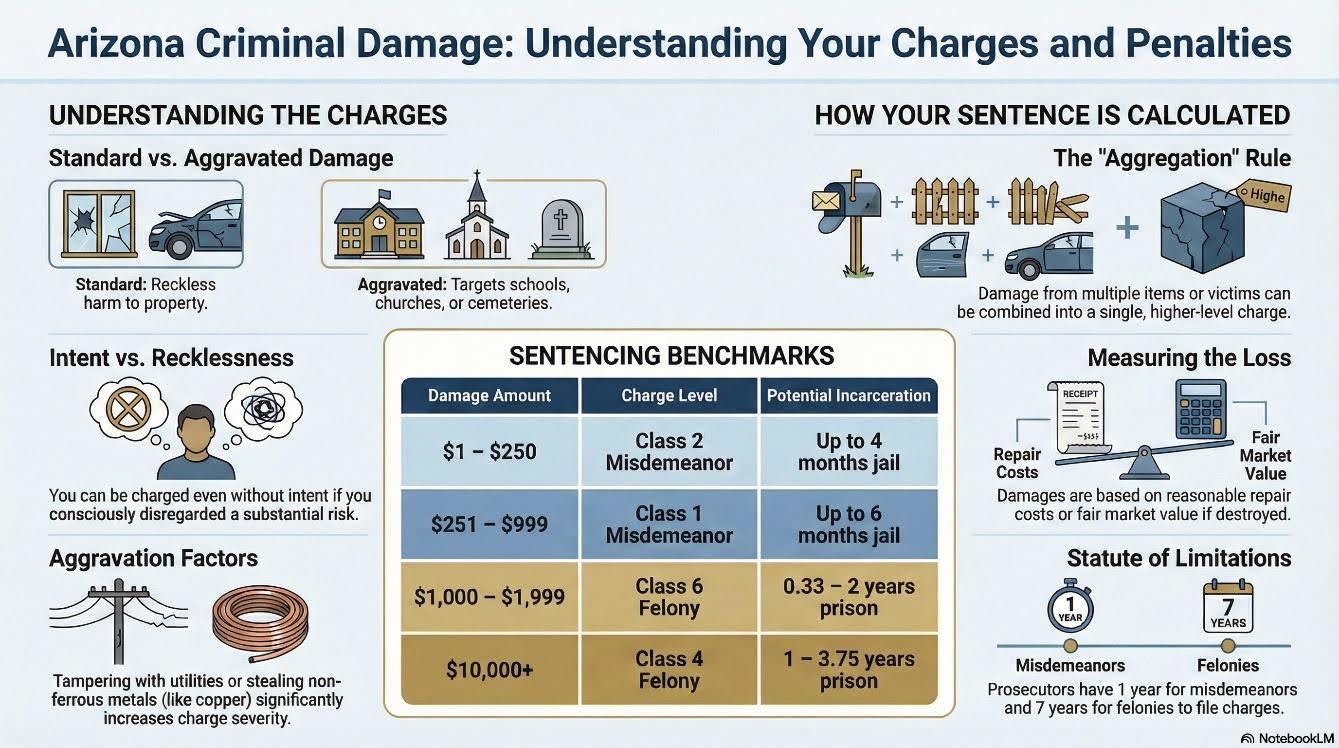
- Definition: Criminal damage in Arizona means recklessly or intentionally harming someone else’s property in a way that reduces its value, usefulness, or appearance. This can include breaking, defacing, tampering with, or otherwise interfering with property. The severity of the charge depends on how much damage was done and, in some cases, what type of property was damaged.
- Value determination:
- Repair costs: When repairs are reasonable, the damage amount is based on the reasonable cost to fix or restore the property.
- Fair market value: If the property is destroyed—or if repairs would cost more than the item was worth—the law uses the fair market value of the property right before the damage.
- Evidence requirements: The State must prove the damage amount with reliable evidence, such as repair estimates, expert opinions, or insurance records. Unsupported guesses or inflated numbers are not enough.
- Combining damages: If multiple items or multiple victims were affected as part of one plan or a continuous course of conduct, Arizona law allows the State to add all the damage together.
- Sentencing: The value of the damage determines whether the charge is a misdemeanor or a felony. Small amounts stay in misdemeanor territory, but higher amounts quickly become felonies with much harsher penalties.
- Damage: $1 – $250
- Class 2 misdemeanor
- Jail: up to 4 months
- Probation: up to 2 years
- Damage: $251 – $999
- Class 1 misdemeanor
- Jail: up to 6 months
- Probation: up to 3 years
- Damage: $1,000 – $1,999
- Class 6 felony
- Prison: 4 months – 2 years
- Probation: up to 3 years
- Damage: $2,000 – $9,999
- Class 5 felony
- Prison: 6 months – 2.5 years
- Probation: up to 3 years
- Damage: $10,000+
- Class 4 felony
- Prison: 1 – 3.75 years
- Probation: up to 4 years
- Damage: $1 – $250
- Statute of limitations: The statute of limitations for criminal damage is 1 year for misdemeanor offenses and 7 years for felony offenses.
Next Steps:

Criminal Damage is a serious criminal allegation with consequences that can affect the rest of your life. Outcomes depend on many factors. Lawyer Listed meets you where you are and helps you understand the law and your rights.
If you’re facing Arizona criminal damage charges, engaging a skilled criminal defense attorney is important to protect your rights and manage the process. Don’t try navigating the legal system alone; match with your ideal lawyer at LawyerListed.com and get an experienced criminal defense lawyer on your side right away.