
Understanding ARS Burglary: ARS 13-1506 | ARS 13-1507 | ARS 13-1508
Facing burglary charges can be overwhelming. The legal system is complicated, and the criminal process can be confusing. Lawyer Listed provides clear information about the charge and the possible penalties, helping you understand each step of the process.
This comprehensive guide breaks down everything you need to know about Arizona burglary laws in clear, simple language. Whether you’re charged with first-degree, second-degree, or third-degree burglary, this resource will help you understand your charges.
What You Will Learn in This Guide
This guide provides a complete overview of burglary ARS laws in Arizona, including:
- Burglary 1st Degree (ARS 13-1508)
- Burglary 2nd Degree (ARS 13-1507)
- Burglary 3rd Degree (ARS 13-1506)
Along with explaining these charges, this guide will help you understand important legal terms, sentencing ranges for each type of burglary in Arizona, and answer common questions people ask about burglary charges.
Remember, this information is for educational purposes only and is not a substitute for legal advice from an experienced Arizona criminal defense attorney. If you are charged with burglary in Arizona, let Lawyer Listed match you with your ideal criminal defense lawyer as soon as possible.
What Is ARS Burglary?

Arizona law defines burglary as unlawfully entering or staying in a structure or on property when you intend to commit theft or any other felony crime while there. Breaking and entering Arizona laws divide burglary into different levels, or degrees, based on the facts of the crime.
Arizona burglary law doesn’t require that you actually steal anything or complete another felony. What matters is your intent when you unlawfully entered or remained in a building or on a property. In other words, burglary in Arizona is based on what you planned to do, not what you ultimately did. If it is proven that you intended to steal or commit a felony while you were unlawfully in a building or on a property—even if you were interrupted, changed your mind, or were caught before taking anything—you can still be found guilty of burglary.
ARS Burglary 3rd Degree: ARS 13-1506
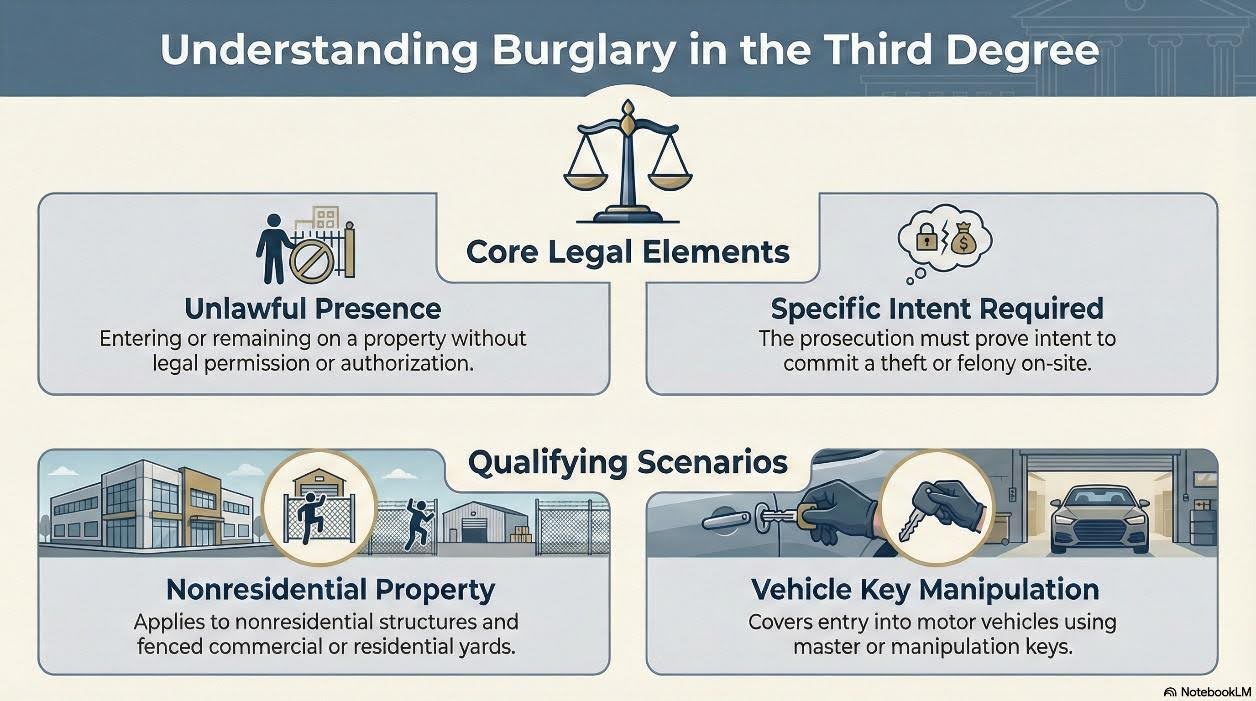
Under ARS 13‑1506, you commit third‑degree burglary when you unlawfully enter or remain in a non‑residential structure, a fenced commercial or residential yard, or a motor vehicle that you access with a manipulation or master key. These places can include storage units, garages, warehouses, enclosed yards, or vehicles.
Even though third‑degree burglary is considered the least serious of Arizona’s burglary offenses, it is still a felony, and a conviction can carry life‑changing consequences.
Elements of Burglary in the Third Degree (Nonresidential Structure): ARS 13-1506 (A)(1)
To convict you of burglary under this statute, the prosecution must prove two elements beyond a reasonable doubt:
You entered or remained unlawfully in or on a nonresidential structure, fenced commercial yard, or fenced residential yard.
You did so with the intent to commit a theft or felony while there.
Elements of Burglary in the Third Degree (Vehicles): ARS 13-1506 (A)(2)
To convict you of burglary under this statute, the prosecution must prove two elements beyond a reasonable doubt:
- You entered into a vehicle by use of a manipulation key or master key.
- You did so with the intent to commit a theft or felony while in the vehicle.
ARS Burglary 2nd Degree: ARS 13-1507
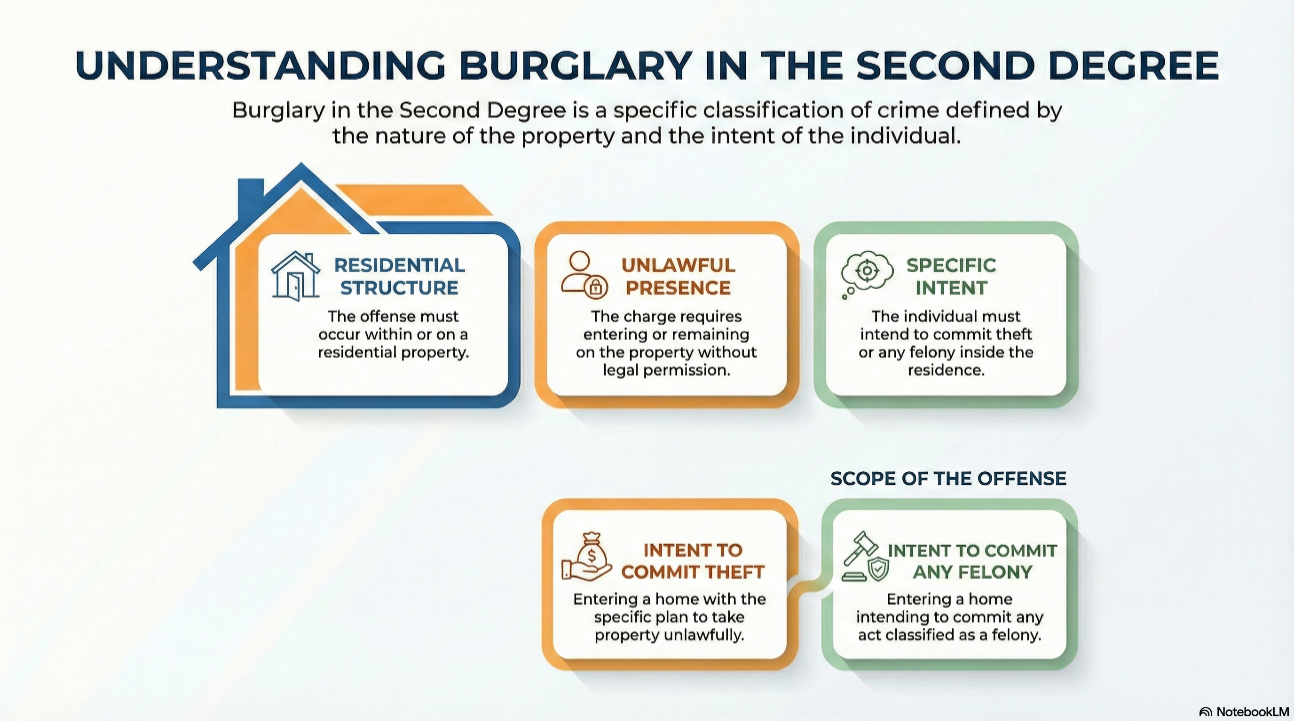
Under ARS 13‑1507, you commit second‑degree burglary if you unlawfully enter or remain inside a residential structure with the intent to commit theft or any felony. This charge is more serious than third‑degree burglary because it involves entering a place where people live. A residential structure includes houses, apartments, mobile homes, condominiums, and any other building used for living purposes.
Elements of Burglary of a Structure or Property: ARS 13-1507
To convict you of burglary under this statute, the prosecution must prove two elements beyond a reasonable doubt:
You entered or remained unlawfully in or on a residential structure.
You did so with the intent to commit a theft or felony while there.
ARS Burglary 1st Degree: ARS 13-1508
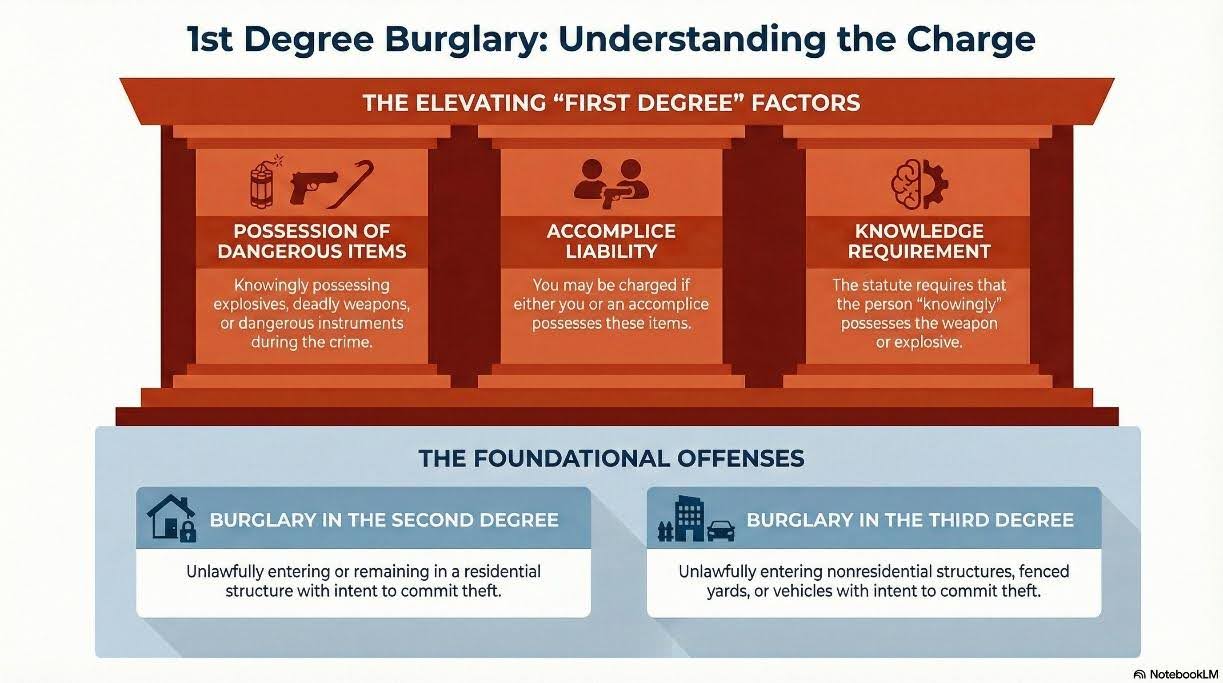
First‑degree burglary is the most serious burglary charge you can face in Arizona because it involves added dangerous elements. You commit first‑degree burglary if you commit 2nd or 3rd degree burglary and knowingly have a deadly weapon, dangerous instrument, or explosive with you during the crime.
The location of the burglary determines the felony level. If the offense happens in a home, apartment, or any other residential structure, the burglary is a Class 2 felony. This is because it combines unlawful entry into someone’s home with the presence of a weapon or explosive. If the offense involves a weapon in a non‑residential structure, fenced yard, or vehicle, the burglary is a Class 3 felony.
It is not necessary that you use the weapon during the burglary. Even if the weapon is never used or displayed, simply having it during the commission of the burglary is enough to elevate the charge to first-degree burglary under ARS 13-1508.
Elements of ARS Burglary 1st Degree: ARS 13-1508
To convict you of 1st degree burglary under this statute, the prosecution must prove three elements beyond a reasonable doubt:
You or an accomplice entered or remained unlawfully in or on a residential or non-residential structure, fenced commercial yard, fenced residential yard, or vehicle.
You or an accomplice intended to commit any theft or felony while you were there.
In the course of committing the crime, you or an accomplice knowingly possessed an explosive, deadly weapon, or dangerous instrument.
Key Concepts of Burglary
- Accomplice: A person who, with the intent to help commit an offense, encourages or directs you to commit it, assists or agrees to assist in planning or carrying it out, or provides the means or opportunity for you to commit the offense.
- Intentionally / With intent to: Acting with the objective of causing a specific result or engaging in particular conduct. In plain terms, you meant to do it.
- Knowingly: You are aware of your actions or the circumstances that make up the offense. Knowingly does not require that you know your conduct is illegal; you just need to be conscious of what you are doing or the situation you are in.
- Enter or remain unlawfully: An act of a person who enters or remains on premises when the person’s intent for so entering or remaining is not licensed, authorized, or otherwise privileged.
- Possess: Knowingly have physical possession of property or exercise control or authority over it.
- Master key: A key that operates all the keyed locks or cylinders in a similar type or group of locks.
- Manipulation key: A key, device or instrument, other than a key that is designed to operate a specific lock, that can be variably positioned and manipulated in a vehicle keyway to operate a lock or cylinder, including a wiggle key, jiggle key or rocker key.
- Residential structure: Any structure, movable or immovable, permanent or temporary, that is adapted for both human residence and lodging whether occupied or not.
- Nonresidential structure: Any structure other than a residential structure and includes a retail establishment.
- Fenced residential yard: A unit of real property that immediately surrounds or is adjacent to a residential structure and that is enclosed by a fence, wall, building or similar barrier or any combination of fences, walls, buildings or similar barriers.
- Fenced commercial yard: A unit of real property that is surrounded completely by fences, walls, buildings or similar barriers, or any combination of fences, walls, buildings or similar barriers, and that is zoned for business operations or where livestock, produce or other commercial items are located.
- In the course of committing: Any acts that are performed by an intruder from the moment of entry to and including flight from the scene of a crime.
- Deadly weapon: Anything designed for lethal use, including a firearm.
- Dangerous instrument: Anything that, under the circumstances in which it is used, attempted to be used, or threatened to be used, is readily capable of causing death or serious physical injury.
Arizona Statute of Limitations for ARS Burglary
The statute of limitations is the deadline for filing criminal charges after an alleged offense. For burglary, prosecutors generally have up to seven years from the date of the alleged offense to bring charges.
Sentencing Under Arizona Burglary Laws

The penalty for burglary is substantial and can have long‑lasting effects. Sentences vary based on your criminal history and the facts of the case. Understanding these consequences helps you make informed decisions about your defense.
| Burglary Degree | Circumstances | Felony Class | Prison | Probation (Max) |
|---|---|---|---|---|
| 1st degree (Residential) | Weapon: residential structure | Class 2 | 3 – 12.5 years | 7 years |
| 1st degree (Non-Residential) | Weapon: non-residential structure, fenced yard, vehicle | Class 3 | 2 – 8.75 years | 5 years |
| 2nd degree | Residential structure | Class 3 | 2 – 8.75 years | 5 years |
| 3rd degree | Non-residential structure, fenced yard, vehicle | Class 4 | 1 – 3.75 years | 4 years |
Frequently Asked Questions (FAQs)

A: Yes. Under Arizona law, burglary is based on your intent at the time you unlawfully entered or remained in a structure or on property. It does not depend on whether you actually stole something or completed a felony while there. You don’t have to complete a theft or commit any other felony to be convicted.
A: A residential structure is any building or dwelling used primarily as a place where people live. This includes houses, apartments, condominiums, mobile homes, townhouses, and any other structure designed or used for residential living. A structure is still considered residential even if no one is home at the time of the burglary or if the home is temporarily vacant.
A: Yes. Under Arizona law, you can be charged with third‑degree burglary if you unlawfully enter a fenced residential or commercial yard with the intent to commit theft or any felony. You do not have to go inside a building to face burglary charges. Fenced yards are treated as protected property, so entering them unlawfully with criminal intent is enough to qualify as burglary under ARS 13‑1506.
A: Yes. Arizona law defines a fence broadly to include any enclosure or barrier that surrounds a property. This includes wooden or chain‑link fences, brick or cinderblock walls, stone walls, and combinations of walls, buildings, or other barriers that form an enclosed area. If a wall or barrier encloses a yard or property and you enter that area unlawfully with the intent to commit a crime, you can be charged with burglary under Arizona law.
A: Yes. Under Arizona law, you can be charged as an accomplice even if you never entered the building or structure or personally possessed a weapon. If you helped plan the burglary, acted as a lookout, drove the getaway car, or assisted in any meaningful way, you can face the same burglary charges as the person who went inside. Arizona treats accomplices as equally responsible for the crimes they help commit, even if they weren’t physically present for every part of the offense.
A: A manipulation key is a tool that isn’t made for a specific lock but can still open it by manipulating the lock’s internal mechanisms. These tools include wiggle or jiggle keys, rocker keys, bump keys, and other devices designed to bypass standard keyways.
Under ARS 13‑1506, using a manipulation key or master key to unlawfully enter a vehicle with the intent to commit theft or any felony while in the vehicle qualifies as third‑degree burglary. This is true even if there is no damage to the vehicle.
A: Yes. Under Arizona law, a residential structure remains a residential structure whether it is occupied, temporarily vacant, between tenants, or foreclosed. This means you can face residential burglary charges for entering places like vacation homes, empty rentals, or properties that look abandoned. What matters is that the building was designed and used for people to live in, not whether anyone is currently living there.
A: In Arizona, prosecutors have seven years to initiate criminal charges for burglary. This means that if more than seven years have passed since the alleged offense, the State is typically prohibited from bringing charges.
A: To find the right lawyer for your case, follow these steps: schedule consultations, verify they are licensed and in good standing with the bar, research their experience, check their specialization, consult with other lawyers about their reputation, read client reviews, and ensure you feel comfortable with them.
Don’t worry if this seems overwhelming; Lawyer Listed has already done the work for you and is ready to match you with an elite lawyer tailored to your needs and your case.
Key Takeaways:
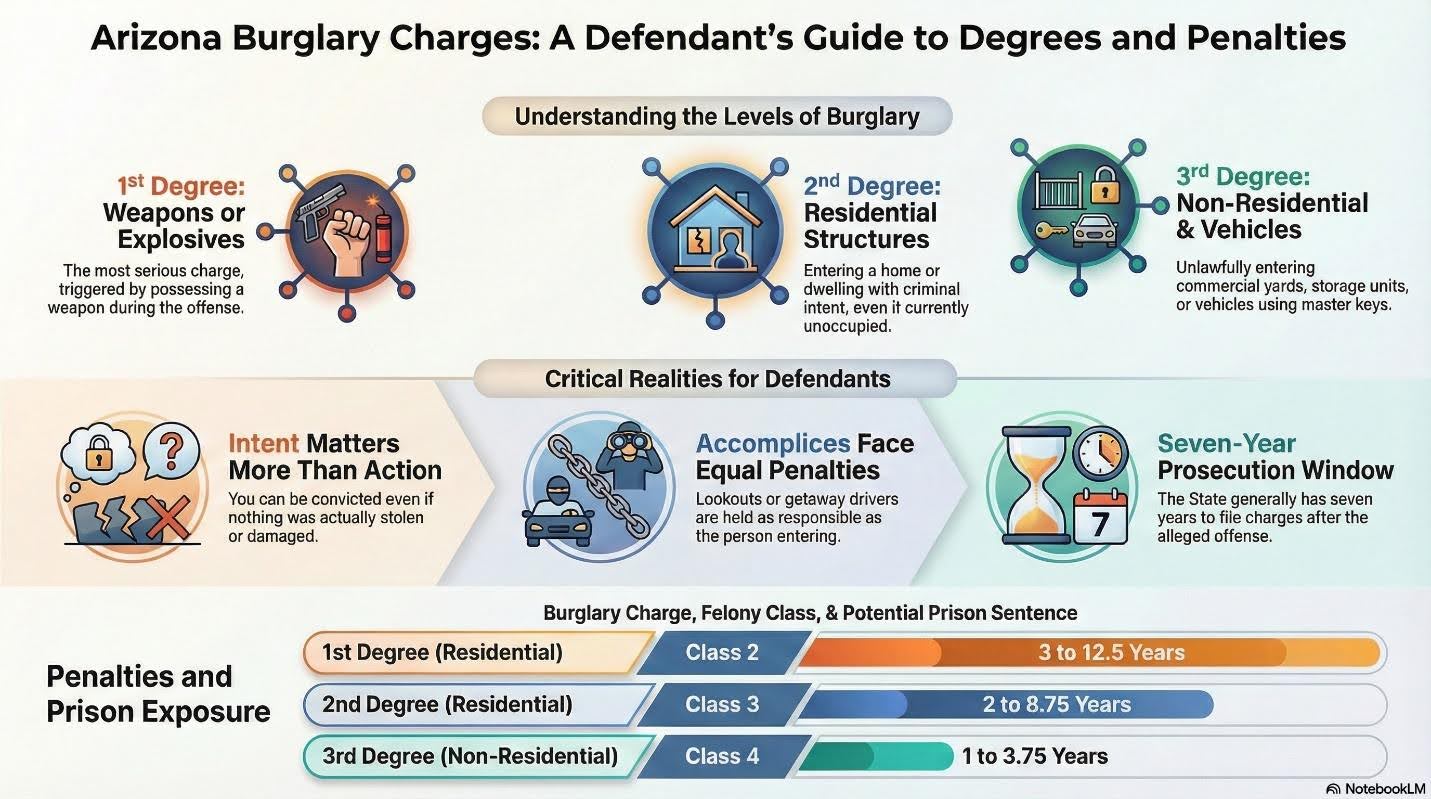
- Definition: Breaking and entering Arizona laws define burglary as unlawfully entering or remaining in a building or on property when you intend to commit theft or any other felony while you are there. The actual completion of the theft or felony is not required for a conviction.
- Different Degrees of Burglary Explained:
- ARS Burglary 1st Degree (ARS 13-1508): This involves burglary with weapons or explosives.
- Residential first-degree burglary:
- Class 2 felony
- Prison sentence: 3 to 12.5 years
- Maximum probation: 7 years
- Non-residential first-degree burglary:
- Class 3 felony
- Prison sentence: 2 to 8.75 years
- Maximum probation: 5 years
- Residential first-degree burglary:
- ARS Burglary 2nd Degree (ARS 13-1507): This involves burglary of a residential structure or home.
- Class 3 felony
- Prison sentence: 2 to 8.75 years
- Maximum probation: 5 years
- ARS Burglary 3rd Degree (ARS 13-1506): This involves burglary of non-residential structures, fenced yards, or vehicles.
- Class 4 felony
- Prison sentence: 1 to 3.75 years
- Maximum probation: 4 years
- ARS Burglary 1st Degree (ARS 13-1508): This involves burglary with weapons or explosives.
- Statute of limitations: The statute of limitations for ARS burglary is seven years from the date of the offense.
Next Steps:

Burglary is a serious criminal allegation with consequences that can affect the rest of your life. Outcomes depend on many factors. Lawyer Listed meets you where you are and helps you understand the law and your rights.
If you’re facing Arizona burglary charges, engaging a skilled criminal defense attorney is important to protect your rights and manage the process. Don’t try navigating the legal system alone; match with your ideal lawyer at LawyerListed.com and get an experienced criminal defense lawyer on your side right away.