

How Arizona classifies criminal offenses
Under Arizona law (ARS 13-601), every criminal offense falls into one of three categories: a felony, a misdemeanor, or a petty offense. The category determines how serious the state considers the crime and what penalties a judge can impose.
Felonies are the most serious. They carry potential prison sentences and are handled in Superior Court. Arizona divides felonies into six classes, with Class 1 being the most severe and Class 6 being the least severe.
Misdemeanors are less serious than felonies, but they are still criminal offenses. They are divided into three classes and are typically handled in justice, city, or municipal courts. A misdemeanor conviction can still result in jail time, fines, and a permanent criminal record.
Petty offenses are the least serious category. They do not carry jail time, but they can result in fines up to $300.
One detail that surprises many people is that a Class 6 felony can sometimes be treated as a misdemeanor. If the prosecutor agrees or the judge finds that a felony sentence would be too harsh, a Class 6 felony can be designated as a Class 1 misdemeanor either at the time of sentencing or at the conclusion of probation.
Felony penalties in Arizona
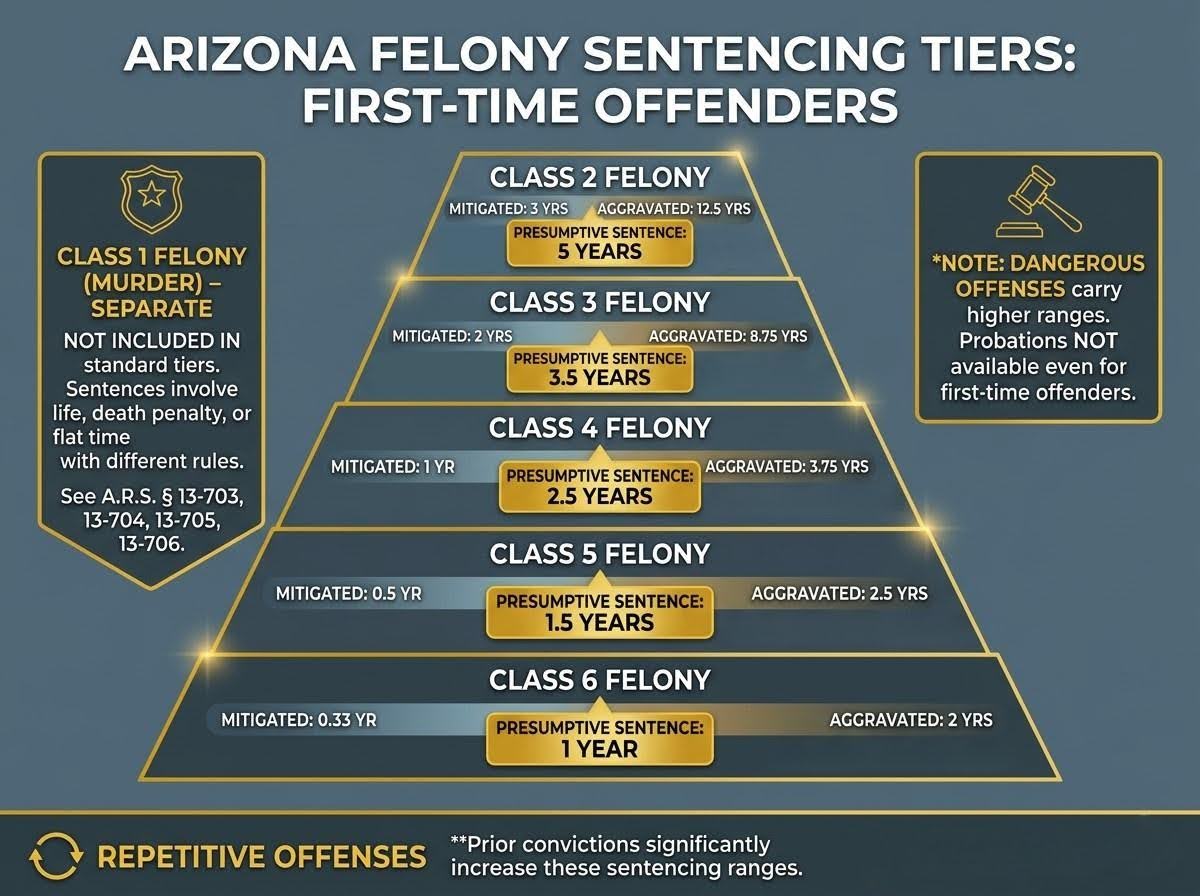
Arizona uses a structured sentencing system for felonies (ARS 13-702). For each felony class, the law sets five possible sentence lengths: mitigated, minimum, presumptive, maximum, and aggravated. The presumptive sentence is the starting point. A judge can go higher or lower based on aggravating or mitigating factors.
Class 1 felonies
Class 1 felonies are reserved for the most serious offenses. First-degree murder is punishable by life in prison or the death penalty (ARS 13-751, 13-752). Second-degree murder carries a prison range of 10 to 25 years, with a presumptive sentence of 16 years (ARS 13-710).
Class 2 through Class 6 felonies
The table below shows the sentencing ranges for first-time felony offenders convicted of non-dangerous offenses. These ranges come directly from ARS 13-702.
Class | Prison Range | Max Fine | Probation | Presumptive | Examples |
Class 2 | 3 – 12.5 yrs | Up to $150,000 | 7 years | 5 years | Manslaughter, armed robbery |
Class 3 | 2 – 8.75 yrs | Up to $150,000 | 5 years | 3.5 years | Aggravated assault, burglary |
Class 4 | 1 – 3.75 yrs | Up to $150,000 | 4 years | 2.5 years | Forgery, theft ($3K-$4K) |
Class 5 | 0.5 – 2.5 yrs | Up to $150,000 | 3 years | 1.5 years | Aggravated DV, stalking |
Class 6 | 0.33 – 2 yrs | Up to $150,000 | 3 years | 1 year | Witness tampering, criminal trespass 1st |
Fines for any felony can reach up to $150,000 per charge (ARS 13-801). Arizona also adds surcharges that can increase the total fine substantially. These surcharges are set by law and apply automatically.
If the offense involved a deadly weapon or the intentional infliction of serious physical injury, it is classified as a “dangerous” offense under ARS 13-704. Dangerous offenses carry significantly longer prison terms and are not eligible for probation.
Prior felony convictions also increase sentencing ranges. Arizona law (ARS 13-703) creates categories for repeat offenders that can more than double the presumptive sentence.
Misdemeanor penalties in Arizona
Misdemeanor penalties are set by ARS 13-707. While less severe than felonies, misdemeanors still carry real consequences. Jail time is served in a county or city jail, not state prison.
Class | Max Jail | Max Fine | Probation | Examples |
Class 1 | Up to 6 months | Up to $2,500 | 3 years | DUI, simple assault, disorderly conduct, shoplifting |
Class 2 | Up to 4 months | Up to $750 | 2 years | Reckless driving, criminal trespass 2nd, giving false name |
Class 3 | Up to 30 days | Up to $500 | 1 year | Excessive speeding, vehicle tampering, highway littering |
One rule catches many people off guard: if you are convicted of the same misdemeanor twice within two years, the second offense is automatically bumped up to the next higher class (ARS 13-707(B)). That means a repeat Class 2 misdemeanor can be sentenced as a Class 1 misdemeanor.
In addition to jail and fines, misdemeanor sentences often include probation, community service, counseling, drug testing, or driver’s license suspension. The specific conditions depend on the offense.
Probation as an alternative to prison

For many offenses, a judge can sentence a defendant to probation instead of prison or jail time (ARS 13-901). Probation means you serve your sentence in the community under court supervision. You must follow strict rules, check in with a probation officer, and meet conditions set by the judge.
Probation lengths vary by offense class (ARS 13-902). Felony probation ranges from three to seven years depending on the class. Misdemeanor probation ranges from one to three years. For certain offenses, including sex crimes and dangerous crimes against children, the court can impose lifetime probation.
Not all offenses are eligible for probation. Dangerous offenses and repeat felony convictions often carry mandatory prison time. An experienced defense attorney can tell you whether probation is a possibility in your case.
If you violate the terms of your probation, the judge can revoke it and send you to prison for the remainder of your original sentence.
What happens beyond the sentence
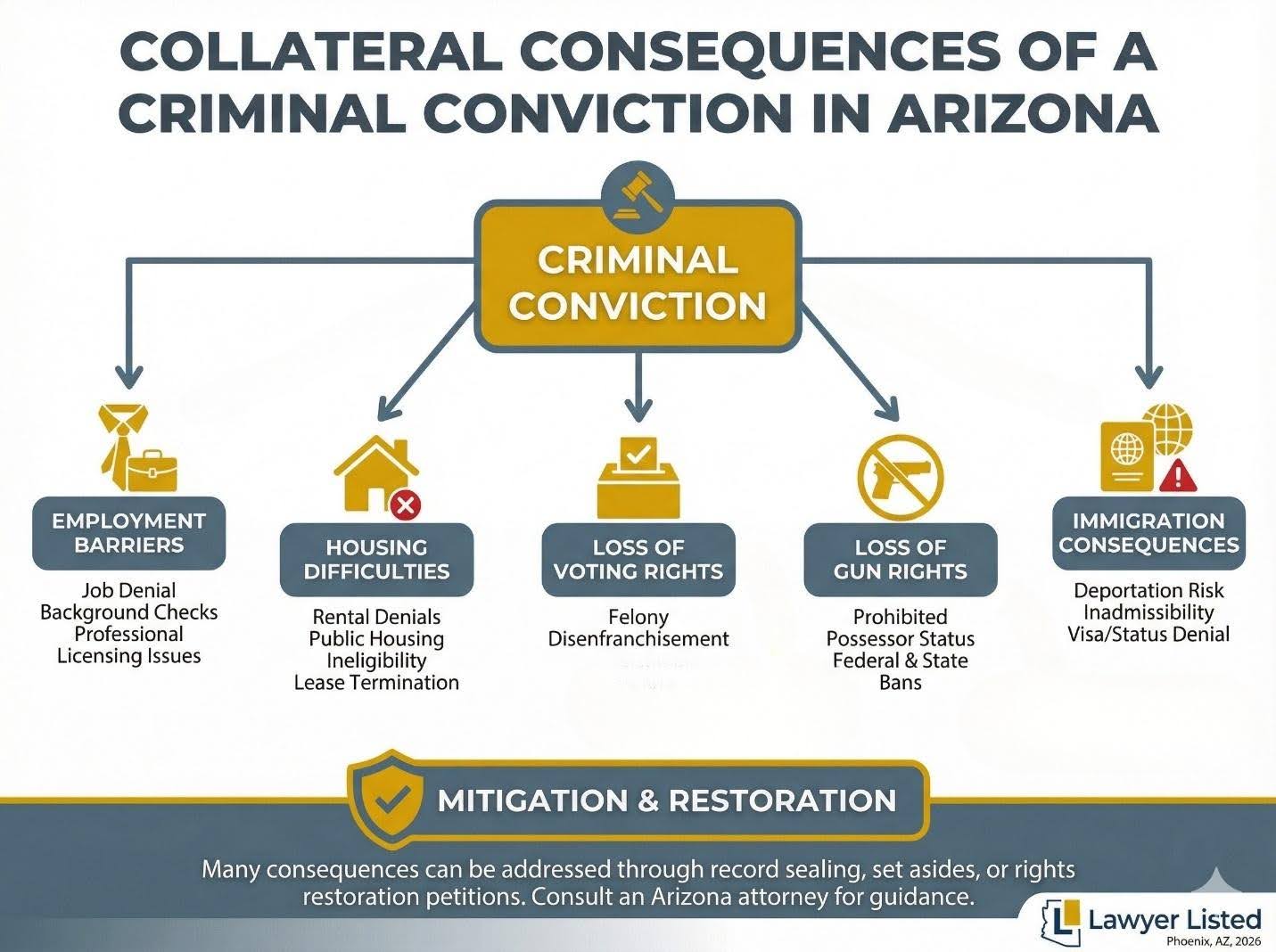
The penalties listed above are only part of the picture. A criminal conviction in Arizona carries consequences that extend far beyond the courtroom. These are often called “collateral consequences,” and they can affect your life for years.
Employment: Many employers run background checks. A conviction, especially a felony conviction, can disqualify you from certain jobs and make it harder to get hired. Some professions require an Arizona DPS fingerprint clearance card, which a conviction can affect.
Housing: Landlords and public housing authorities may deny applications based on criminal history. People with certain convictions may be denied access to public housing.
Voting rights: A felony conviction suspends your right to vote. For a first felony, voting rights are automatically restored once you complete your sentence and pay all fines and restitution. Two or more felonies require a separate court application.
Firearms: A felony conviction prohibits you from possessing a firearm under Arizona law. Restoring gun rights requires a separate court petition.
Immigration: For non-citizens, even a misdemeanor conviction can trigger deportation or affect immigration status. If you are not a U.S. citizen and have been charged with any crime, speak with both a criminal defense attorney and an immigration attorney before making any decisions.
Common myths about criminal penalties in Arizona
Myth: “A misdemeanor is no big deal. It is basically just a fine.”
Reality: Even a Class 3 misdemeanor can carry up to 30 days in jail, and a Class 1 misdemeanor can mean up to six months behind bars. Beyond that, any misdemeanor conviction creates a permanent criminal record that shows up on background checks.
Myth: “If it is my first offense, I will just get probation.”
Reality: While first-time offenders are more likely to receive probation for non-dangerous crimes, it is not guaranteed. Certain offenses carry mandatory prison time regardless of your criminal history. The judge has discretion within the sentencing range set by law.
Myth: “A felony conviction means my life is over.”
Reality: Arizona offers several post-conviction options. You can apply to have your judgment set aside (ARS 13-905), petition to seal your record (ARS 13-911), or apply for a Certificate of Second Chance. These do not erase the conviction, but they can reduce barriers to employment, housing, and licensing.
Arizona criminal penalties at a glance: complete comparison table
The table below combines felony and misdemeanor penalty ranges in one place for quick reference. It provides a quick a clear breakdown of what each offense level means in Arizona.
Offense Level | Incarceration | Max Fine | Probation | Examples |
Class 1 Felony | Life / Death | Up to $150,000 | N/A | Murder only |
Class 2 Felony | 3 – 12.5 years | Up to $150,000 | Up to 7 years | Manslaughter, armed robbery |
Class 3 Felony | 2 – 8.75 years | Up to $150,000 | Up to 5 years | Agg. assault, burglary 1st |
Class 4 Felony | 1 – 3.75 years | Up to $150,000 | Up to 4 years | Forgery, theft ($3K-$4K) |
Class 5 Felony | 0.5 – 2.5 years | Up to $150,000 | Up to 3 years | Agg. DV, credit card theft |
Class 6 Felony | 0.33 – 2 years | Up to $150,000 | Up to 3 years | Criminal trespass 1st |
Class 1 Misdemeanor | Up to 6 months | Up to $2,500 | Up to 3 years | DUI, simple assault |
Class 2 Misdemeanor | Up to 4 months | Up to $750 | Up to 2 years | Reckless driving |
Class 3 Misdemeanor | Up to 30 days | Up to $500 | Up to 1 year | Excessive speeding |
Petty Offense | None | Up to $300 | N/A | Minor violations |
Frequently asked questions
Q: What is the difference between a felony and a misdemeanor in Arizona?
A: The main difference is the severity of the penalty. Felonies carry potential prison sentences, while misdemeanors carry a maximum of six months in county jail. Felonies are divided into six classes, and misdemeanors are divided into three classes. Felonies are tried in Superior Court, while misdemeanors are handled in lower courts.
Q: Can a felony be reduced to a misdemeanor in Arizona?
A: In some cases, yes. Class 6 felonies can be designated as Class 1 misdemeanors. The prosecutor can file charges as a misdemeanor from the start, or the judge may reclassify the offense at sentencing or at the conclusion of probation if a felony conviction would be too harsh (ARS 13-702).
Q: Do I need a lawyer for a misdemeanor charge in Arizona?
A: Yes. A misdemeanor conviction creates a permanent criminal record and can result in jail time, fines, and long-term consequences for your employment, housing, and driving privileges. An experienced attorney can evaluate your options, negotiate with prosecutors, and work toward the best possible outcome.
Q: What is a presumptive sentence in Arizona?
A: The presumptive sentence is the standard prison term a judge starts with for a given felony class. If there are no aggravating or mitigating factors, the judge will typically impose this sentence. For example, the presumptive sentence for a Class 4 felony is 2.5 years in prison (ARS 13-702).
Q: How long does a criminal record last in Arizona?
A: A criminal record in Arizona is permanent unless you take steps to address it. You can petition to have your conviction set aside (ARS 13-905) or sealed (ARS 13-911). Setting aside a conviction adds a notation to your record but does not erase it. Sealing hides the record from public view but is only available for certain offenses and after a waiting period.
Q: Will a misdemeanor show up on a background check in Arizona?
A: Yes. Both felony and misdemeanor convictions appear on standard criminal background checks in Arizona. Employers, landlords, and licensing agencies can all see this information unless the conviction has been sealed by court order.
Find the right attorney for your case

If you have been charged with a crime in Arizona, the most important step you can take right now is finding an experienced criminal defense attorney who knows Arizona law. The classification of your charge, whether it is a misdemeanor or a felony, and whether aggravating factors apply can all affect your sentence. The right attorney can evaluate the evidence, identify your options, and fight for the best possible outcome.
Lawyer Listed connects you with a curated, peer-vetted network of elite criminal defense attorneys, free of charge. Our matching tool analyzes your specific situation and pairs you with the attorney best equipped to handle your case. Get matched now at lawyerlisted.com.