

Facing criminal charges in Arizona can be overwhelming. Whether you were recently arrested or are worried about a possible charge, understanding the legal system is one of the most important things you can do right now. Arizona divides criminal cases into different categories based on how serious they are. The type of charge you face affects everything from how long you could go to jail or prison to whether you end up with a permanent criminal record.
This guide breaks down the main types of criminal cases in Arizona. It explains what each category means, gives real-world examples, and outlines the potential consequences. Understanding your charges is the first step toward making informed decisions about your defense.
Once you understand the charges you are facing, it is important to talk with a criminal defense attorney who has experience handling your type of case. Choosing the right attorney can feel as daunting as the criminal justice system itself, but it shouldn’t be. Let Lawyer Listed match you with your ideal criminal defense lawyer today.
How Arizona Classifies Criminal Offenses
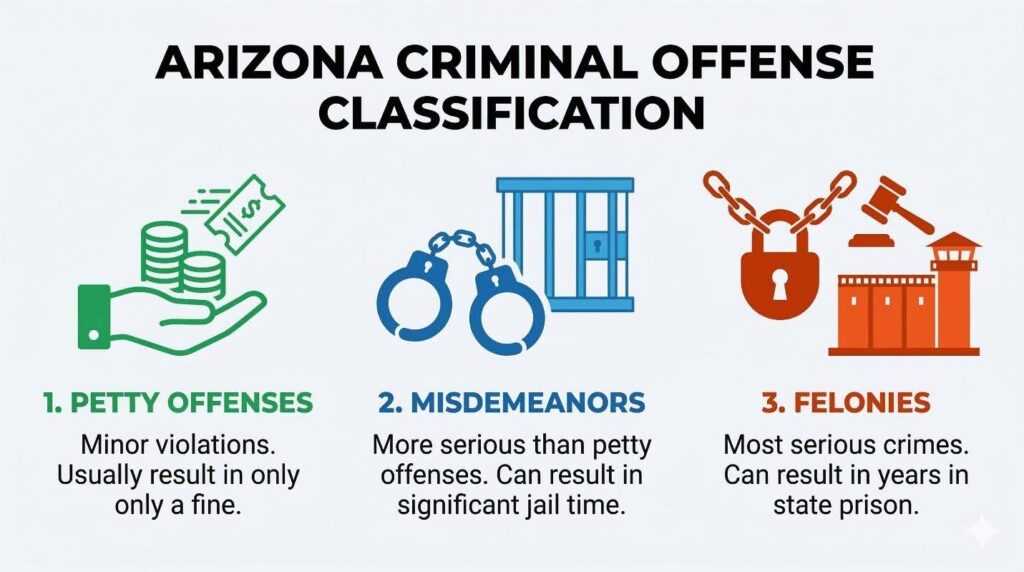
Arizona law organizes criminal offenses into three main groups: petty offenses, misdemeanors, and felonies. Each group carries different levels of punishment. As a general rule, the more serious the harm caused, the more serious the charge.
Here is a simple breakdown of the three categories:
- Petty offenses: Minor violations that usually result in only a fine.
- Misdemeanors: More serious than petty offenses but less serious than felonies. Misdemeanors can still result in significant jail time.
- Felonies: The most serious crimes that can result in years in state prison.
Petty Offenses in Arizona
Petty offenses in Arizona are the lowest level of criminal charges in the state. They involve minor violations such as small‑scale littering, certain animal‑control issues, or other low‑impact conduct that the law still treats as criminal. Under Arizona law, an offense is considered “petty” when the statute labels it that way or when the law doesn’t classify it as a felony or misdemeanor and doesn’t list a specific punishment. These offenses are meant to address behavior that breaks the law but doesn’t rise to the seriousness of other criminal categories.
Even though petty offenses are minor, they can still have consequences. The penalty is limited to a fine and there is no jail time or probation. However, a conviction can still appear on someone’s criminal record, which may matter for jobs, school applications, or background checks. Because of this, people often try to resolve petty offenses through dismissal, diversion programs, or other options that help prevent long‑term impact.
Misdemeanor Charges in Arizona
A misdemeanor is more serious than a petty offense, but not as serious as a felony. Under Arizona Revised Statutes (ARS), misdemeanors are divided into three classes: Class 1, Class 2, and Class 3. Class 1 is the most serious.
Misdemeanor convictions can result in:
- Jail time (served in a county or city jail, not state prison)
- Fines and surcharges
- Probation
- Community service
- A criminal record that shows up on background checks
Misdemeanor Classes and Penalties
The table below shows the three misdemeanor classes, common examples, and the maximum penalties under Arizona law.
| Class | Common Examples | Maximum Penalties |
|---|---|---|
| Class 1 Misdemeanor | DUI (first offense), assault (minor injury), theft (less than $1,000) | Up to 6 months jail, $2,500 fine |
| Class 2 Misdemeanor | Criminal damage ($250 or less), criminal trespass (2nd degree) | Up to 4 months jail, $750 fine |
| Class 3 Misdemeanor | Criminal trespass (3rd degree), minor traffic violations with criminal charges | Up to 1 month jail, $500 fine |
Common Arizona Misdemeanor Examples
Some of the most frequently charged misdemeanors in Arizona include:
- DUI (first offense without aggravating factors): Under ARS 28-1381, a first-time DUI is a Class 1 misdemeanor. It carries a minimum of 24 hours in jail, fines, and a license suspension.
- Simple assault: Under ARS 13-1203, intentionally causing minor physical injury to another person is typically a Class 1 misdemeanor.
- Disorderly conduct: Under ARS 13-2904, this can include fighting in public or making unreasonable noise and is usually a Class 1 misdemeanor.
- Shoplifting (under $1,000): Under ARS 13-1805, theft of merchandise valued under $1,000 is generally a Class 1 misdemeanor for a first offense.
- Criminal damage: Under ARS 13-1602, recklessly damaging property of another in an amount of $250 or less is a Class 2 misdemeanor.
- Criminal trespass (third degree): Entering or staying on someone’s property without permission can be charged as a Class 3 misdemeanor under ARS 13-1502.
Even though misdemeanors are considered less serious than felonies, they still carry real consequences. A conviction can affect your ability to get a job, rent an apartment, or qualify for professional licenses.
Felony Charges in Arizona
A felony is the most serious type of criminal charge in Arizona. Felony convictions can result in significant prison time, large fines, and a permanent criminal record that can follow you for life. In Arizona, felonies are divided into six classes: Class 1 through Class 6. Class 1 is the most serious.
Arizona uses a sentencing grid that considers both the class of the felony and your prior criminal history. First-time offenders typically face a range of sentences called the “presumptive” range. Repeat offenders can face much longer sentences.
Felony Classes and Prison Sentences
The table below summarizes the six felony classes, common examples, and typical prison ranges for first-time offenders.
| Felony Class | Common Examples | Prison Range (First Offense) | Probation (Max) |
|---|---|---|---|
| Class 1 | Murder (first and second degree) | Life in prison or death penalty | Not available |
| Class 2 | Armed robbery, sexual assault, manslaughter | 3 – 12.5 years | 7 years |
| Class 3 | Aggravated assault, burglary (first degree) | 2 – 8.75 years | 5 years |
| Class 4 | Aggravated DUI, identity theft | 1 – 3.75 years | 4 years |
| Class 5 | Criminal damage, theft ($3,000+) | 6 months – 2.5 years | 3 years |
| Class 6 | Shoplifting (repeat), criminal trespass | 4 months – 2 years; court can reduce to a misdemeanor | 3 years |
Sentences increase significantly for repeat offenders, dangerous offenses, or crimes involving weapons. Some offenses also carry mandatory minimum sentences that judges cannot reduce.
Violent Felony Offenses
Violent crimes are among the most serious felonies in Arizona. These involve the use or threat of force against another person. Common examples include:
- Murder (first and second degree): Under ARS 13-1105, first-degree murder involves premeditation and can result in life in prison or the death penalty. Second-degree murder, under ARS 13-1104, involves intentionally killing someone without planning it in advance.
- Aggravated assault: Under ARS 13-1204, using a weapon, causing serious physical injury, or assaulting certain protected individuals (like police officers) elevates the charge to a felony aggravated assault.
- Robbery and armed robbery: Under ARS 13-1902 and 13-1904, taking property by force is robbery. Using a weapon or simulating a weapon during a theft makes it armed robbery, which is a Class 2 felony.
- Sexual assault: Under ARS 13-1406, engaging in sexual intercourse without consent is a Class 2 felony. A conviction for sexual assault results in lifetime sex offender registration.
- Kidnapping: Under ARS 13-1304, unlawfully restraining a person can range from a Class 2 to Class 4 felony depending on the circumstances.
Vehicular Crimes
Arizona prosecutes a wide range of crimes that involve motor vehicles. Some of these charges are misdemeanors, but many rise to the level of a felony depending on the circumstances. Common vehicular crimes in Arizona include:
- Driving under the influence (DUI): Under ARS 28-1381, driving with an alcohol concentration of 0.08 or higher or while impaired to the slightest degree by drugs or alcohol is a DUI. A DUI offense is a Class 1 misdemeanor and requires jail time.
- Aggravated DUI: Under ARS 28-1383, a DUI becomes a felony when certain factors are present. These include driving on a suspended license, having a passenger under 15 in the vehicle, having two or more prior DUI convictions within 84 months, or driving the wrong way on a highway. Aggravated DUI is a Class 4 felony and carries mandatory prison time.
- Leaving the scene of an accident (hit and run): Under ARS 28-661 and ARS 28-662, drivers involved in an accident that results in injury, death, or property damage are required to stop and provide assistance. Failing to do so is a criminal offense. If the accident involves death or serious injury, leaving the scene is a Class 2 or Class 3 felony, depending on who is at fault in the collision.
- Endangerment with a vehicle: Under ARS 13-1201, recklessly endangering another person with a substantial risk of death or serious physical injury can be charged as a Class 6 felony. This includes incidents like street racing or driving at extreme speeds in populated areas.
- Unlawful flight from law enforcement: Under ARS 28-622.01, willfully fleeing from a police officer in a motor vehicle is a Class 5 felony.
- Vehicular manslaughter: Under ARS 13-1103, causing the death of another person while driving recklessly is a Class 2 felony. This charge is often filed when a driver causes a fatal accident while under the influence of alcohol or drugs, or while engaging in street racing.
- Vehicular homicide: Under ARS 13-1104, causing the death of another person while driving with extreme indifference for human life is a Class 1 felony. This charge is reserved for extreme driving behavior that leads to a fatal accident. Typically, the driving behavior involves a combination of impairment by alcohol or drugs, extreme speed, and disregard for traffic signals.
Vehicular crime cases often involve complex evidence, including police reports, toxicology results, traffic camera footage, and crash reconstruction analysis.
Drug-Related Felony Offenses
Drug offenses are very common in Arizona criminal courts. The severity of the charge depends on the type of drug, the amount involved, and whether there is evidence of intent to sell or distribute. Arizona categorizes controlled substances under ARS Title 13, Chapter 34.
Common Arizona drug crimes include:
- Dangerous drugs: Under ARS 13-3407, possessing drugs like methamphetamine, mushrooms, or PCP without a prescription can be charged as a felony, even for small amounts.
- Narcotic drugs: Under ARS 13-3408, possessing drugs like cocaine, heroin, or fentanyl without a prescription can be charged as a felony, even for small amounts.
- Possession of marijuana: While Arizona legalized recreational marijuana under Proposition 207, possessing more than one ounce or any amount with intent to sell can still lead to criminal charges.
- Drug trafficking and transportation: Transporting or selling controlled substances carries serious felony penalties.
Arizona does have diversion programs and drug courts available for some defendants. These programs allow eligible individuals to complete treatment instead of serving a prison sentence.
Property and Theft Felony Offenses
Not all felonies involve violence. Property crimes can also rise to the level of a felony depending on the dollar value involved or the method used. Common examples include:
- Theft: Under ARS 13-1802, theft becomes a felony when the value of the property stolen reaches $1,000. Theft of property worth $25,000 or more is a Class 2 felony.
- Burglary: Under ARS 13-1507 and 13-1508, entering a building or home to commit a crime inside is burglary. First-degree burglary (residential) is a Class 2 felony.
- Arson: Under ARS 13-1703, intentionally setting fire to a structure or property is a felony if the value of the property exceeds $100. Arson of an occupied structure, under ARS 13-1704, is a Class 2 felony.
- Fraud and identity theft: Under ARS 13-2008, using someone else’s identity without consent for unlawful purposes is a Class 4 felony.
- Criminal damage: Under ARS 13-1602, damaging someone’s property in an amount of $10,000 or more is a Class 4 felony.
Sex Offenses and Registration Requirements
Sex crimes in Arizona carry some of the harshest penalties. Beyond prison time, a conviction often means lifetime registration on the Arizona Sex Offender Registry under ARS 13-3821. Registration affects where you can live and work.
Common sex offense charges in Arizona include:
- Sexual assault (ARS 13-1406): Class 2 felony with a mandatory prison sentence
- Sexual conduct with a minor (ARS 13-1405): Can be a Class 2 felony and carries mandatory prison time depending on the victim’s age
- Molestation of a child (ARS 13-1410): Class 2 felony with mandatory prison time
- Indecent exposure (ARS 13-1402): Can range from a misdemeanor to a felony depending on the circumstances
White-Collar Crimes
White-collar crimes involve dishonesty or deception for financial gain. These cases are often investigated for months before charges are filed. Arizona takes these offenses very seriously, and in some situations you can also face federal charges. Common examples include:
- Fraudulent schemes: ARS 13-2310 criminalizes schemes like insurance fraud, mortgage fraud, and investment fraud
- Embezzlement: ARS 13-1802 makes it a crime to steal money or assets that were entrusted to you
- Forgery: Under ARS 13-2002, falsifying documents or signatures is a Class 4 felony
- Money laundering: Under ARS 13-2317, concealing the true source of illegally obtained money is a crime ranging from a Class 2 felony to a Class 6 felony
Juvenile Criminal Cases in Arizona
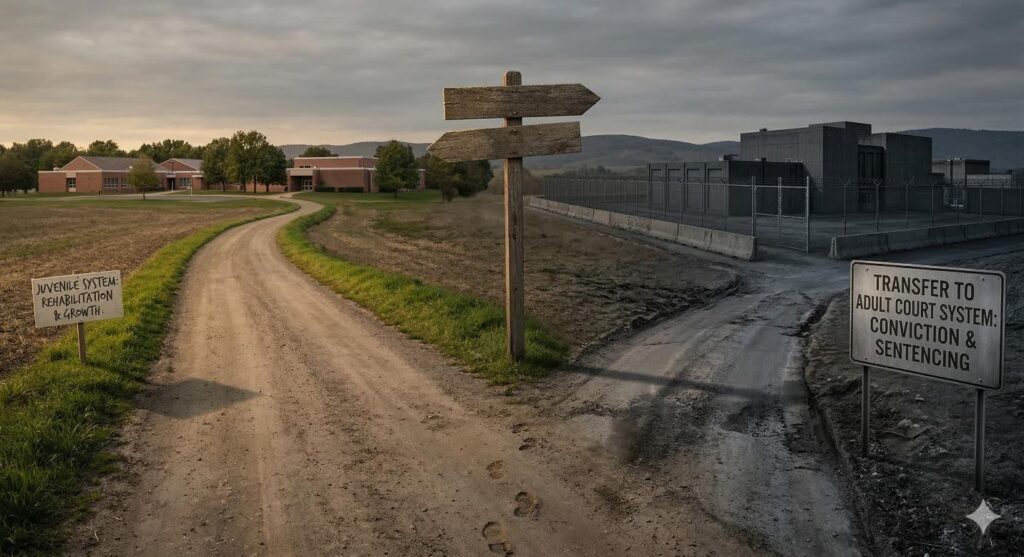
Arizona handles most criminal cases involving minors separately from adult court. The juvenile justice system focuses more on rehabilitation than punishment. Cases involving defendants under 18 are generally heard in the Arizona Juvenile Court under ARS Title 8.
However, certain serious offenses such as first-degree murder or armed robbery can result in a juvenile being tried as an adult. This is known as a transfer or “direct file” to adult court. If tried as an adult, a juvenile faces the same range of penalties as an adult offender.
Federal Criminal Cases in Arizona
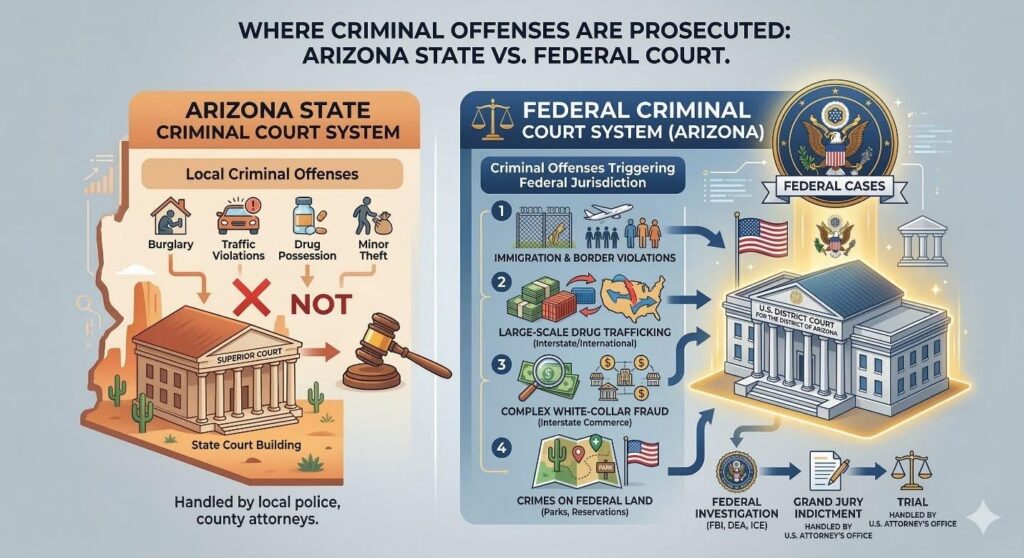
Some criminal offenses are prosecuted in federal court rather than Arizona state court. Federal cases are handled by the U.S. District Court for the District of Arizona and follow federal sentencing guidelines, which are often stricter than state guidelines.
Crimes commonly prosecuted at the federal level in Arizona include:
- Drug trafficking across state lines or the U.S.-Mexico border
- Immigration offenses, including illegal re-entry
- Human trafficking
- Bank robbery and wire fraud
- Federal gun charges
- Crimes committed on federal property or against federal employees
Federal charges are serious. They are prosecuted by the U.S. Attorney’s Office, which has significant resources and high conviction rates.
What Happens After You Are Charged in Arizona
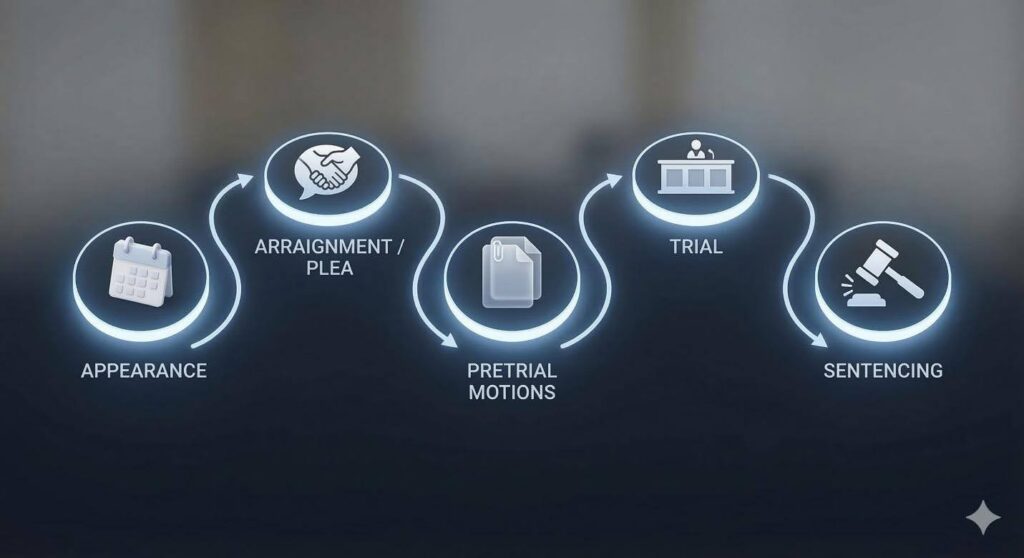
Once charges are filed, the criminal process in Arizona typically follows these steps:
- Initial appearance: You appear before a judge who informs you of the charges and sets bail.
- Arraignment: You enter a formal plea — guilty, not guilty, or no contest.
- Pretrial hearings: Your attorney and the prosecutor may file motions, negotiate a plea deal, or prepare for trial.
- Trial: If no plea agreement is reached, your case goes before a judge or jury.
- Sentencing: If convicted, a judge imposes the penalty according to Arizona sentencing guidelines.
Many cases are resolved through plea agreements before ever reaching trial. A plea deal can sometimes result in reduced charges or a lighter sentence, but it is not always the right choice. An experienced Arizona criminal defense attorney can help you evaluate your options.
Final Thoughts: Know Your Rights and Get Help Early
Understanding the types of criminal cases in Arizona is the first step in protecting yourself. Whether you are facing a misdemeanor DUI, a felony drug charge, or something in between, the stakes are real. Convictions can affect your freedom, your job, your family, and your future.
You have the right to an attorney. If you cannot afford one, the court will appoint a public defender. If you can afford private representation, hiring a criminal defense lawyer with experience in Arizona law can make a meaningful difference in how your case is handled.
Do not wait. The earlier you get legal help, the more options you may have. Whether it is challenging the evidence, negotiating with the prosecutor, or preparing for trial, a skilled defense attorney can guide you through every step of the process.