
Understanding ARS Arson: ARS 13-1704
Facing arson charges can be overwhelming. The legal system is complicated, and the criminal process can be confusing. Lawyer Listed provides clear information about the charge and the possible penalties, helping you understand each step of the process.
This guide breaks down ARS arson in clear, straightforward language. It explains the key legal terms, walks you through the sentencing guidelines under Arizona arson laws, and answers the most common questions asked by people charged with this crime.
Remember, this information is for educational purposes only and is not a substitute for legal advice from an experienced Arizona criminal defense attorney. If you are charged with arson in Arizona, let Lawyer Listed match you with your ideal criminal defense lawyer as soon as possible.
What Is ARS Arson?

Arizona law defines arson under two main statutes: ARS 13-1703 and ARS 13-1704. According to these statutes, arson involves knowingly causing a fire or explosion that unlawfully damages a structure or property. It is important to understand that not all arson cases are treated the same under Arizona arson laws. The seriousness of the charge hinges on two key factors: (1) whether the fire affected an occupied structure or only property and (2) the monetary value of the resulting damage.
Understanding these distinctions is crucial because they determine whether the offense is charged as a misdemeanor or a felony, and they directly influence the length and severity of any potential jail or prison sentence you face.
Arson of an Occupied Structure: The Most Serious Offense (ARS 13 1704)
Arson of an occupied structure is the most serious arson offense under Arizona law. This crime involves knowingly damaging a building or structure by fire or explosion when people are present or could reasonably be expected to be present.
What elevates this offense to such a severe level is the risk to human life. Even if no one is actually inside at the time of the fire or explosion, the mere possibility that people might be present is enough to trigger the statute’s harshest penalties. Because of this inherent danger, arson of an occupied structure is a Class 2 felony, which is one of the most serious criminal charges in Arizona.
Elements of Arson of an Occupied Structure: ARS 13-1704
To convict you of arson under this statute, the prosecution must prove two elements beyond a reasonable doubt:
- You knowingly and unlawfully damaged an occupied structure.
- You caused the damage by knowingly starting a fire or causing an explosion.
Arson of a Structure or Property: A Tiered Offense (ARS 13 1703)
Arson of a structure or property involves knowingly damaging a structure or property by knowingly causing a fire or explosion. Unlike arson of an occupied structure, this offense centers on property damage rather than the immediate risk to human life.
Arson of a structure is a Class 4 felony regardless of the value of the structures. Arson of property, on the other hand, is classified based on the value of the property involved, not the extent of the damage. Arizona law uses the following tiered penalty system based on that valuation:
- Arson of property: Class 4 felony if the property value exceeds $1,000.
- Arson of property: Class 5 felony if the property value is more than $100 but does not exceed $1,000.
- Arson of property: Class 1 misdemeanor if the property value is $100 or less.
This value‑based classification system makes the appraisal of the property a critical issue in any arson case, and it often becomes a central point of dispute between the prosecution and the defense.
Elements of Arson of a Structure or Property: ARS 13-1703
To convict you of arson under this statute, the prosecution must prove two elements beyond a reasonable doubt:
- You knowingly and unlawfully damaged a structure or property.
- You caused the damage by knowingly starting a fire or causing an explosion.
Reckless Burning: A Less Severe Charge (ARS 13 1702)
Reckless burning, under ARS 13‑1702, is a related but less severe fire‑related offense. It involves recklessly causing a fire or explosion that results in damage to a structure, land, or property. The critical distinction between reckless burning and arson is the mental state required. Reckless burning requires proof of recklessness, and arson requires proof of knowingly causing a fire or explosion.
Reckless burning is classified as a Class 1 misdemeanor in Arizona. Although it is less serious than felony arson charges, a Class 1 misdemeanor still carries significant consequences.
Elements of Reckless Burning: ARS 13-1702
To convict you of reckless burning under this statute, the prosecution must prove two elements beyond a reasonable doubt:
- You recklessly caused a fire or explosion.
- The fire or explosion you caused resulted in damage to an occupied structure, a structure, wildland, or property.
Key Concepts of Arson
- Knowingly: You are aware of your actions or the circumstances that make up the offense. Knowingly does not require that you know your conduct is illegal; you just need to be conscious of what you are doing or the situation you are in.
- Recklessly: You are aware of and deliberately choose to ignore a significant and unjustifiable risk that could lead to harmful consequences. This conscious disregard must represent a substantial departure from how a reasonable person would behave under the same circumstances.
- Unlawful: Against the law or not allowed by law.
- Damage: Any physical or visual impairment of any surface.
- Structure: Any building, vehicle, watercraft, aircraft, or other place with walls and a floor that is used for lodging, business, transportation, recreation, or storage.
- Occupied structure: A structure where one or more people are present, are reasonably likely to be present, or are close enough to face the same danger when a fire or explosion happens. It also includes any house or dwelling, even if it is empty, unoccupied, or vacant.
- Property: Anything that has value, other than a structure. It can be physical or non‑physical, public or private, and real or personal. It also includes papers or documents that show value or ownership
- Dangerous instrument: Anything that, under the circumstances in which it is used, attempted to be used, or threatened to be used, is readily capable of causing death or serious physical injury.
- Dangerous offense: An offense involving the discharge, use, or threatening exhibition of a deadly weapon or dangerous instrument or the intentional or knowing infliction of serious physical injury on another person.
Arson as a Dangerous Offense
A fire qualifies as a “dangerous instrument” under Arizona law when, in a specific case, it is readily capable of causing death or serious physical injury.
Arizona Statute of Limitations for ARS Arson
The statute of limitations is the deadline for filing criminal charges. For misdemeanor arson or reckless burning, prosecutors must file the case within one year of the incident. For felony arson, prosecutors generally have up to seven years from the date of the offense to file charges.
Sentencing Under Arizona Arson Laws

The penalty for arson is substantial and can have long‑lasting effects. Sentences vary based on your criminal history and the facts of the case. Understanding these consequences helps you make informed decisions about your defense.
| Charge | Class | Prison/Jail | Probation (max) |
|---|---|---|---|
| Arson: Occupied Structure | Class 2 Dangerous Felony | Prison: 7 – 21 years | Not available |
| Arson: Occupied Structure | Class 2 Felony | Prison: 3 – 12.5 years | 7 years |
| Arson: Structure | Class 4 Dangerous Felony | Prison: 4 – 8 years | Not available |
| Arson: Structure | Class 4 Felony | Prison: 1 – 3.75 years | 4 years |
| Arson: Property ($1,000+) | Class 4 Felony | Prison: 1 – 3.75 years | 4 years |
| Arson: Property ($101 - $1,000) | Class 5 Felony | Prison: 0.5 – 2.5 years | 3 years |
| Arson: Property ($1 - $100) | Class 1 Misdemeanor | Jail: up to 6 months | 3 years |
| Reckless Burning | Class 1 Misdemeanor | Jail: up to 6 months | 3 years |
Frequently Asked Questions (FAQs)

A: A structure is any place with walls and a floor that is used for living, working, transportation, recreation, or storage. This includes homes, buildings, sheds, vehicles, boats, and aircraft. Property is anything of value that is not a structure. It can be public or private, real or personal, and includes documents that show value or ownership.
A: Under Arizona law, a dangerous instrument is anything that is readily capable of causing death or serious physical injury by the way it is used. A fire meets that definition when it is set in a manner that puts people at risk. In those circumstances, the law treats the fire as a dangerous instrument because of its capacity to cause severe harm and potential to endanger human life.
A: Yes. Under Arizona law, a trash dumpster is a structure. It meets all of the criteria of the definition of structure: it has walls, a floor, and is used for business.
A: Yes. A building can be an occupied structure even when no one is inside. A structure is considered “occupied” if people are present, reasonably likely to be present, or close enough to be in the same danger when the fire or explosion occurs. This includes any dwelling, whether occupied, unoccupied, or vacant.
A: Very little damage is needed for you to be charged with arson. Arizona defines damage as any physical or visual impairment of any surface, so even minor changes—like charring, smoke staining, scorching, or blackened surfaces—can qualify. You don’t need to destroy a structure or cause high‑dollar loss to face arson charges.
A: Yes. The location of the fire can determine which court handles the case and what charges apply. Arson committed anywhere in Arizona—on private property, state land, or within city limits—is prosecuted under Arizona law. If the fire occurs on federal land—such as a national park, national forest, military base, or other federal property—you may face federal arson charges, which are handled in federal court and can carry different penalties. In serious cases, both state and federal charges are possible.
A: Knowingly means you were aware your actions would start a fire or explosion. An example of knowing conduct would be deliberately lighting a match and throwing it onto gasoline‑soaked materials. Recklessly means you knew there was a serious risk of starting a fire but chose to ignore it. An example of recklessness would be discarding a lit cigarette in dry brush during high fire danger. The mental state matters because knowing conduct is charged as arson, while reckless conduct is charged as reckless burning, which carries less severe penalties.
A: In Arizona, the statute of limitations depends on how the arson is charged. For misdemeanor arson or reckless burning, the State generally has one year from the incident to file charges. For felony arson, the State usually has up to seven years to start the case.
A: To find the right lawyer for your case, follow these steps: schedule consultations, verify they are licensed and in good standing with the bar, research their experience, check their specialization, consult with other lawyers about their reputation, read client reviews, and ensure you feel comfortable with them.
Don’t worry if this seems overwhelming; Lawyer Listed has already done the work for you and is ready to match you with an elite lawyer tailored to your needs and your case.
Key Takeaways:
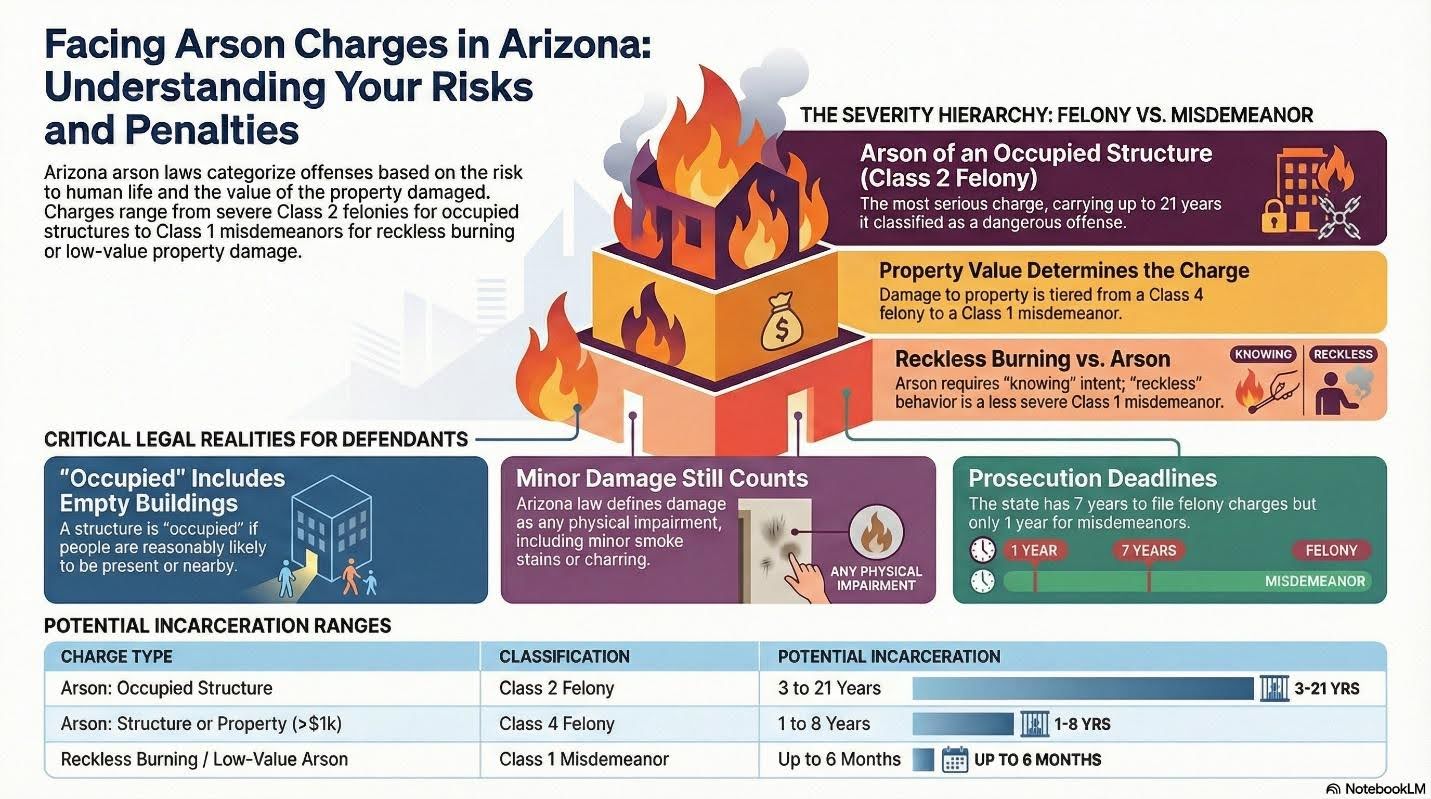
- Definition: Under Arizona arson laws (ARS 13-1703 and ARS 13-1704), arson is defined as knowingly and unlawfully damaging a structure or property by causing a fire or explosion. The key word is “knowingly.” You must be aware of your actions that cause a fire or explosion.
- Different Categories of Arson Charges:
- Arson of an Occupied Structure (ARS 13-1704): This involves knowingly causing damage to an occupied structure through fire or explosion.
- Classified as a Class 2 felony
- Prison sentence: 3 to 12.5 years
- Maximum probation: 7 years
- Arson of a Structure or Property (ARS 13-1703): This involves knowingly causing damage to a structure or property by causing a fire or explosion. The specific charge depends on whether the damage was to a structure or property. If the damage was to property, then the value of the property involved determines the charge:
- Structure:
- Class 4 felony
- Prison sentence: 1 to 3.75 years
- Maximum probation: 4 years
- Property value over $1,000:
- Class 4 felony
- Prison sentence: 1 to 3.75 years
- Maximum probation: 4 years
- Property value between $101 and $1,000:
- Class 5 felony
- Prison sentence: 6 months to 2.5 years
- Maximum probation: 3 years
- Property value of $100 or less:
- Class 1 misdemeanor
- Maximum jail sentence: 6 months
- Maximum probation: 3 years
- Structure:
- Reckless Burning (ARS 13-1702): This is a less severe charge for recklessly, rather than knowingly, causing a fire or explosion that damages a structure, land, or property.
- Class 1 misdemeanor
- Maximum jail sentence: 6 months
- Maximum probation: 3 years
- Arson of an Occupied Structure (ARS 13-1704): This involves knowingly causing damage to an occupied structure through fire or explosion.
- Dangerous Offense: A fire is considered a dangerous instrument when it is used or allowed to burn in a way that could cause death or serious physical injury. When that happens, the offense can be treated as a dangerous offense.
- Statute of limitations: The statute of limitations is 1 year for misdemeanor arson and reckless burning offenses and 7 years for felony arson offenses.
Next Steps:

Arson is a serious criminal allegation with consequences that can affect the rest of your life. Outcomes depend on many factors. Lawyer Listed meets you where you are and helps you understand the law and your rights.
If you’re facing Arizona arson charges, engaging a skilled criminal defense attorney is important to protect your rights and manage the process. Don’t try navigating the legal system alone; match with your ideal lawyer at LawyerListed.com and get an experienced criminal defense lawyer on your side right away.